

Photoactive Non-covalent LCP
Usually, the spacers are used for the mesogens as well as for chromophore so that
main-chain independent mobility is achieved. However, non-covalent approach has
also been developed in supramolecular chemistry, such as:
1. Liquid crystalline ionomers containing azobenzene mesogens
2. Hydrogen-bonded liquid crystalline azo polymer
Liquid Crystalline Ionomers Containing Azobenzene Mesogens
For self-assembly or self-organization as in the case of LC molecules, a viable and
facile route to design various functional or structured materials, ionic self-assembly
has gained increasing attention. The electrostatic interactions act in binding the
oppositely charged functionalities together. The selection of constituents for designing the complex architectures is done according to the requirement of different
applications.
Liquid crystalline (LC) ionomers generated interest as they have properties
characteristic of both LC and ion-containing polymers. The LC phases are observed
together with existence of ionic aggregates. Other advantages of these materials are
the simple synthesis methodologies. The solubility-related problems are also eliminated. Dye-polyelectrolyte complexes combining rigidity, liquid crystallinity, and
ionic polymer properties are very useful for optical applications. High dye loading
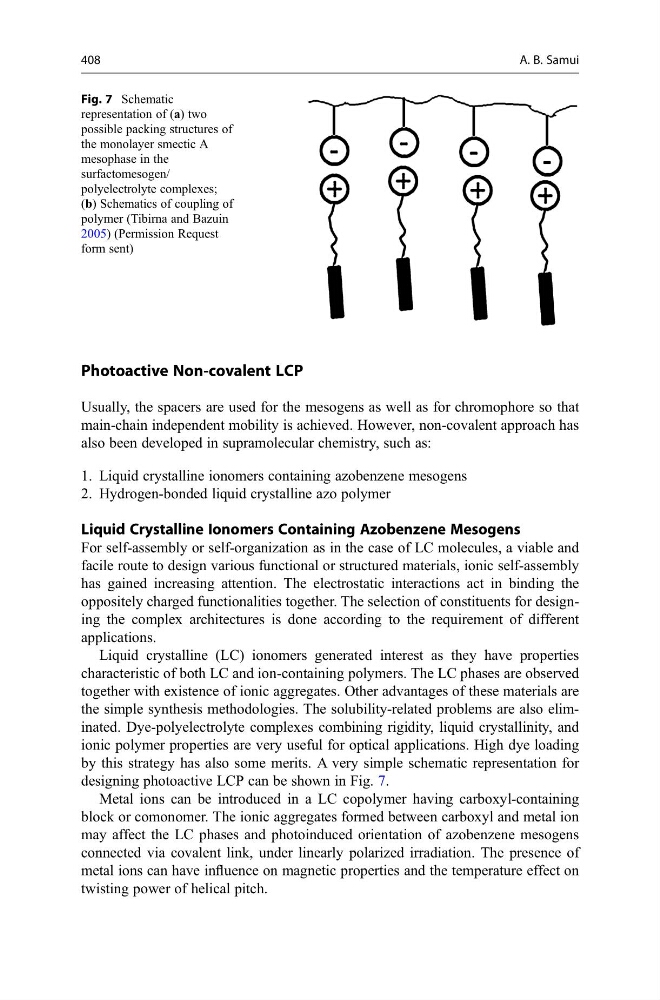
by this strategy has also some merits. A very simple schematic representation for
designing photoactive LCP can be shown in Fig. 7.
Metal ions can be introduced in a LC copolymer having carboxyl-containing
block or comonomer. The ionic aggregates formed between carboxyl and metal ion
may affect the LC phases and photoinduced orientation of azobenzene mesogens
connected via covalent link, under linearly polarized irradiation. The presence of
metal ions can have influence on magnetic properties and the temperature effect on
twisting power of helical pitch.
Fig. 7 Schematic
representation of (a) two
possible packing structures of
the monolayer smectic A
mesophase in the
surfactomesogen/
polyelectrolyte complexes;
(b) Schematics of coupling of
polymer (Tibirna and Bazuin
2005) (Permission Request
form sent)
408
A. B. Samui
Usually, the spacers are used for the mesogens as well as for chromophore so that
main-chain independent mobility is achieved. However, non-covalent approach has
also been developed in supramolecular chemistry, such as:
1. Liquid crystalline ionomers containing azobenzene mesogens
2. Hydrogen-bonded liquid crystalline azo polymer
Liquid Crystalline Ionomers Containing Azobenzene Mesogens
For self-assembly or self-organization as in the case of LC molecules, a viable and
facile route to design various functional or structured materials, ionic self-assembly
has gained increasing attention. The electrostatic interactions act in binding the
oppositely charged functionalities together. The selection of constituents for designing the complex architectures is done according to the requirement of different
applications.
Liquid crystalline (LC) ionomers generated interest as they have properties
characteristic of both LC and ion-containing polymers. The LC phases are observed
together with existence of ionic aggregates. Other advantages of these materials are
the simple synthesis methodologies. The solubility-related problems are also eliminated. Dye-polyelectrolyte complexes combining rigidity, liquid crystallinity, and
ionic polymer properties are very useful for optical applications. High dye loading
by this strategy has also some merits. A very simple schematic representation for
designing photoactive LCP can be shown in Fig. 7.
Metal ions can be introduced in a LC copolymer having carboxyl-containing
block or comonomer. The ionic aggregates formed between carboxyl and metal ion
may affect the LC phases and photoinduced orientation of azobenzene mesogens
connected via covalent link, under linearly polarized irradiation. The presence of
metal ions can have influence on magnetic properties and the temperature effect on
twisting power of helical pitch.
Fig. 7 Schematic
representation of (a) two
possible packing structures of
the monolayer smectic A
mesophase in the
surfactomesogen/
polyelectrolyte complexes;
(b) Schematics of coupling of
polymer (Tibirna and Bazuin
2005) (Permission Request
form sent)
408
A. B. Samui