

Holographic Recording
Photoinduced alignment of azobenzene group is stable in polymers having high
Tg. The birefringence arising out of azo orientation can be used for making
holographic grating. As the birefringence will disappear if beamed with unpolarized or circularly polarized light, erasable holograms can be designed with this
material. Large amplitude and stable surface relief grating can be formed by
using interference pattern of polarized laser beams of moderate intensity (Kim
et al. 1995). Subsequent processing steps are not required. The grating depth
depends on the polarization of the laser beams. The depth in grating is high if the
beams are p-polarized rather than s polarized, although the energy used in both
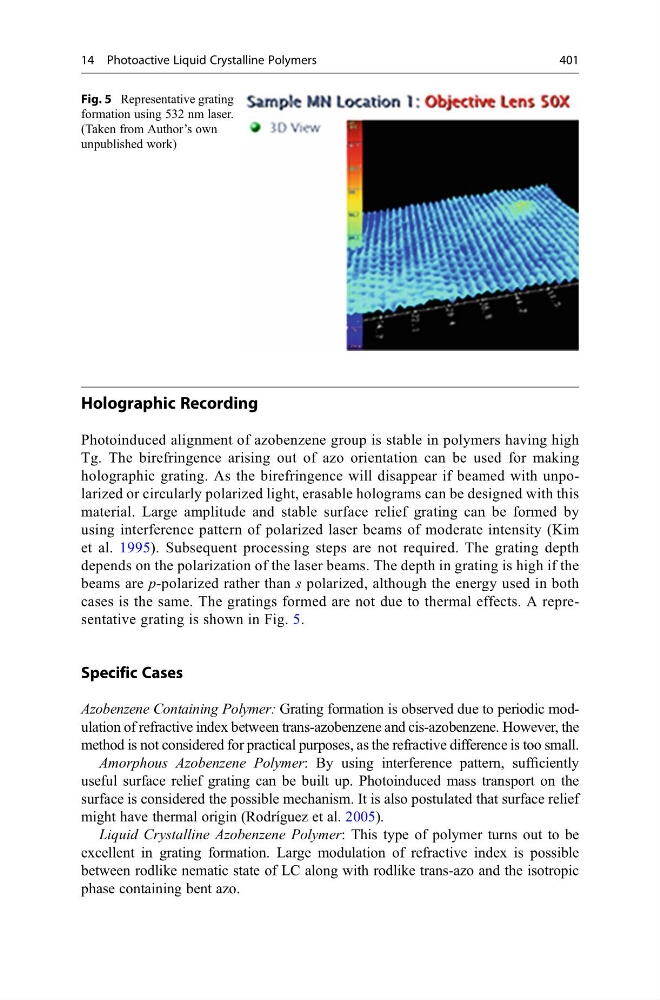
cases is the same. The gratings formed are not due to thermal effects. A representative grating is shown in Fig. 5.
Specific Cases
Azobenzene Containing Polymer: Grating formation is observed due to periodic modulation of refractive index between trans-azobenzene and cis-azobenzene. However, the
method is not considered for practical purposes, as the refractive difference is too small.
Amorphous Azobenzene Polymer: By using interference pattern, sufficiently
useful surface relief grating can be built up. Photoinduced mass transport on the
surface is considered the possible mechanism. It is also postulated that surface relief
might have thermal origin (Rodríguez et al. 2005).
Liquid Crystalline Azobenzene Polymer: This type of polymer turns out to be
excellent in grating formation. Large modulation of refractive index is possible
between rodlike nematic state of LC along with rodlike trans-azo and the isotropic
phase containing bent azo.
Fig. 5 Representative grating
formation using 532 nm laser.
(Taken from Author’s own
unpublished work)
14 Photoactive Liquid Crystalline Polymers
401
Photoinduced alignment of azobenzene group is stable in polymers having high
Tg. The birefringence arising out of azo orientation can be used for making
holographic grating. As the birefringence will disappear if beamed with unpolarized or circularly polarized light, erasable holograms can be designed with this
material. Large amplitude and stable surface relief grating can be formed by
using interference pattern of polarized laser beams of moderate intensity (Kim
et al. 1995). Subsequent processing steps are not required. The grating depth
depends on the polarization of the laser beams. The depth in grating is high if the
beams are p-polarized rather than s polarized, although the energy used in both
cases is the same. The gratings formed are not due to thermal effects. A representative grating is shown in Fig. 5.
Specific Cases
Azobenzene Containing Polymer: Grating formation is observed due to periodic modulation of refractive index between trans-azobenzene and cis-azobenzene. However, the
method is not considered for practical purposes, as the refractive difference is too small.
Amorphous Azobenzene Polymer: By using interference pattern, sufficiently
useful surface relief grating can be built up. Photoinduced mass transport on the
surface is considered the possible mechanism. It is also postulated that surface relief
might have thermal origin (Rodríguez et al. 2005).
Liquid Crystalline Azobenzene Polymer: This type of polymer turns out to be
excellent in grating formation. Large modulation of refractive index is possible
between rodlike nematic state of LC along with rodlike trans-azo and the isotropic
phase containing bent azo.
Fig. 5 Representative grating
formation using 532 nm laser.
(Taken from Author’s own
unpublished work)
14 Photoactive Liquid Crystalline Polymers
401