

encouraging. Photo-orientation suits best as there is no environmental issue, and it
does not need any other help and a clean process.
In photoactive LC polymer, two distinct processes take place in LC due to transcis photoisomerization of azobenzene chromophore:
• Decrease in the LC ordering followed by phase transition in the polymer network
• The reorientation normal to the polarization of radiation
The relative contribution and strength of each process is dependent on the
wavelength of radiation. When irradiated with UV-light, the maximum of the
absorption of azo molecules matches. In effect, the trans-cis isomerization rate
prevails on the orientational order leading to nematic-isotropic phase transition.
Radiation at visible wavelengths is mostly absorbed by cis-isomers resulting in
reverse cis-trans isomerization.
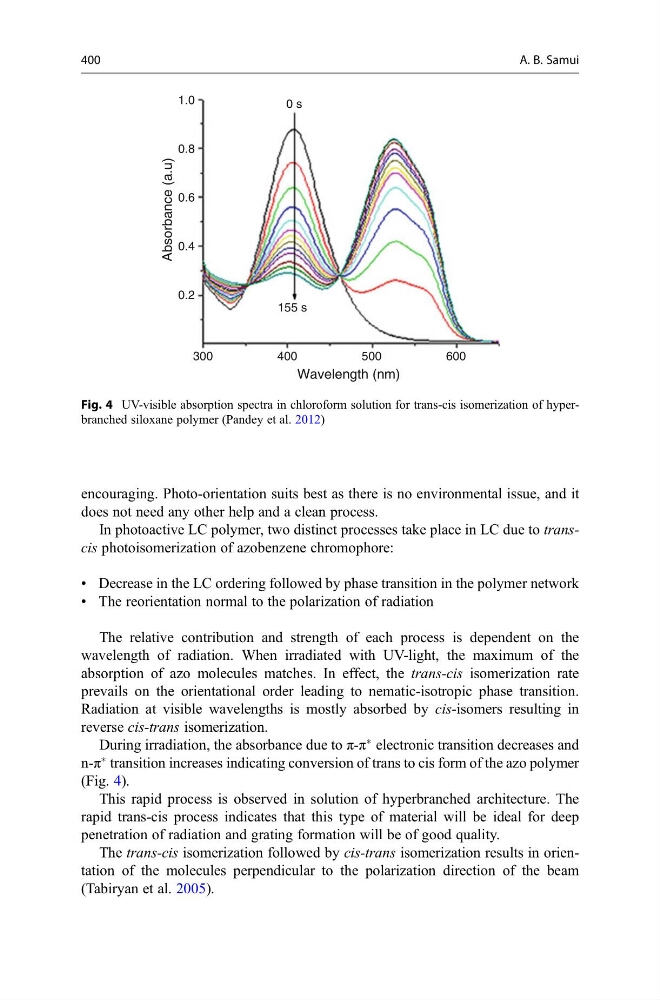
During irradiation, the absorbance due to π-π
à electronic transition decreases and
n-π
à transition increases indicating conversion of trans to cis form of the azo polymer
(Fig. 4).
This rapid process is observed in solution of hyperbranched architecture. The
rapid trans-cis process indicates that this type of material will be ideal for deep
penetration of radiation and grating formation will be of good quality.
The trans-cis isomerization followed by cis-trans isomerization results in orientation of the molecules perpendicular to the polarization direction of the beam
(Tabiryan et al. 2005).
300
0.2
0.4
0.6
0.8
1.0
400
0 s
155 s
500
Wavelength (nm)
Absorbance (a.u)
600
Fig. 4 UV-visible absorption spectra in chloroform solution for trans-cis isomerization of hyperbranched siloxane polymer (Pandey et al. 2012)
400
A. B. Samui
does not need any other help and a clean process.
In photoactive LC polymer, two distinct processes take place in LC due to transcis photoisomerization of azobenzene chromophore:
• Decrease in the LC ordering followed by phase transition in the polymer network
• The reorientation normal to the polarization of radiation
The relative contribution and strength of each process is dependent on the
wavelength of radiation. When irradiated with UV-light, the maximum of the
absorption of azo molecules matches. In effect, the trans-cis isomerization rate
prevails on the orientational order leading to nematic-isotropic phase transition.
Radiation at visible wavelengths is mostly absorbed by cis-isomers resulting in
reverse cis-trans isomerization.
During irradiation, the absorbance due to π-π
à electronic transition decreases and
n-π
à transition increases indicating conversion of trans to cis form of the azo polymer
(Fig. 4).
This rapid process is observed in solution of hyperbranched architecture. The
rapid trans-cis process indicates that this type of material will be ideal for deep
penetration of radiation and grating formation will be of good quality.
The trans-cis isomerization followed by cis-trans isomerization results in orientation of the molecules perpendicular to the polarization direction of the beam
(Tabiryan et al. 2005).
300
0.2
0.4
0.6
0.8
1.0
400
0 s
155 s
500
Wavelength (nm)
Absorbance (a.u)
600
Fig. 4 UV-visible absorption spectra in chloroform solution for trans-cis isomerization of hyperbranched siloxane polymer (Pandey et al. 2012)
400
A. B. Samui