

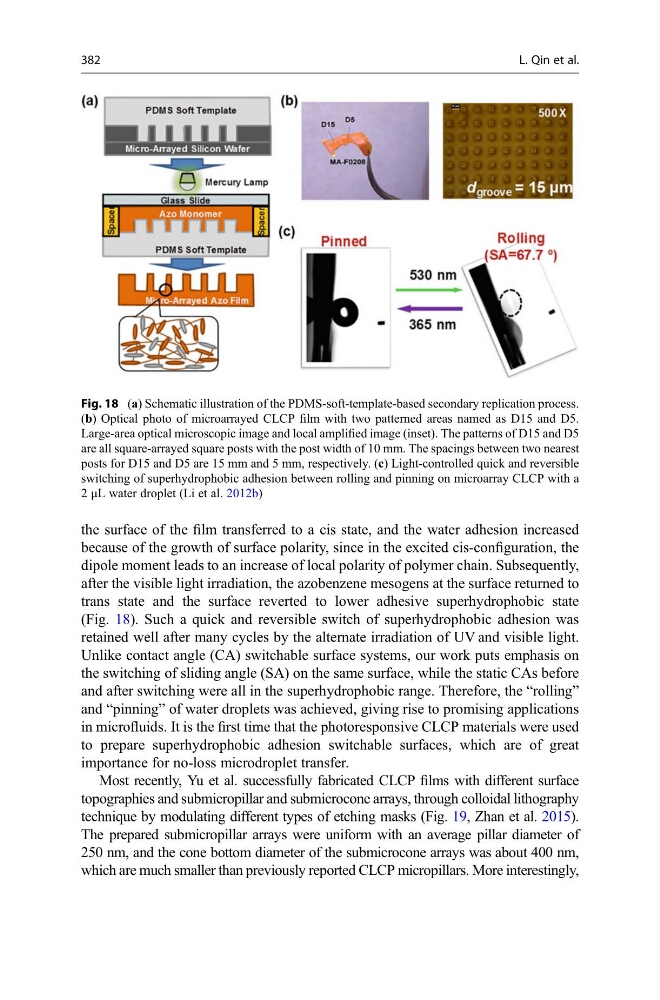
the surface of the film transferred to a cis state, and the water adhesion increased
because of the growth of surface polarity, since in the excited cis-configuration, the
dipole moment leads to an increase of local polarity of polymer chain. Subsequently,
after the visible light irradiation, the azobenzene mesogens at the surface returned to
trans state and the surface reverted to lower adhesive superhydrophobic state
(Fig. 18). Such a quick and reversible switch of superhydrophobic adhesion was
retained well after many cycles by the alternate irradiation of UV and visible light.
Unlike contact angle (CA) switchable surface systems, our work puts emphasis on
the switching of sliding angle (SA) on the same surface, while the static CAs before
and after switching were all in the superhydrophobic range. Therefore, the “rolling”
and “pinning” of water droplets was achieved, giving rise to promising applications
in microfluids. It is the first time that the photoresponsive CLCP materials were used
to prepare superhydrophobic adhesion switchable surfaces, which are of great
importance for no-loss microdroplet transfer.
Most recently, Yu et al. successfully fabricated CLCP films with different surface
topographies and submicropillar and submicrocone arrays, through colloidal lithography
technique by modulating different types of etching masks (Fig. 19, Zhan et al. 2015).
The prepared submicropillar arrays were uniform with an average pillar diameter of
250 nm, and the cone bottom diameter of the submicrocone arrays was about 400 nm,
which are much smaller than previously reported CLCP micropillars. More interestingly,
Fig. 18 (a) Schematic illustration of the PDMS-soft-template-based secondary replication process.
(b) Optical photo of microarrayed CLCP film with two patterned areas named as D15 and D5.
Large-area optical microscopic image and local amplified image (inset). The patterns of D15 and D5
are all square-arrayed square posts with the post width of 10 mm. The spacings between two nearest
posts for D15 and D5 are 15 mm and 5 mm, respectively. (c) Light-controlled quick and reversible
switching of superhydrophobic adhesion between rolling and pinning on microarray CLCP with a
2 μL water droplet (Li et al. 2012b)
382
L. Qin et al.
because of the growth of surface polarity, since in the excited cis-configuration, the
dipole moment leads to an increase of local polarity of polymer chain. Subsequently,
after the visible light irradiation, the azobenzene mesogens at the surface returned to
trans state and the surface reverted to lower adhesive superhydrophobic state
(Fig. 18). Such a quick and reversible switch of superhydrophobic adhesion was
retained well after many cycles by the alternate irradiation of UV and visible light.
Unlike contact angle (CA) switchable surface systems, our work puts emphasis on
the switching of sliding angle (SA) on the same surface, while the static CAs before
and after switching were all in the superhydrophobic range. Therefore, the “rolling”
and “pinning” of water droplets was achieved, giving rise to promising applications
in microfluids. It is the first time that the photoresponsive CLCP materials were used
to prepare superhydrophobic adhesion switchable surfaces, which are of great
importance for no-loss microdroplet transfer.
Most recently, Yu et al. successfully fabricated CLCP films with different surface
topographies and submicropillar and submicrocone arrays, through colloidal lithography
technique by modulating different types of etching masks (Fig. 19, Zhan et al. 2015).
The prepared submicropillar arrays were uniform with an average pillar diameter of
250 nm, and the cone bottom diameter of the submicrocone arrays was about 400 nm,
which are much smaller than previously reported CLCP micropillars. More interestingly,
Fig. 18 (a) Schematic illustration of the PDMS-soft-template-based secondary replication process.
(b) Optical photo of microarrayed CLCP film with two patterned areas named as D15 and D5.
Large-area optical microscopic image and local amplified image (inset). The patterns of D15 and D5
are all square-arrayed square posts with the post width of 10 mm. The spacings between two nearest
posts for D15 and D5 are 15 mm and 5 mm, respectively. (c) Light-controlled quick and reversible
switching of superhydrophobic adhesion between rolling and pinning on microarray CLCP with a
2 μL water droplet (Li et al. 2012b)
382
L. Qin et al.