

the conventional mechanical rubbing method, the introduction of aligned CNTs
remarkably improved mechanical strength and high electrical conductivity of the
CLCP film.
Besides the bending behavior, the coiling movement of CLCPs in response to
light was also reported. Broer and coworkers prepared CLCP films with a densely
crosslinked, twisted configuration of azobenzene units (Harris et al. 2005). Although
the networks were stiff and glassy at room temperature, the films showed large
amplitude coiling motion as well as bending motion upon exposure to UV light,
which was based on the configuration of twisted LC alignment of 90
.
Recently, Iamsaard and coworkers reported complex motion of springlike
CLCP materials (Iamsaard et al. 2014). Nature provides a valuable source of
inspiration for many fields of research. Based on the general concept of plantlike
helical deformations, such as spasmoneme springs, seed pod opening, and tendril
coiling, they designed, synthesized, and studied the versatile actuation modes of
photoresponsive CLCP springs (Fig. 7). A small amount of chiral dopant S-811
was added into the mixture to induce a left-handed twist. The resultant orientation
of LC director smoothly changed by 90
from bottom to top surface (Fig. 7a). The
direction in which the ribbon was cut determined the pitch, the handedness of the
helical shapes, and their photoresponsive behaviors. Under irradiation with light,
left-handed spiral ribbons doped with S-811 decreased in their macroscopic
pitch, and the corresponding right-handed ribbons showed an increase in macroscopic pitch. Remarkably, it was also possible to observe inversion of the helical
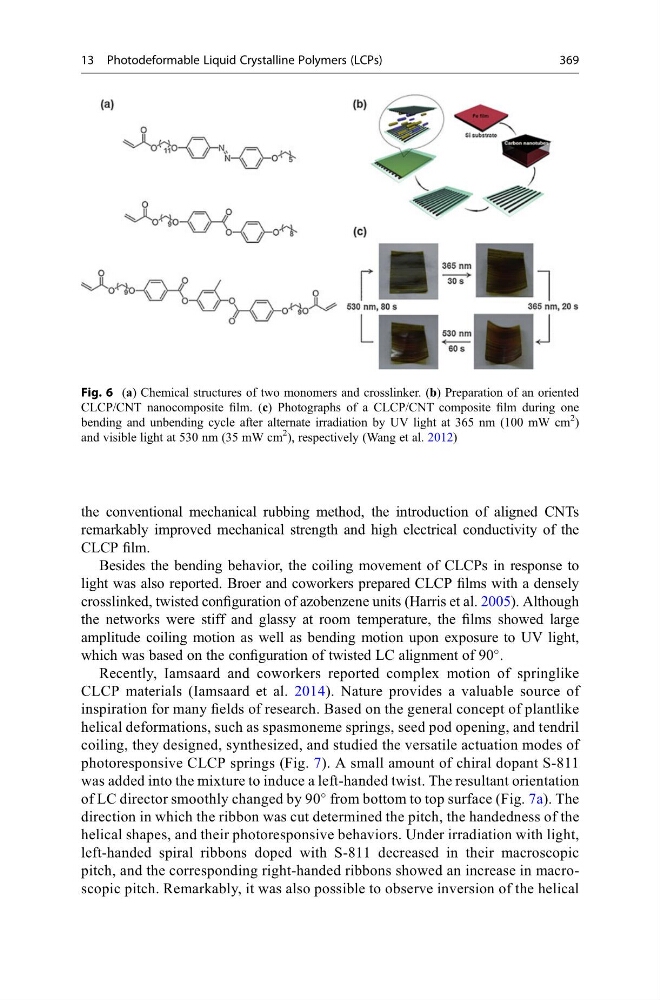
Fig. 6 (a) Chemical structures of two monomers and crosslinker. (b) Preparation of an oriented
CLCP/CNT nanocomposite film. (c) Photographs of a CLCP/CNT composite film during one
bending and unbending cycle after alternate irradiation by UV light at 365 nm (100 mW cm
2
)
and visible light at 530 nm (35 mW cm
2
), respectively (Wang et al. 2012)
13 Photodeformable Liquid Crystalline Polymers (LCPs)
369
remarkably improved mechanical strength and high electrical conductivity of the
CLCP film.
Besides the bending behavior, the coiling movement of CLCPs in response to
light was also reported. Broer and coworkers prepared CLCP films with a densely
crosslinked, twisted configuration of azobenzene units (Harris et al. 2005). Although
the networks were stiff and glassy at room temperature, the films showed large
amplitude coiling motion as well as bending motion upon exposure to UV light,
which was based on the configuration of twisted LC alignment of 90
.
Recently, Iamsaard and coworkers reported complex motion of springlike
CLCP materials (Iamsaard et al. 2014). Nature provides a valuable source of
inspiration for many fields of research. Based on the general concept of plantlike
helical deformations, such as spasmoneme springs, seed pod opening, and tendril
coiling, they designed, synthesized, and studied the versatile actuation modes of
photoresponsive CLCP springs (Fig. 7). A small amount of chiral dopant S-811
was added into the mixture to induce a left-handed twist. The resultant orientation
of LC director smoothly changed by 90
from bottom to top surface (Fig. 7a). The
direction in which the ribbon was cut determined the pitch, the handedness of the
helical shapes, and their photoresponsive behaviors. Under irradiation with light,
left-handed spiral ribbons doped with S-811 decreased in their macroscopic
pitch, and the corresponding right-handed ribbons showed an increase in macroscopic pitch. Remarkably, it was also possible to observe inversion of the helical
Fig. 6 (a) Chemical structures of two monomers and crosslinker. (b) Preparation of an oriented
CLCP/CNT nanocomposite film. (c) Photographs of a CLCP/CNT composite film during one
bending and unbending cycle after alternate irradiation by UV light at 365 nm (100 mW cm
2
)
and visible light at 530 nm (35 mW cm
2
), respectively (Wang et al. 2012)
13 Photodeformable Liquid Crystalline Polymers (LCPs)
369