

Ikeda and coworkers prepared the films by thermal polymerization of a liquid
crystal monomer and a diacrylate crosslinker. By means of selective absorption of
linearly polarized UV light in polydomain CLCP films, they succeeded in controlling the direction of photoinduced bending so that a single polydomain CLCP film
was found to be bent repeatedly and precisely along any chosen direction (Fig. 4a)
(Yu et al. 2003). The film bent toward the irradiation source in a direction parallel to
the polarization of the light and completely reverted to its initial flat state upon
exposure to visible light with a wavelength longer than 540 nm. The polydomain
CLCP film consists of many micro-sized domains of azobenzene moieties aligned in
one direction in each domain. Although macroscopically the direction of alignment
is random (Fig. 4b), upon exposure of the film to linearly polarized light, the
selective absorption of light in a specific direction leads to a contraction in specific
domains where the azobenzene moieties are aligned along the direction of light
polarization.
It is well-known that human skeletal muscles are composed of many bundles of
fibers and their crucial function is to convert chemical energy into mechanical work.
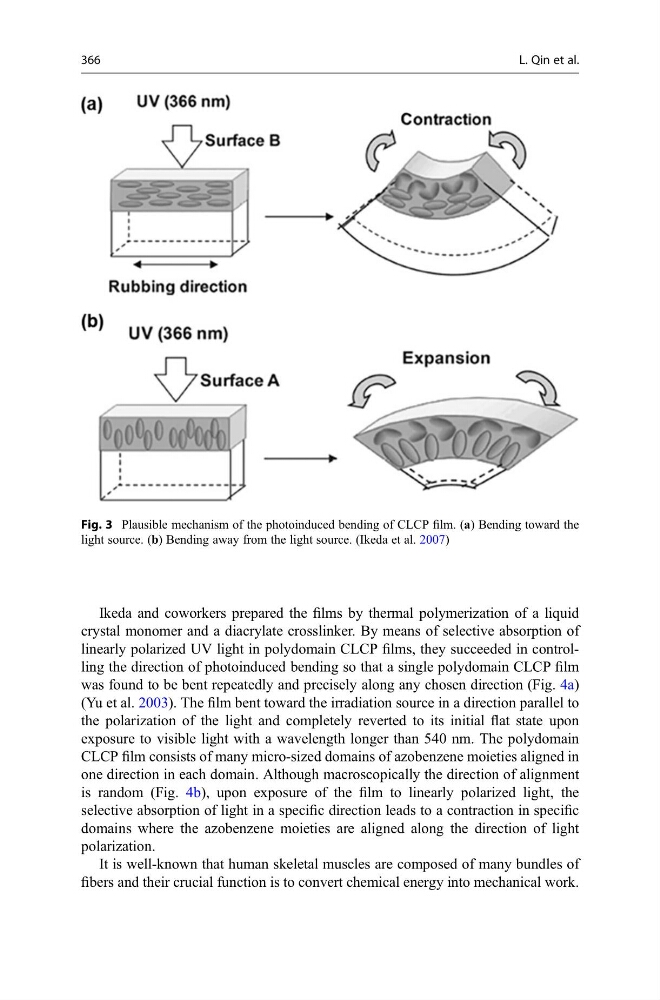
Fig. 3 Plausible mechanism of the photoinduced bending of CLCP film. (a) Bending toward the
light source. (b) Bending away from the light source. (Ikeda et al. 2007)
366
L. Qin et al.
crystal monomer and a diacrylate crosslinker. By means of selective absorption of
linearly polarized UV light in polydomain CLCP films, they succeeded in controlling the direction of photoinduced bending so that a single polydomain CLCP film
was found to be bent repeatedly and precisely along any chosen direction (Fig. 4a)
(Yu et al. 2003). The film bent toward the irradiation source in a direction parallel to
the polarization of the light and completely reverted to its initial flat state upon
exposure to visible light with a wavelength longer than 540 nm. The polydomain
CLCP film consists of many micro-sized domains of azobenzene moieties aligned in
one direction in each domain. Although macroscopically the direction of alignment
is random (Fig. 4b), upon exposure of the film to linearly polarized light, the
selective absorption of light in a specific direction leads to a contraction in specific
domains where the azobenzene moieties are aligned along the direction of light
polarization.
It is well-known that human skeletal muscles are composed of many bundles of
fibers and their crucial function is to convert chemical energy into mechanical work.
Fig. 3 Plausible mechanism of the photoinduced bending of CLCP film. (a) Bending toward the
light source. (b) Bending away from the light source. (Ikeda et al. 2007)
366
L. Qin et al.