

(Shukla and Mazumdar 1999; Ghosh et al. 2000; Hidayat et al. 2001; Shukla et al.
2001). Excitons are electron-hole pairs that are formed during photoexcitation. For
the di-LCPAs, the excitons are initially confined (localized) to the polyene main
chain because of steric effects between the bulky side chains (Fig. 5a). They then are
deconfined (delocalized) to the phenyl moieties where they radiatively recombine
(Fig. 5b). The structures of the polyene main chain and the phenyl moieties of the diPAs determine the polymer emission behavior.
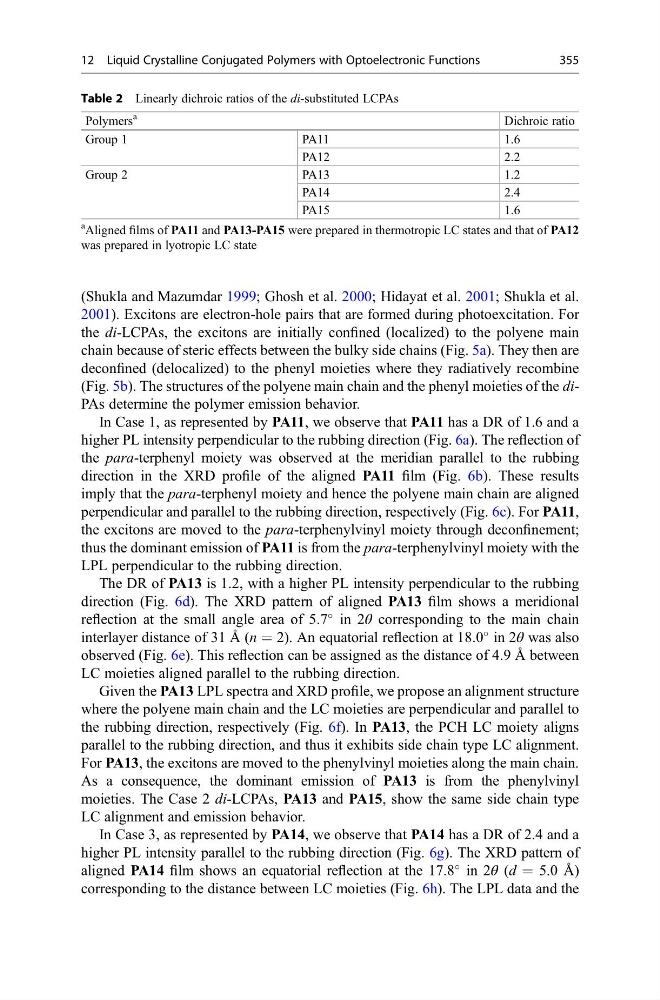
In Case 1, as represented by PA11, we observe that PA11 has a DR of 1.6 and a
higher PL intensity perpendicular to the rubbing direction (Fig. 6a). The reflection of
the para-terphenyl moiety was observed at the meridian parallel to the rubbing
direction in the XRD profile of the aligned PA11 film (Fig. 6b). These results
imply that the para-terphenyl moiety and hence the polyene main chain are aligned
perpendicular and parallel to the rubbing direction, respectively (Fig. 6c). For PA11,
the excitons are moved to the para-terphenylvinyl moiety through deconfinement;
thus the dominant emission of PA11 is from the para-terphenylvinyl moiety with the
LPL perpendicular to the rubbing direction.
The DR of PA13 is 1.2, with a higher PL intensity perpendicular to the rubbing
direction (Fig. 6d). The XRD pattern of aligned PA13 film shows a meridional
reflection at the small angle area of 5.7
in 2θ corresponding to the main chain
interlayer distance of 31 Å (n = 2). An equatorial reflection at 18.0
in 2θ was also
observed (Fig. 6e). This reflection can be assigned as the distance of 4.9 Å between
LC moieties aligned parallel to the rubbing direction.
Given the PA13 LPL spectra and XRD profile, we propose an alignment structure
where the polyene main chain and the LC moieties are perpendicular and parallel to
the rubbing direction, respectively (Fig. 6f). In PA13, the PCH LC moiety aligns
parallel to the rubbing direction, and thus it exhibits side chain type LC alignment.
For PA13, the excitons are moved to the phenylvinyl moieties along the main chain.
As a consequence, the dominant emission of PA13 is from the phenylvinyl
moieties. The Case 2 di-LCPAs, PA13 and PA15, show the same side chain type
LC alignment and emission behavior.
In Case 3, as represented by PA14, we observe that PA14 has a DR of 2.4 and a
higher PL intensity parallel to the rubbing direction (Fig. 6g). The XRD pattern of
aligned PA14 film shows an equatorial reflection at the 17.8
in 2θ (d = 5.0 Å)
corresponding to the distance between LC moieties (Fig. 6h). The LPL data and the
Table 2 Linearly dichroic ratios of the di-substituted LCPAs
Polymers
a
Dichroic ratio
Group 1
PA11
1.6
PA12
2.2
Group 2
PA13
1.2
PA14
2.4
PA15
1.6
a Aligned films of PA11 and PA13-PA15 were prepared in thermotropic LC states and that of PA12
was prepared in lyotropic LC state
12 Liquid Crystalline Conjugated Polymers with Optoelectronic Functions
355
2001). Excitons are electron-hole pairs that are formed during photoexcitation. For
the di-LCPAs, the excitons are initially confined (localized) to the polyene main
chain because of steric effects between the bulky side chains (Fig. 5a). They then are
deconfined (delocalized) to the phenyl moieties where they radiatively recombine
(Fig. 5b). The structures of the polyene main chain and the phenyl moieties of the diPAs determine the polymer emission behavior.
In Case 1, as represented by PA11, we observe that PA11 has a DR of 1.6 and a
higher PL intensity perpendicular to the rubbing direction (Fig. 6a). The reflection of
the para-terphenyl moiety was observed at the meridian parallel to the rubbing
direction in the XRD profile of the aligned PA11 film (Fig. 6b). These results
imply that the para-terphenyl moiety and hence the polyene main chain are aligned
perpendicular and parallel to the rubbing direction, respectively (Fig. 6c). For PA11,
the excitons are moved to the para-terphenylvinyl moiety through deconfinement;
thus the dominant emission of PA11 is from the para-terphenylvinyl moiety with the
LPL perpendicular to the rubbing direction.
The DR of PA13 is 1.2, with a higher PL intensity perpendicular to the rubbing
direction (Fig. 6d). The XRD pattern of aligned PA13 film shows a meridional
reflection at the small angle area of 5.7
in 2θ corresponding to the main chain
interlayer distance of 31 Å (n = 2). An equatorial reflection at 18.0
in 2θ was also
observed (Fig. 6e). This reflection can be assigned as the distance of 4.9 Å between
LC moieties aligned parallel to the rubbing direction.
Given the PA13 LPL spectra and XRD profile, we propose an alignment structure
where the polyene main chain and the LC moieties are perpendicular and parallel to
the rubbing direction, respectively (Fig. 6f). In PA13, the PCH LC moiety aligns
parallel to the rubbing direction, and thus it exhibits side chain type LC alignment.
For PA13, the excitons are moved to the phenylvinyl moieties along the main chain.
As a consequence, the dominant emission of PA13 is from the phenylvinyl
moieties. The Case 2 di-LCPAs, PA13 and PA15, show the same side chain type
LC alignment and emission behavior.
In Case 3, as represented by PA14, we observe that PA14 has a DR of 2.4 and a
higher PL intensity parallel to the rubbing direction (Fig. 6g). The XRD pattern of
aligned PA14 film shows an equatorial reflection at the 17.8
in 2θ (d = 5.0 Å)
corresponding to the distance between LC moieties (Fig. 6h). The LPL data and the
Table 2 Linearly dichroic ratios of the di-substituted LCPAs
Polymers
a
Dichroic ratio
Group 1
PA11
1.6
PA12
2.2
Group 2
PA13
1.2
PA14
2.4
PA15
1.6
a Aligned films of PA11 and PA13-PA15 were prepared in thermotropic LC states and that of PA12
was prepared in lyotropic LC state
12 Liquid Crystalline Conjugated Polymers with Optoelectronic Functions
355