

125–250
C and 100–250
C in heating and cooling processes, respectively, and
thermal decomposition occurred at temperatures over 250
C. The LC phase of PA11
was also investigated using XRD. The XRD patterns reveal a single broad
diffraction peak in the wide angle region (Fig. 4b), typical of an N-LC phase
(Shibaev and Lam 1994). The broad peak at 19.6
in 2θ is 4.5 Å, and it is assigned
to the distance between mesogenic groups.
The two PCH mesogen cores attached via flexible spacers on PA15 result in a
smectic B (S B ) phase (Fig. 4c) with temperature ranges of 55–120
C and 55–110
C
in heating and cooling processes, respectively. The XRD patterns of PA15 have two
sharp diffraction peaks at 5.2 and 19.4
in 2θ (Fig. 4d), corresponding to distances of
34.4 and 4.6 Å, respectively. The former represents the smectic interlayer distance,
while the latter corresponds to the distance between mesogenic groups. The sharp
signal in the wide angle peak of the XRD profile is typical in a hexagonal S B phase
due to the regularity of the hexagonal packing arrangement.
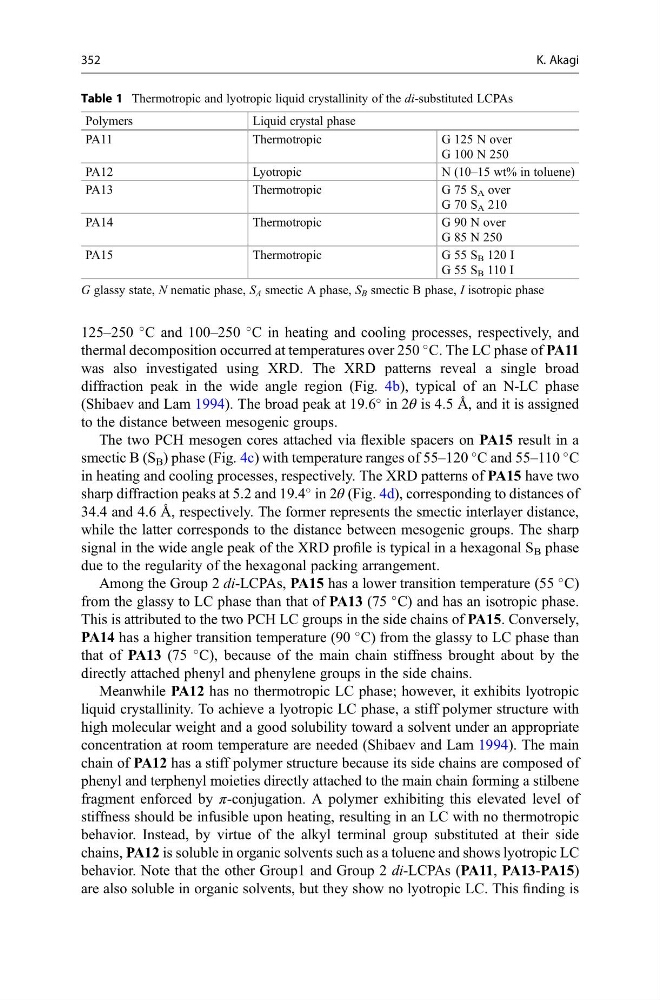
Among the Group 2 di-LCPAs, PA15 has a lower transition temperature (55
C)
from the glassy to LC phase than that of PA13 (75
C) and has an isotropic phase.
This is attributed to the two PCH LC groups in the side chains of PA15. Conversely,
PA14 has a higher transition temperature (90
C) from the glassy to LC phase than
that of PA13 (75
C), because of the main chain stiffness brought about by the
directly attached phenyl and phenylene groups in the side chains.
Meanwhile PA12 has no thermotropic LC phase; however, it exhibits lyotropic
liquid crystallinity. To achieve a lyotropic LC phase, a stiff polymer structure with
high molecular weight and a good solubility toward a solvent under an appropriate
concentration at room temperature are needed (Shibaev and Lam 1994). The main
chain of PA12 has a stiff polymer structure because its side chains are composed of
phenyl and terphenyl moieties directly attached to the main chain forming a stilbene
fragment enforced by π-conjugation. A polymer exhibiting this elevated level of
stiffness should be infusible upon heating, resulting in an LC with no thermotropic
behavior. Instead, by virtue of the alkyl terminal group substituted at their side
chains, PA12 is soluble in organic solvents such as a toluene and shows lyotropic LC
behavior. Note that the other Group1 and Group 2 di-LCPAs (PA11, PA13-PA15)
are also soluble in organic solvents, but they show no lyotropic LC. This finding is
Table 1 Thermotropic and lyotropic liquid crystallinity of the di-substituted LCPAs
Polymers
Liquid crystal phase
PA11
Thermotropic
G 125 N over
G 100 N 250
PA12
Lyotropic
N (10–15 wt% in toluene)
PA13
Thermotropic
G 75 S A over
G 70 S A 210
PA14
Thermotropic
G 90 N over
G 85 N 250
PA15
Thermotropic
G 55 S B 120 I
G 55 S B 110 I
G glassy state, N nematic phase, S A smectic A phase, S B smectic B phase, I isotropic phase
352
K. Akagi
C and 100–250
C in heating and cooling processes, respectively, and
thermal decomposition occurred at temperatures over 250
C. The LC phase of PA11
was also investigated using XRD. The XRD patterns reveal a single broad
diffraction peak in the wide angle region (Fig. 4b), typical of an N-LC phase
(Shibaev and Lam 1994). The broad peak at 19.6
in 2θ is 4.5 Å, and it is assigned
to the distance between mesogenic groups.
The two PCH mesogen cores attached via flexible spacers on PA15 result in a
smectic B (S B ) phase (Fig. 4c) with temperature ranges of 55–120
C and 55–110
C
in heating and cooling processes, respectively. The XRD patterns of PA15 have two
sharp diffraction peaks at 5.2 and 19.4
in 2θ (Fig. 4d), corresponding to distances of
34.4 and 4.6 Å, respectively. The former represents the smectic interlayer distance,
while the latter corresponds to the distance between mesogenic groups. The sharp
signal in the wide angle peak of the XRD profile is typical in a hexagonal S B phase
due to the regularity of the hexagonal packing arrangement.
Among the Group 2 di-LCPAs, PA15 has a lower transition temperature (55
C)
from the glassy to LC phase than that of PA13 (75
C) and has an isotropic phase.
This is attributed to the two PCH LC groups in the side chains of PA15. Conversely,
PA14 has a higher transition temperature (90
C) from the glassy to LC phase than
that of PA13 (75
C), because of the main chain stiffness brought about by the
directly attached phenyl and phenylene groups in the side chains.
Meanwhile PA12 has no thermotropic LC phase; however, it exhibits lyotropic
liquid crystallinity. To achieve a lyotropic LC phase, a stiff polymer structure with
high molecular weight and a good solubility toward a solvent under an appropriate
concentration at room temperature are needed (Shibaev and Lam 1994). The main
chain of PA12 has a stiff polymer structure because its side chains are composed of
phenyl and terphenyl moieties directly attached to the main chain forming a stilbene
fragment enforced by π-conjugation. A polymer exhibiting this elevated level of
stiffness should be infusible upon heating, resulting in an LC with no thermotropic
behavior. Instead, by virtue of the alkyl terminal group substituted at their side
chains, PA12 is soluble in organic solvents such as a toluene and shows lyotropic LC
behavior. Note that the other Group1 and Group 2 di-LCPAs (PA11, PA13-PA15)
are also soluble in organic solvents, but they show no lyotropic LC. This finding is
Table 1 Thermotropic and lyotropic liquid crystallinity of the di-substituted LCPAs
Polymers
Liquid crystal phase
PA11
Thermotropic
G 125 N over
G 100 N 250
PA12
Lyotropic
N (10–15 wt% in toluene)
PA13
Thermotropic
G 75 S A over
G 70 S A 210
PA14
Thermotropic
G 90 N over
G 85 N 250
PA15
Thermotropic
G 55 S B 120 I
G 55 S B 110 I
G glassy state, N nematic phase, S A smectic A phase, S B smectic B phase, I isotropic phase
352
K. Akagi