

with metathesis catalysts to yield high molecular weight di-substituted PAs
(Shiotsuki et al. 2011). They have reported the synthesis of freestanding PDPA gas
permeable films, using TaCl 5 as catalyst, with very high number average molecular
weights (M n = over 10
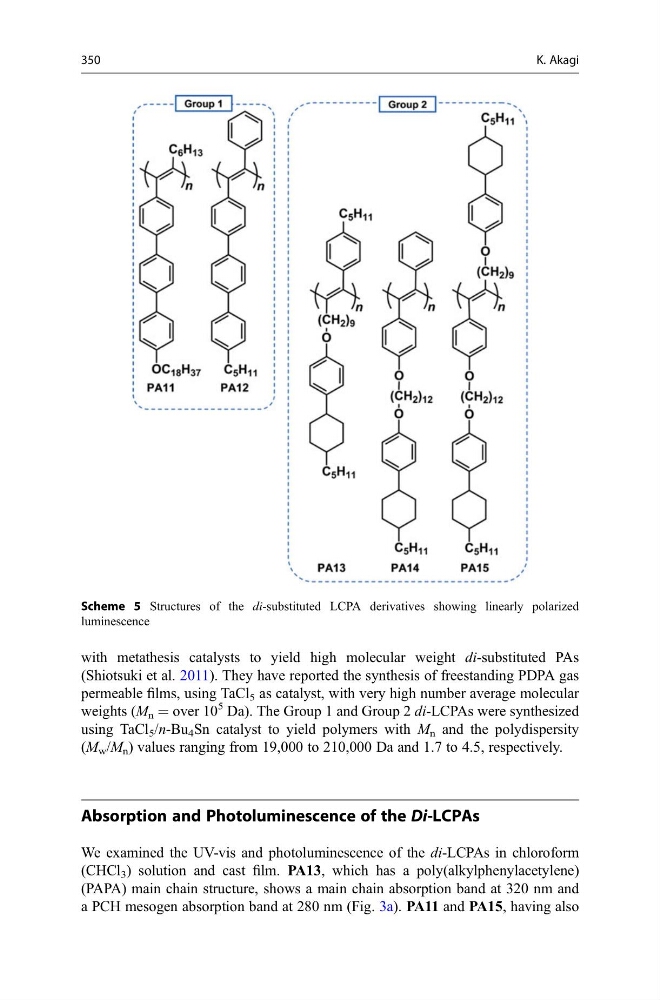
5 Da). The Group 1 and Group 2 di-LCPAs were synthesized
using TaCl 5 /n-Bu 4 Sn catalyst to yield polymers with M n and the polydispersity
(M w /M n ) values ranging from 19,000 to 210,000 Da and 1.7 to 4.5, respectively.
Absorption and Photoluminescence of the Di-LCPAs
We examined the UV-vis and photoluminescence of the di-LCPAs in chloroform
(CHCl 3 ) solution and cast film. PA13, which has a poly(alkylphenylacetylene)
(PAPA) main chain structure, shows a main chain absorption band at 320 nm and
a PCH mesogen absorption band at 280 nm (Fig. 3a). PA11 and PA15, having also
Scheme 5 Structures of the di-substituted LCPA derivatives showing linearly polarized
luminescence
350
K. Akagi
(Shiotsuki et al. 2011). They have reported the synthesis of freestanding PDPA gas
permeable films, using TaCl 5 as catalyst, with very high number average molecular
weights (M n = over 10
5 Da). The Group 1 and Group 2 di-LCPAs were synthesized
using TaCl 5 /n-Bu 4 Sn catalyst to yield polymers with M n and the polydispersity
(M w /M n ) values ranging from 19,000 to 210,000 Da and 1.7 to 4.5, respectively.
Absorption and Photoluminescence of the Di-LCPAs
We examined the UV-vis and photoluminescence of the di-LCPAs in chloroform
(CHCl 3 ) solution and cast film. PA13, which has a poly(alkylphenylacetylene)
(PAPA) main chain structure, shows a main chain absorption band at 320 nm and
a PCH mesogen absorption band at 280 nm (Fig. 3a). PA11 and PA15, having also
Scheme 5 Structures of the di-substituted LCPA derivatives showing linearly polarized
luminescence
350
K. Akagi