

ionic liquids (Lee et al. 2010), just to mention a few. They are also discussed by
K. Akagi in ▶ Chap. 12, “Liquid Crystalline Conjugated Polymers with Optoelectronic
Functions.”
Conjugated Polymers as Liquid Crystalline Hairy-Rod Polymers
Concept
Despite the variety of chemical structures, the phase behavior of the polymers shown
in Fig. 1 or similar does possess certain universality. This universality stems from the
archetypical structural features of the molecules, which can be expressed via a
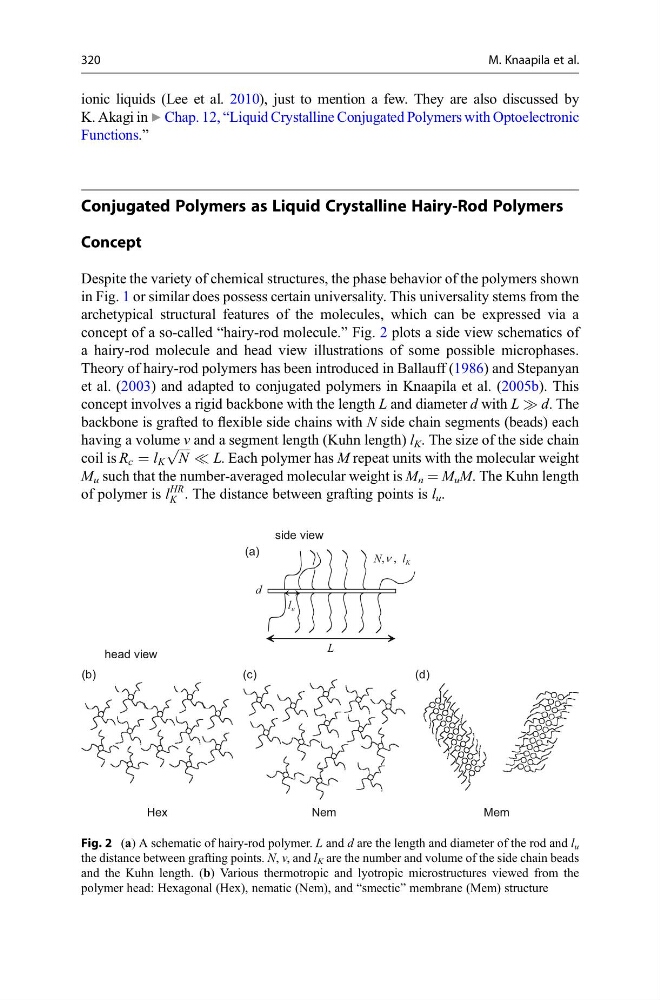
concept of a so-called “hairy-rod molecule.” Fig. 2 plots a side view schematics of
a hairy-rod molecule and head view illustrations of some possible microphases.
Theory of hairy-rod polymers has been introduced in Ballauff (1986) and Stepanyan
et al. (2003) and adapted to conjugated polymers in Knaapila et al. (2005b). This
concept involves a rigid backbone with the length L and diameter d with L ) d. The
backbone is grafted to flexible side chains with N side chain segments (beads) each
having a volume v and a segment length (Kuhn length) l K . The size of the side chain
coil is R c ¼ l K
ffiffiffiffi
N
p ( L. Each polymer has M repeat units with the molecular weight
M u such that the number-averaged molecular weight is M n = M u M. The Kuhn length
of polymer is l
HR
K . The distance between grafting points is l u .
d
N,n , l K
l u
side view
(a)
L
(d)
head view
(c)
Hex
Nem
Mem
(b)
Fig. 2 (a) A schematic of hairy-rod polymer. L and d are the length and diameter of the rod and l u
the distance between grafting points. N, v, and l K are the number and volume of the side chain beads
and the Kuhn length. (b) Various thermotropic and lyotropic microstructures viewed from the
polymer head: Hexagonal (Hex), nematic (Nem), and “smectic” membrane (Mem) structure
320
M. Knaapila et al.
K. Akagi in ▶ Chap. 12, “Liquid Crystalline Conjugated Polymers with Optoelectronic
Functions.”
Conjugated Polymers as Liquid Crystalline Hairy-Rod Polymers
Concept
Despite the variety of chemical structures, the phase behavior of the polymers shown
in Fig. 1 or similar does possess certain universality. This universality stems from the
archetypical structural features of the molecules, which can be expressed via a
concept of a so-called “hairy-rod molecule.” Fig. 2 plots a side view schematics of
a hairy-rod molecule and head view illustrations of some possible microphases.
Theory of hairy-rod polymers has been introduced in Ballauff (1986) and Stepanyan
et al. (2003) and adapted to conjugated polymers in Knaapila et al. (2005b). This
concept involves a rigid backbone with the length L and diameter d with L ) d. The
backbone is grafted to flexible side chains with N side chain segments (beads) each
having a volume v and a segment length (Kuhn length) l K . The size of the side chain
coil is R c ¼ l K
ffiffiffiffi
N
p ( L. Each polymer has M repeat units with the molecular weight
M u such that the number-averaged molecular weight is M n = M u M. The Kuhn length
of polymer is l
HR
K . The distance between grafting points is l u .
d
N,n , l K
l u
side view
(a)
L
(d)
head view
(c)
Hex
Nem
Mem
(b)
Fig. 2 (a) A schematic of hairy-rod polymer. L and d are the length and diameter of the rod and l u
the distance between grafting points. N, v, and l K are the number and volume of the side chain beads
and the Kuhn length. (b) Various thermotropic and lyotropic microstructures viewed from the
polymer head: Hexagonal (Hex), nematic (Nem), and “smectic” membrane (Mem) structure
320
M. Knaapila et al.