

much from simple polymers and assume essentially similar trends for their chemically more complicated variants.
This chapter illustrates some essential factors behind the LC nature of conjugated polymers and supramolecules especially when related in our own experience. It discusses concepts of hairy-rod polymers and hairy-rod supramolecules
and compares our ideas to the works of other groups. We emphasize that LC
conjugated polymers are not limited to these materials but can be prepared using
various other strategies including side-chain mesogens (Liang and Lin 2009;
Roudini and Foot 2016) or stacked-conjugated macromolecules (Hanack and Lang
1994; Laschat et al. 2007) or immersing-conjugated polymers into LC solutions
(Fritz and Scholes 2003; Tcherniak et al. 2008; Zhu and Swager 2002), or polymerizing
R 1
R 2
n
S
S
n
n
R R
n
S
R
n
O
O
n
N
S
N
n
N
n
S
O
SO 3
-
Na
+
n
P1
P2
P3
P4
P5
P6
P7
P8
P9
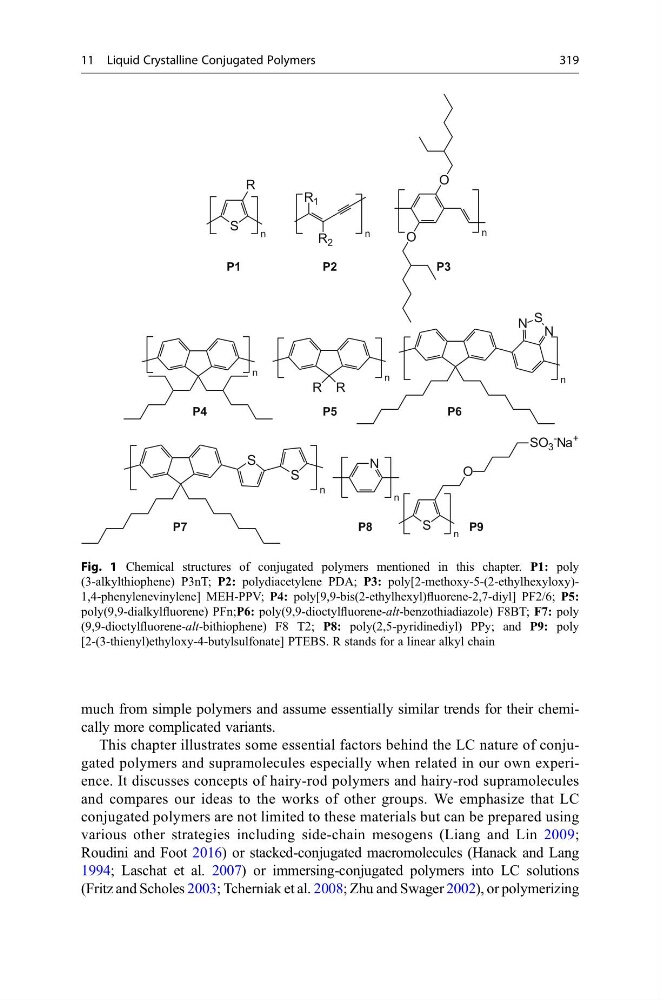
Fig. 1 Chemical structures of conjugated polymers mentioned in this chapter. P1: poly
(3-alkylthiophene) P3nT; P2: polydiacetylene PDA; P3: poly[2-methoxy-5-(2-ethylhexyloxy)1,4-phenylenevinylene] MEH-PPV; P4: poly[9,9-bis(2-ethylhexyl)fluorene-2,7-diyl] PF2/6; P5:
poly(9,9-dialkylfluorene) PFn;P6: poly(9,9-dioctylfluorene-alt-benzothiadiazole) F8BT; F7: poly
(9,9-dioctylfluorene-alt-bithiophene) F8 T2; P8: poly(2,5-pyridinediyl) PPy; and P9: poly
[2-(3-thienyl)ethyloxy-4-butylsulfonate] PTEBS. R stands for a linear alkyl chain
11 Liquid Crystalline Conjugated Polymers
319
This chapter illustrates some essential factors behind the LC nature of conjugated polymers and supramolecules especially when related in our own experience. It discusses concepts of hairy-rod polymers and hairy-rod supramolecules
and compares our ideas to the works of other groups. We emphasize that LC
conjugated polymers are not limited to these materials but can be prepared using
various other strategies including side-chain mesogens (Liang and Lin 2009;
Roudini and Foot 2016) or stacked-conjugated macromolecules (Hanack and Lang
1994; Laschat et al. 2007) or immersing-conjugated polymers into LC solutions
(Fritz and Scholes 2003; Tcherniak et al. 2008; Zhu and Swager 2002), or polymerizing
R 1
R 2
n
S
S
n
n
R R
n
S
R
n
O
O
n
N
S
N
n
N
n
S
O
SO 3
-
Na
+
n
P1
P2
P3
P4
P5
P6
P7
P8
P9
Fig. 1 Chemical structures of conjugated polymers mentioned in this chapter. P1: poly
(3-alkylthiophene) P3nT; P2: polydiacetylene PDA; P3: poly[2-methoxy-5-(2-ethylhexyloxy)1,4-phenylenevinylene] MEH-PPV; P4: poly[9,9-bis(2-ethylhexyl)fluorene-2,7-diyl] PF2/6; P5:
poly(9,9-dialkylfluorene) PFn;P6: poly(9,9-dioctylfluorene-alt-benzothiadiazole) F8BT; F7: poly
(9,9-dioctylfluorene-alt-bithiophene) F8 T2; P8: poly(2,5-pyridinediyl) PPy; and P9: poly
[2-(3-thienyl)ethyloxy-4-butylsulfonate] PTEBS. R stands for a linear alkyl chain
11 Liquid Crystalline Conjugated Polymers
319