

In this context and considering the major role of the intermolecular interactions
in liquids (Hansen and McDonald 1991; Chandler and Andersen 1972), it is
particularly relevant to consider dynamic approaches taking into account also
interchain non-covalent interactions and not only intrachain interactions. Very
few studies examine the possible contribution of intermolecular chain interactions
in polymer physics. Despite the continuum condition from the unentangled state to
the molecular fluid, the single (noninteracting) chain concept is generally kept to
describe the low molecular weight polymer dynamics (Rouse model). However,
Weiner and Fixman (Gao and Weiner 1991; Fixman 1991) demonstrate by computer simulation that the dominant contribution to the viscoelasticity would be due
to excluded volume interactions, i.e., interchain forces. Their simulation results are
in agreement with NMR experiments (Deloche 1986; Sotta et al. 1987) showing
that a free chain is influenced by an anisotropic chain medium. Other recent
computer simulations still evidence the relevance of considering intermolecular
interactions in unentangled polymer fluids (Guenza 2002a, b). To our knowledge,
the early prediction of long-range elastic correlations in the (generic) liquid state is
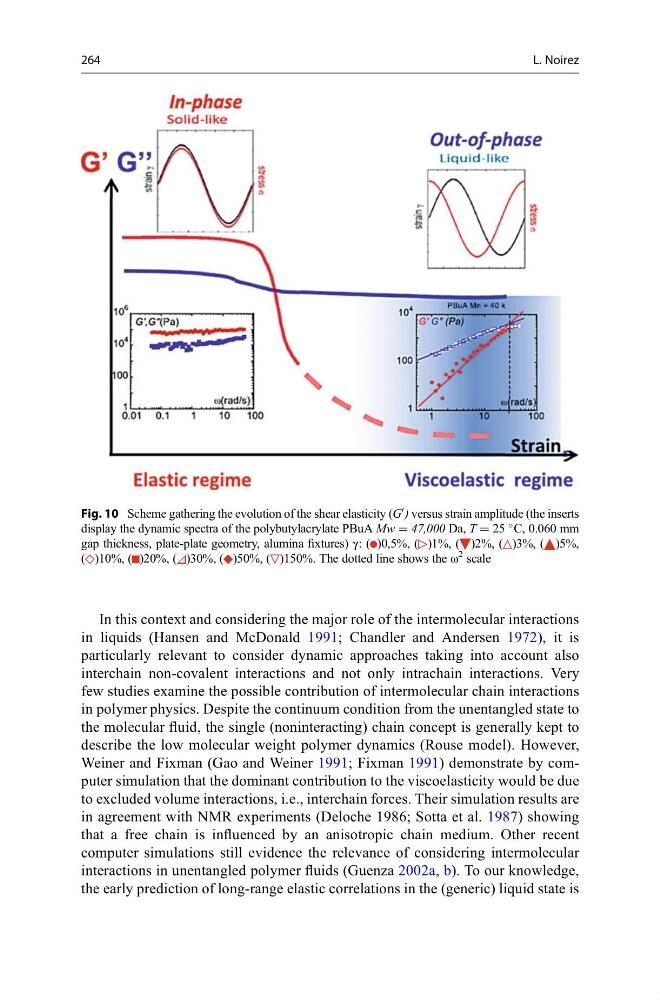
Fig. 10 Scheme gathering the evolution of the shear elasticity (G
0 ) versus strain amplitude (the inserts
display the dynamic spectra of the polybutylacrylate PBuA Mw = 47,000 Da, T = 25
C, 0.060 mm
gap thickness, plate-plate geometry, alumina fixtures) γ: ( )0,5%, ( )1%, ( )2%, ( )3%, ( )5%,
( )10%, ( )20%, ( )30%, ( )50%, ( )150%. The dotted line shows the ω
2 scale
264
L. Noirez
in liquids (Hansen and McDonald 1991; Chandler and Andersen 1972), it is
particularly relevant to consider dynamic approaches taking into account also
interchain non-covalent interactions and not only intrachain interactions. Very
few studies examine the possible contribution of intermolecular chain interactions
in polymer physics. Despite the continuum condition from the unentangled state to
the molecular fluid, the single (noninteracting) chain concept is generally kept to
describe the low molecular weight polymer dynamics (Rouse model). However,
Weiner and Fixman (Gao and Weiner 1991; Fixman 1991) demonstrate by computer simulation that the dominant contribution to the viscoelasticity would be due
to excluded volume interactions, i.e., interchain forces. Their simulation results are
in agreement with NMR experiments (Deloche 1986; Sotta et al. 1987) showing
that a free chain is influenced by an anisotropic chain medium. Other recent
computer simulations still evidence the relevance of considering intermolecular
interactions in unentangled polymer fluids (Guenza 2002a, b). To our knowledge,
the early prediction of long-range elastic correlations in the (generic) liquid state is
Fig. 10 Scheme gathering the evolution of the shear elasticity (G
0 ) versus strain amplitude (the inserts
display the dynamic spectra of the polybutylacrylate PBuA Mw = 47,000 Da, T = 25
C, 0.060 mm
gap thickness, plate-plate geometry, alumina fixtures) γ: ( )0,5%, ( )1%, ( )2%, ( )3%, ( )5%,
( )10%, ( )20%, ( )30%, ( )50%, ( )150%. The dotted line shows the ω
2 scale
264
L. Noirez