

25
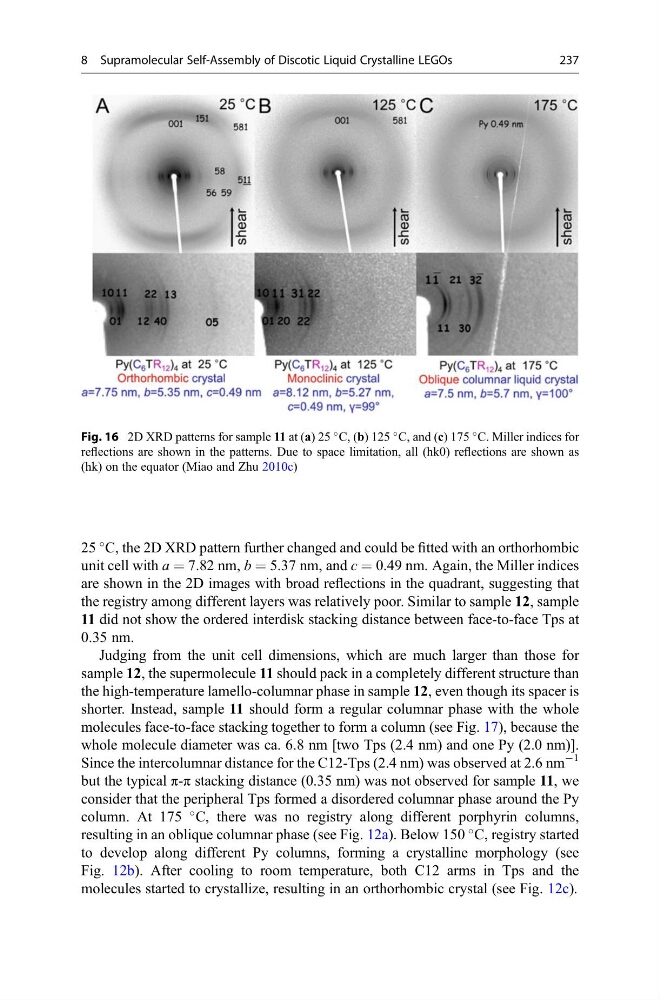
C, the 2D XRD pattern further changed and could be fitted with an orthorhombic
unit cell with a = 7.82 nm, b = 5.37 nm, and c = 0.49 nm. Again, the Miller indices
are shown in the 2D images with broad reflections in the quadrant, suggesting that
the registry among different layers was relatively poor. Similar to sample 12, sample
11 did not show the ordered interdisk stacking distance between face-to-face Tps at
0.35 nm.
Judging from the unit cell dimensions, which are much larger than those for
sample 12, the supermolecule 11 should pack in a completely different structure than
the high-temperature lamello-columnar phase in sample 12, even though its spacer is
shorter. Instead, sample 11 should form a regular columnar phase with the whole
molecules face-to-face stacking together to form a column (see Fig. 17), because the
whole molecule diameter was ca. 6.8 nm [two Tps (2.4 nm) and one Py (2.0 nm)].
Since the intercolumnar distance for the C12-Tps (2.4 nm) was observed at 2.6 nm
À1
but the typical π-π stacking distance (0.35 nm) was not observed for sample 11, we
consider that the peripheral Tps formed a disordered columnar phase around the Py
column. At 175
C, there was no registry along different porphyrin columns,
resulting in an oblique columnar phase (see Fig. 12a). Below 150
C, registry started
to develop along different Py columns, forming a crystalline morphology (see
Fig. 12b). After cooling to room temperature, both C12 arms in Tps and the
molecules started to crystallize, resulting in an orthorhombic crystal (see Fig. 12c).
Fig. 16 2D XRD patterns for sample 11 at (a) 25
C, (b) 125
C, and (c) 175
C. Miller indices for
reflections are shown in the patterns. Due to space limitation, all (hk0) reflections are shown as
(hk) on the equator (Miao and Zhu 2010c)
8 Supramolecular Self-Assembly of Discotic Liquid Crystalline LEGOs
237
C, the 2D XRD pattern further changed and could be fitted with an orthorhombic
unit cell with a = 7.82 nm, b = 5.37 nm, and c = 0.49 nm. Again, the Miller indices
are shown in the 2D images with broad reflections in the quadrant, suggesting that
the registry among different layers was relatively poor. Similar to sample 12, sample
11 did not show the ordered interdisk stacking distance between face-to-face Tps at
0.35 nm.
Judging from the unit cell dimensions, which are much larger than those for
sample 12, the supermolecule 11 should pack in a completely different structure than
the high-temperature lamello-columnar phase in sample 12, even though its spacer is
shorter. Instead, sample 11 should form a regular columnar phase with the whole
molecules face-to-face stacking together to form a column (see Fig. 17), because the
whole molecule diameter was ca. 6.8 nm [two Tps (2.4 nm) and one Py (2.0 nm)].
Since the intercolumnar distance for the C12-Tps (2.4 nm) was observed at 2.6 nm
À1
but the typical π-π stacking distance (0.35 nm) was not observed for sample 11, we
consider that the peripheral Tps formed a disordered columnar phase around the Py
column. At 175
C, there was no registry along different porphyrin columns,
resulting in an oblique columnar phase (see Fig. 12a). Below 150
C, registry started
to develop along different Py columns, forming a crystalline morphology (see
Fig. 12b). After cooling to room temperature, both C12 arms in Tps and the
molecules started to crystallize, resulting in an orthorhombic crystal (see Fig. 12c).
Fig. 16 2D XRD patterns for sample 11 at (a) 25
C, (b) 125
C, and (c) 175
C. Miller indices for
reflections are shown in the patterns. Due to space limitation, all (hk0) reflections are shown as
(hk) on the equator (Miao and Zhu 2010c)
8 Supramolecular Self-Assembly of Discotic Liquid Crystalline LEGOs
237