

suggests that H-bonding is important in the formation of self-assembled liquid
crystalline structure.
In the PLM textures for samples 9, 10, and 12 in Fig. 11, no typical spherulitic
crystalline morphology was observed. Instead, a liquid crystal-like texture was
observed. Due to the high molecular weight of the supermolecules and H-bonding,
the grain sizes are fairly small. The situation is different for sample 11, whose PLM
texture is shown in Fig. 12. At 205
C, a typical columnar liquid crystalline texture is
seen in Fig. 12a. After cooling to 150
C, a fanlike texture is observed in Fig. 12b.
Finally, at room temperature, the texture does not change much from that at 150
C.
From these textures, we speculate that the high-temperature phase should be a
columnar phase and the room temperature phase should be a crystalline phase.
H-bond-assisted supramolecular self-assembly in amide-linked Py(Tp) 4 supermolecules is studied by temperature-dependent FTIR. Typical results are shown in
Fig. 12a for sample 11, which showed an onset isotropization temperature at 208
C.
Below 206
C, H-bonded N–H stretching and amide I C=O stretching absorption
bands were observed at 3303 and 1640 cm
À1 , respectively. The appearance of amide
I band at 1640 cm
À1 was consistent with a trans amide conformation. Above 208
C,
the intensity of H-bonded N–H and amide I bands substantially decreased in
intensity. Meanwhile, broad new absorption bands appeared at 3434 and
1672 cm
À1 , which could be assigned to non-H-bonded N–H and amide C=O
absorption bands. Similar results were also seen for samples 9, 10, and 12. We
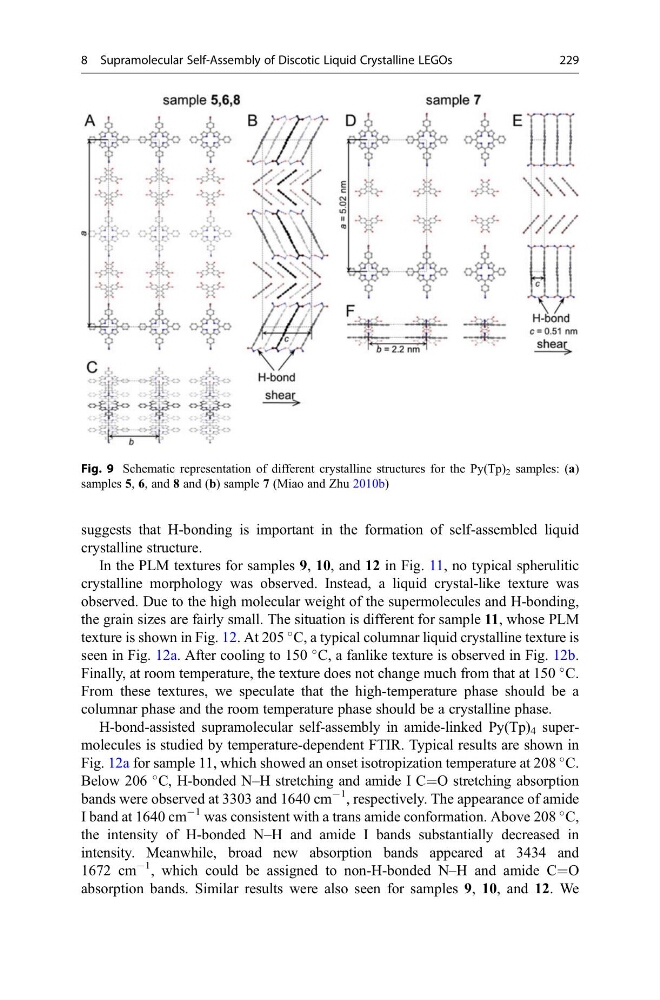
Fig. 9 Schematic representation of different crystalline structures for the Py(Tp) 2 samples: (a)
samples 5, 6, and 8 and (b) sample 7 (Miao and Zhu 2010b)
8 Supramolecular Self-Assembly of Discotic Liquid Crystalline LEGOs
229
crystalline structure.
In the PLM textures for samples 9, 10, and 12 in Fig. 11, no typical spherulitic
crystalline morphology was observed. Instead, a liquid crystal-like texture was
observed. Due to the high molecular weight of the supermolecules and H-bonding,
the grain sizes are fairly small. The situation is different for sample 11, whose PLM
texture is shown in Fig. 12. At 205
C, a typical columnar liquid crystalline texture is
seen in Fig. 12a. After cooling to 150
C, a fanlike texture is observed in Fig. 12b.
Finally, at room temperature, the texture does not change much from that at 150
C.
From these textures, we speculate that the high-temperature phase should be a
columnar phase and the room temperature phase should be a crystalline phase.
H-bond-assisted supramolecular self-assembly in amide-linked Py(Tp) 4 supermolecules is studied by temperature-dependent FTIR. Typical results are shown in
Fig. 12a for sample 11, which showed an onset isotropization temperature at 208
C.
Below 206
C, H-bonded N–H stretching and amide I C=O stretching absorption
bands were observed at 3303 and 1640 cm
À1 , respectively. The appearance of amide
I band at 1640 cm
À1 was consistent with a trans amide conformation. Above 208
C,
the intensity of H-bonded N–H and amide I bands substantially decreased in
intensity. Meanwhile, broad new absorption bands appeared at 3434 and
1672 cm
À1 , which could be assigned to non-H-bonded N–H and amide C=O
absorption bands. Similar results were also seen for samples 9, 10, and 12. We
Fig. 9 Schematic representation of different crystalline structures for the Py(Tp) 2 samples: (a)
samples 5, 6, and 8 and (b) sample 7 (Miao and Zhu 2010b)
8 Supramolecular Self-Assembly of Discotic Liquid Crystalline LEGOs
229