

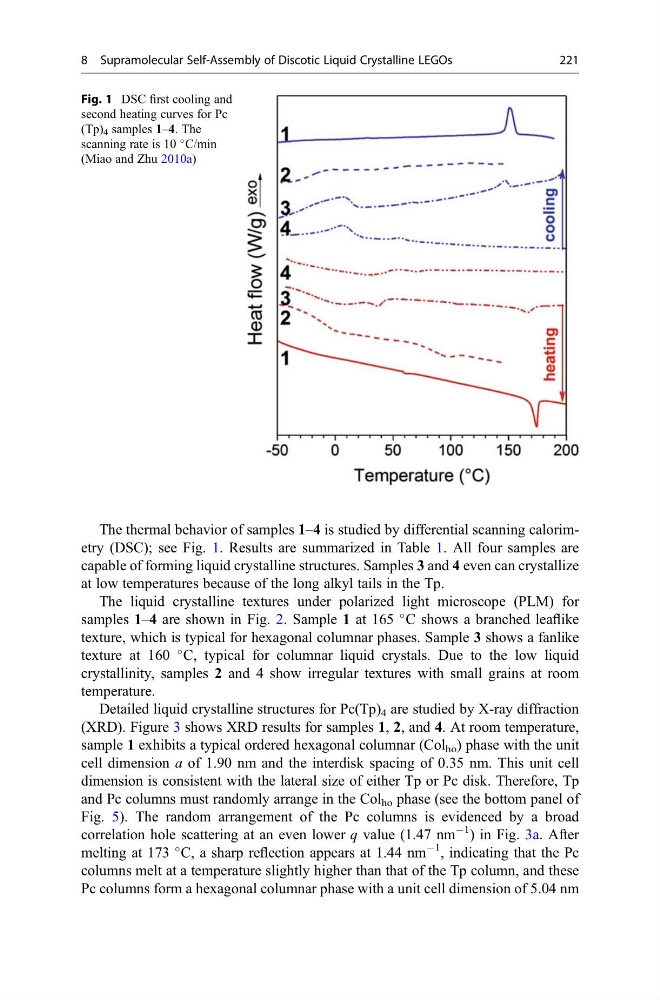
The thermal behavior of samples 1–4 is studied by differential scanning calorimetry (DSC); see Fig. 1. Results are summarized in Table 1. All four samples are
capable of forming liquid crystalline structures. Samples 3 and 4 even can crystallize
at low temperatures because of the long alkyl tails in the Tp.
The liquid crystalline textures under polarized light microscope (PLM) for
samples 1–4 are shown in Fig. 2. Sample 1 at 165
C shows a branched leaflike
texture, which is typical for hexagonal columnar phases. Sample 3 shows a fanlike
texture at 160
C, typical for columnar liquid crystals. Due to the low liquid
crystallinity, samples 2 and 4 show irregular textures with small grains at room
temperature.
Detailed liquid crystalline structures for Pc(Tp) 4 are studied by X-ray diffraction
(XRD). Figure 3 shows XRD results for samples 1, 2, and 4. At room temperature,
sample 1 exhibits a typical ordered hexagonal columnar (Col ho ) phase with the unit
cell dimension a of 1.90 nm and the interdisk spacing of 0.35 nm. This unit cell
dimension is consistent with the lateral size of either Tp or Pc disk. Therefore, Tp
and Pc columns must randomly arrange in the Col ho phase (see the bottom panel of
Fig. 5). The random arrangement of the Pc columns is evidenced by a broad
correlation hole scattering at an even lower q value (1.47 nm
À1 ) in Fig. 3a. After
melting at 173
C, a sharp reflection appears at 1.44 nm
À1 , indicating that the Pc
columns melt at a temperature slightly higher than that of the Tp column, and these
Pc columns form a hexagonal columnar phase with a unit cell dimension of 5.04 nm
Fig. 1 DSC first cooling and
second heating curves for Pc
(Tp) 4 samples 1–4. The
scanning rate is 10
C/min
(Miao and Zhu 2010a)
8 Supramolecular Self-Assembly of Discotic Liquid Crystalline LEGOs
221
capable of forming liquid crystalline structures. Samples 3 and 4 even can crystallize
at low temperatures because of the long alkyl tails in the Tp.
The liquid crystalline textures under polarized light microscope (PLM) for
samples 1–4 are shown in Fig. 2. Sample 1 at 165
C shows a branched leaflike
texture, which is typical for hexagonal columnar phases. Sample 3 shows a fanlike
texture at 160
C, typical for columnar liquid crystals. Due to the low liquid
crystallinity, samples 2 and 4 show irregular textures with small grains at room
temperature.
Detailed liquid crystalline structures for Pc(Tp) 4 are studied by X-ray diffraction
(XRD). Figure 3 shows XRD results for samples 1, 2, and 4. At room temperature,
sample 1 exhibits a typical ordered hexagonal columnar (Col ho ) phase with the unit
cell dimension a of 1.90 nm and the interdisk spacing of 0.35 nm. This unit cell
dimension is consistent with the lateral size of either Tp or Pc disk. Therefore, Tp
and Pc columns must randomly arrange in the Col ho phase (see the bottom panel of
Fig. 5). The random arrangement of the Pc columns is evidenced by a broad
correlation hole scattering at an even lower q value (1.47 nm
À1 ) in Fig. 3a. After
melting at 173
C, a sharp reflection appears at 1.44 nm
À1 , indicating that the Pc
columns melt at a temperature slightly higher than that of the Tp column, and these
Pc columns form a hexagonal columnar phase with a unit cell dimension of 5.04 nm
Fig. 1 DSC first cooling and
second heating curves for Pc
(Tp) 4 samples 1–4. The
scanning rate is 10
C/min
(Miao and Zhu 2010a)
8 Supramolecular Self-Assembly of Discotic Liquid Crystalline LEGOs
221