

observed. In addition, implementing hydrogen bonding in the doubly discotic
systems, different liquid crystalline structures are achieved from the systems without
hydrogen bonding. Basically, hydrogen bonding among the amide groups locks in
different columns into mesophase-separated structures, which may find potential
applications for organic molecular electronics.
Self-assembly of Doubly Discotic Liquid Crystalline
Supermolecules
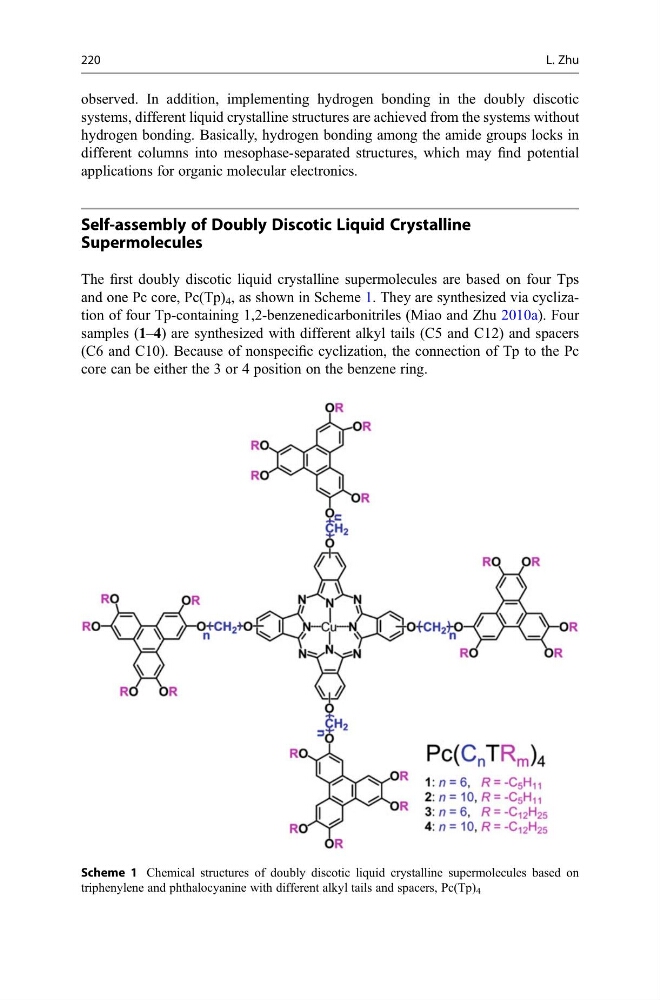
The first doubly discotic liquid crystalline supermolecules are based on four Tps
and one Pc core, Pc(Tp) 4 , as shown in Scheme 1. They are synthesized via cyclization of four Tp-containing 1,2-benzenedicarbonitriles (Miao and Zhu 2010a). Four
samples (1–4) are synthesized with different alkyl tails (C5 and C12) and spacers
(C6 and C10). Because of nonspecific cyclization, the connection of Tp to the Pc
core can be either the 3 or 4 position on the benzene ring.
Scheme 1 Chemical structures of doubly discotic liquid crystalline supermolecules based on
triphenylene and phthalocyanine with different alkyl tails and spacers, Pc(Tp) 4
220
L. Zhu
systems, different liquid crystalline structures are achieved from the systems without
hydrogen bonding. Basically, hydrogen bonding among the amide groups locks in
different columns into mesophase-separated structures, which may find potential
applications for organic molecular electronics.
Self-assembly of Doubly Discotic Liquid Crystalline
Supermolecules
The first doubly discotic liquid crystalline supermolecules are based on four Tps
and one Pc core, Pc(Tp) 4 , as shown in Scheme 1. They are synthesized via cyclization of four Tp-containing 1,2-benzenedicarbonitriles (Miao and Zhu 2010a). Four
samples (1–4) are synthesized with different alkyl tails (C5 and C12) and spacers
(C6 and C10). Because of nonspecific cyclization, the connection of Tp to the Pc
core can be either the 3 or 4 position on the benzene ring.
Scheme 1 Chemical structures of doubly discotic liquid crystalline supermolecules based on
triphenylene and phthalocyanine with different alkyl tails and spacers, Pc(Tp) 4
220
L. Zhu