

et al. 1995; Nandan et al. 2005), metal coordinate complex formation (Ruokolainen
et al. 1995; Valkama et al. 2003a, b), and hydrogen bonding (Fahmi et al. 2003;
Ikkala and ten Brinke 2004; Ruokolainen et al. 1998, 1999; Sidorenko et al. 2003).
In general, these interactions between a polymer and low M n surfactants led to the
formation of phase separated structures in the range of 1–5 nm. In a pioneering
research, Kato and Frechet demonstrated that supramolecular LC materials can be
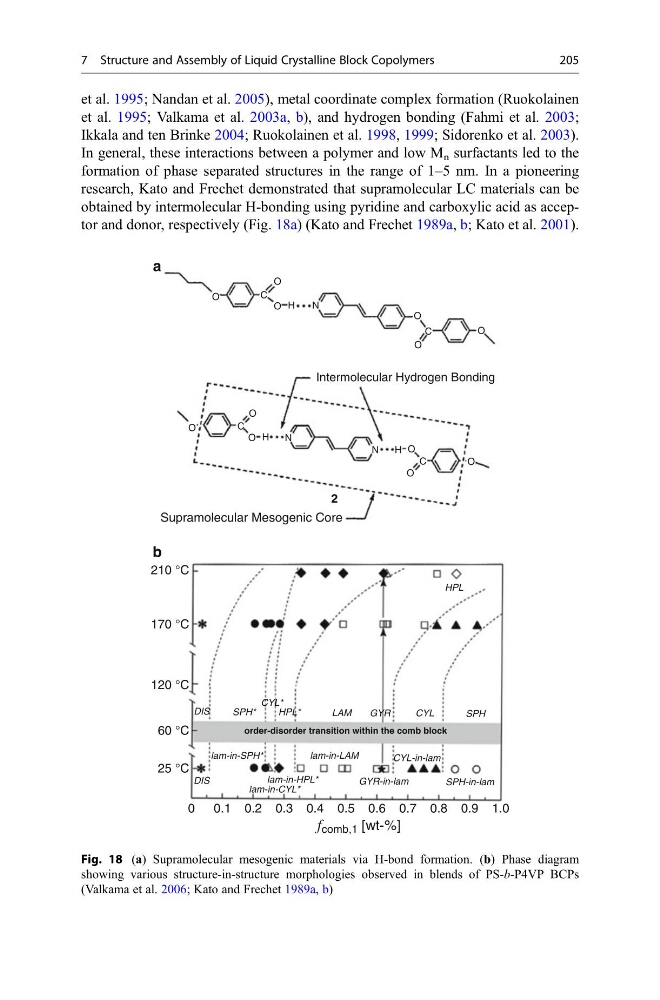
obtained by intermolecular H-bonding using pyridine and carboxylic acid as acceptor and donor, respectively (Fig. 18a) (Kato and Frechet 1989a, b; Kato et al. 2001).
O
O
C
C
O
O
O
Supramolecular Mesogenic Core
210 °C
170 °C
120 °C
60 °C
25 °C
0 0.1 0.2 0.3 0.4 0.5
f comb,1 [wt-%]
0.6 0.7 0.8 0.9 1.0
O
O
O
2
C
O
C
O
Intermolecular Hydrogen Bonding
O
O H
H
N
N
H
N
DIS
lam-in-SPH*
lam-in-HPL*
lam-in-CYL*
DIS
lam-in-LAM
CYL-in-lam
GYR-in-lam
SPH-in-lam
SPH*
CYL*
order-disorder transition within the comb block
LAM
HPL*
HPL
GYR
CYL
SPH
a
b
Fig. 18 (a) Supramolecular mesogenic materials via H-bond formation. (b) Phase diagram
showing various structure-in-structure morphologies observed in blends of PS-b-P4VP BCPs
(Valkama et al. 2006; Kato and Frechet 1989a, b)
7 Structure and Assembly of Liquid Crystalline Block Copolymers
205
et al. 1995; Valkama et al. 2003a, b), and hydrogen bonding (Fahmi et al. 2003;
Ikkala and ten Brinke 2004; Ruokolainen et al. 1998, 1999; Sidorenko et al. 2003).
In general, these interactions between a polymer and low M n surfactants led to the
formation of phase separated structures in the range of 1–5 nm. In a pioneering
research, Kato and Frechet demonstrated that supramolecular LC materials can be
obtained by intermolecular H-bonding using pyridine and carboxylic acid as acceptor and donor, respectively (Fig. 18a) (Kato and Frechet 1989a, b; Kato et al. 2001).
O
O
C
C
O
O
O
Supramolecular Mesogenic Core
210 °C
170 °C
120 °C
60 °C
25 °C
0 0.1 0.2 0.3 0.4 0.5
f comb,1 [wt-%]
0.6 0.7 0.8 0.9 1.0
O
O
O
2
C
O
C
O
Intermolecular Hydrogen Bonding
O
O H
H
N
N
H
N
DIS
lam-in-SPH*
lam-in-HPL*
lam-in-CYL*
DIS
lam-in-LAM
CYL-in-lam
GYR-in-lam
SPH-in-lam
SPH*
CYL*
order-disorder transition within the comb block
LAM
HPL*
HPL
GYR
CYL
SPH
a
b
Fig. 18 (a) Supramolecular mesogenic materials via H-bond formation. (b) Phase diagram
showing various structure-in-structure morphologies observed in blends of PS-b-P4VP BCPs
(Valkama et al. 2006; Kato and Frechet 1989a, b)
7 Structure and Assembly of Liquid Crystalline Block Copolymers
205