

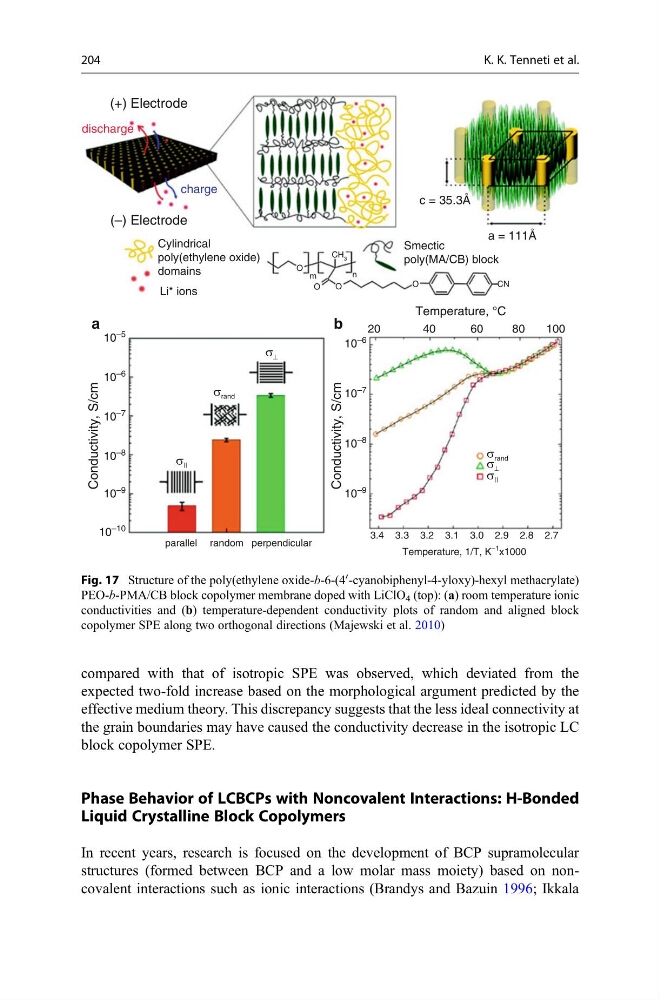
compared with that of isotropic SPE was observed, which deviated from the
expected two-fold increase based on the morphological argument predicted by the
effective medium theory. This discrepancy suggests that the less ideal connectivity at
the grain boundaries may have caused the conductivity decrease in the isotropic LC
block copolymer SPE.
Phase Behavior of LCBCPs with Noncovalent Interactions: H-Bonded
Liquid Crystalline Block Copolymers
In recent years, research is focused on the development of BCP supramolecular
structures (formed between BCP and a low molar mass moiety) based on noncovalent interactions such as ionic interactions (Brandys and Bazuin 1996; Ikkala
(+) Electrode
c = 35.3Å
a = 111Å
(–) Electrode
Cylindrical
poly(ethylene oxide)
domains
Smectic
poly(MA/CB) block
Li* ions
10
–5
Conductivity, S/cm
10
–6
10
–7
10
–8
10
–9
Conductivity, S/cm
10
–6
10
–7
20
40
60
80
100
10
–8
10
–9
10
–10
parallel
s ||
s ||
s ⊥
s ⊥
s rand
s rand
random perpendicular
3.4 3.3 3.2 3.1 3.0
Temperature, 1/T, K
–1
x1000
2.9 2.8 2.7
CH 3
O
O
O
O
Temperature, °C
CN
n
m
discharge
charge
a
b
Fig. 17 Structure of the poly(ethylene oxide-b-6-(4
0 -cyanobiphenyl-4-yloxy)-hexyl methacrylate)
PEO-b-PMA/CB block copolymer membrane doped with LiClO 4 (top): (a) room temperature ionic
conductivities and (b) temperature-dependent conductivity plots of random and aligned block
copolymer SPE along two orthogonal directions (Majewski et al. 2010)
204
K. K. Tenneti et al.
expected two-fold increase based on the morphological argument predicted by the
effective medium theory. This discrepancy suggests that the less ideal connectivity at
the grain boundaries may have caused the conductivity decrease in the isotropic LC
block copolymer SPE.
Phase Behavior of LCBCPs with Noncovalent Interactions: H-Bonded
Liquid Crystalline Block Copolymers
In recent years, research is focused on the development of BCP supramolecular
structures (formed between BCP and a low molar mass moiety) based on noncovalent interactions such as ionic interactions (Brandys and Bazuin 1996; Ikkala
(+) Electrode
c = 35.3Å
a = 111Å
(–) Electrode
Cylindrical
poly(ethylene oxide)
domains
Smectic
poly(MA/CB) block
Li* ions
10
–5
Conductivity, S/cm
10
–6
10
–7
10
–8
10
–9
Conductivity, S/cm
10
–6
10
–7
20
40
60
80
100
10
–8
10
–9
10
–10
parallel
s ||
s ||
s ⊥
s ⊥
s rand
s rand
random perpendicular
3.4 3.3 3.2 3.1 3.0
Temperature, 1/T, K
–1
x1000
2.9 2.8 2.7
CH 3
O
O
O
O
Temperature, °C
CN
n
m
discharge
charge
a
b
Fig. 17 Structure of the poly(ethylene oxide-b-6-(4
0 -cyanobiphenyl-4-yloxy)-hexyl methacrylate)
PEO-b-PMA/CB block copolymer membrane doped with LiClO 4 (top): (a) room temperature ionic
conductivities and (b) temperature-dependent conductivity plots of random and aligned block
copolymer SPE along two orthogonal directions (Majewski et al. 2010)
204
K. K. Tenneti et al.