

induce flexibility in the molecule and help modify the accessibility of the LC phases
within moderate temperatures. In a mesogen, transformation from X to an LC phase
can occur due to increase in temperature or due to a change in concentration. The
former are called thermotropic LCs whereas latter are called lyotropic LCs. General
LC mesogens can be either rod-like (calamitic LCs) or disc-like (discotic LCs) in
shape. In an LC phase, the mesogens orient in a preferred direction called the director
and is denoted by the unit vector, ^
n. The amount of orientational order in an LC phase
can be defined using an order parameter, S. In a sample where all the molecules are
perfectly oriented in a particular direction, S = 1 and for perfect disorientation,
S = 0. For LCs, S varies between 0.3 and 0.8 (Collings and Hird 1997). In
thermotropic LCs, S decreases with an increase in temperature due to the transition
from X to I via LC phase. In different materials, this phase transition results in
various unique correlations between the molecules that are identified as different LC
phases (Collings and Hird 1997; de Gennes 1975; Zhou et al. 1989).
H 3 CO
C
H
N
C 4 H 9
a
b
Nematic
Smectic A Smectic C
Chiral Smectic C
Chiral mesogen
Spiralling
polarization
direction
Front view
Side view
Polar order
P
P
Antiferroelectric
Ferroelectric
c
Back view
θ
n
∧
n
∧
n
∧
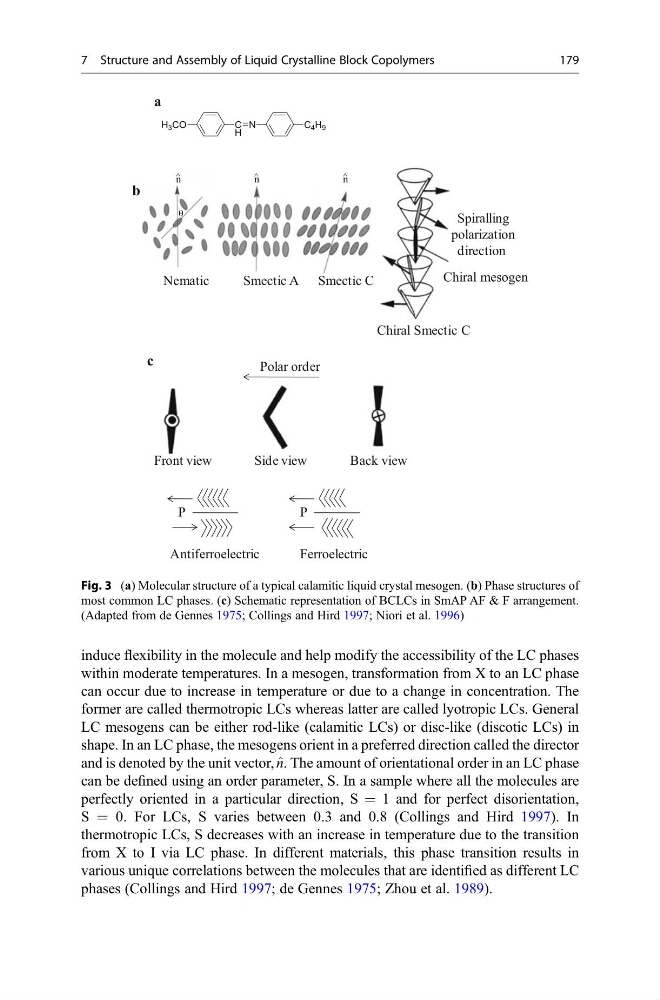
Fig. 3 (a) Molecular structure of a typical calamitic liquid crystal mesogen. (b) Phase structures of
most common LC phases. (c) Schematic representation of BCLCs in SmAP AF & F arrangement.
(Adapted from de Gennes 1975; Collings and Hird 1997; Niori et al. 1996)
7 Structure and Assembly of Liquid Crystalline Block Copolymers
179
within moderate temperatures. In a mesogen, transformation from X to an LC phase
can occur due to increase in temperature or due to a change in concentration. The
former are called thermotropic LCs whereas latter are called lyotropic LCs. General
LC mesogens can be either rod-like (calamitic LCs) or disc-like (discotic LCs) in
shape. In an LC phase, the mesogens orient in a preferred direction called the director
and is denoted by the unit vector, ^
n. The amount of orientational order in an LC phase
can be defined using an order parameter, S. In a sample where all the molecules are
perfectly oriented in a particular direction, S = 1 and for perfect disorientation,
S = 0. For LCs, S varies between 0.3 and 0.8 (Collings and Hird 1997). In
thermotropic LCs, S decreases with an increase in temperature due to the transition
from X to I via LC phase. In different materials, this phase transition results in
various unique correlations between the molecules that are identified as different LC
phases (Collings and Hird 1997; de Gennes 1975; Zhou et al. 1989).
H 3 CO
C
H
N
C 4 H 9
a
b
Nematic
Smectic A Smectic C
Chiral Smectic C
Chiral mesogen
Spiralling
polarization
direction
Front view
Side view
Polar order
P
P
Antiferroelectric
Ferroelectric
c
Back view
θ
n
∧
n
∧
n
∧
Fig. 3 (a) Molecular structure of a typical calamitic liquid crystal mesogen. (b) Phase structures of
most common LC phases. (c) Schematic representation of BCLCs in SmAP AF & F arrangement.
(Adapted from de Gennes 1975; Collings and Hird 1997; Niori et al. 1996)
7 Structure and Assembly of Liquid Crystalline Block Copolymers
179