

diagram using self-consistent mean-field approach that unified the SSL and WSL
along with the intermediate segregation limit (ISL) and was recently modified as
shown in Fig. 2a (Cochran et al. 2006; Matsen and Bates 1996). The phase diagram
consists of the traditional BCP L, G, C, and S (both BCC and close packed) phases as
a function of f.
Advances in polymerization techniques (especially anionic) facilitated the synthesis of a variety of BCPs with very narrow M n distributions (PDI = M w /M n , where
M w is the weight average molecular weight). Figure 2b shows the phase diagram
obtained from experimental observations of phase structures in poly(styrene-bisoprene) (PS-b-PI) BCP system (Khandpur et al. 1995). The similarity between
the two phase diagrams indicates the good agreement between theory and experimental observations. The phase behavior of PS-b-PI BCP system is one of the most
extensively investigated (Bates et al. 1994; Forster et al. 1994; Hajduk et al. 1994,
1998; Hasegawa et al. 1987; Hashimoto et al. 1990; Khandpur et al. 1995; Winey
et al. 1993a, b). Conventional L, G, C, and S phase structures where PS forms both
minority and majority phase have been reported in samples with narrow PDI. In
addition to these conventional BCP morphologies, complex morphologies such as
perforated layered (PL) or catenoid structures were also observed where the majority
phase forms regular perforations/channels in the domains of the minority blocks and
these perforations possessed an in-plane hexagonal symmetry inside the minority
domain. The PL structure is considered as a long-lived metastable state.
Similar traditional BCP morphologies were also observed in a number of amorphous coil-coil BCP systems consisting of both low and high glass transition
temperature (T g ) polymers such as poly(styrene-b-butadiene) (PS-b-PB) (Bates
et al. 1982; Winey et al. 1991, 1992a, b), poly(styrene-b-methyl methacrylate)
(PS-b-PMMA) (Akiyama and Jamieson 1992; Lowenhaupt and Hellmann 1991),
poly(styrene-b-4-vinylpyridine) (PS-b-P4VP),(Saito et al. 1994; Schulz et al. 1996)
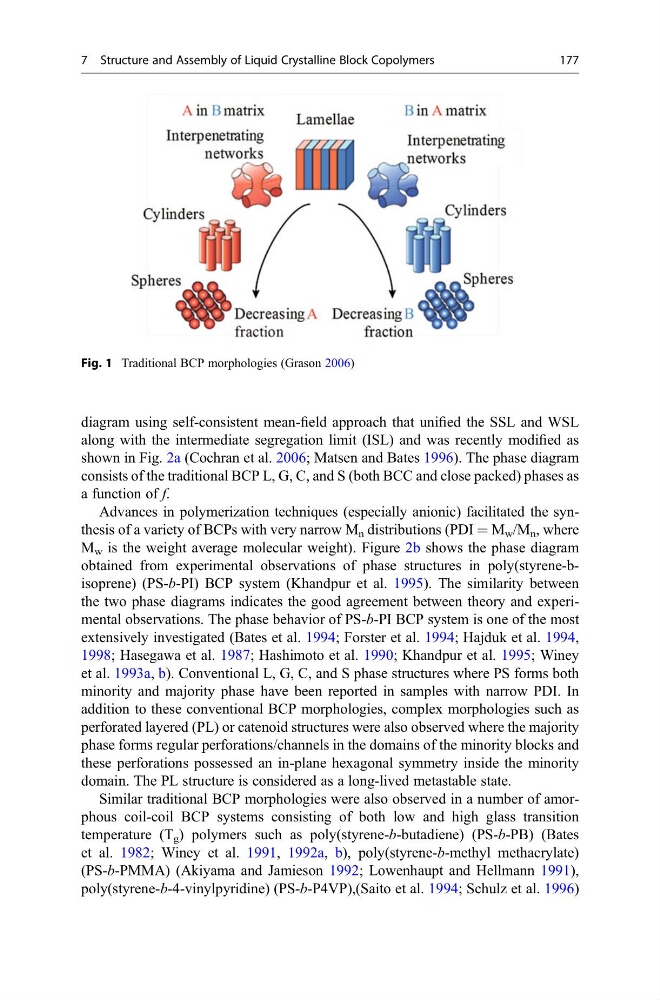
Fig. 1 Traditional BCP morphologies (Grason 2006)
7 Structure and Assembly of Liquid Crystalline Block Copolymers
177
along with the intermediate segregation limit (ISL) and was recently modified as
shown in Fig. 2a (Cochran et al. 2006; Matsen and Bates 1996). The phase diagram
consists of the traditional BCP L, G, C, and S (both BCC and close packed) phases as
a function of f.
Advances in polymerization techniques (especially anionic) facilitated the synthesis of a variety of BCPs with very narrow M n distributions (PDI = M w /M n , where
M w is the weight average molecular weight). Figure 2b shows the phase diagram
obtained from experimental observations of phase structures in poly(styrene-bisoprene) (PS-b-PI) BCP system (Khandpur et al. 1995). The similarity between
the two phase diagrams indicates the good agreement between theory and experimental observations. The phase behavior of PS-b-PI BCP system is one of the most
extensively investigated (Bates et al. 1994; Forster et al. 1994; Hajduk et al. 1994,
1998; Hasegawa et al. 1987; Hashimoto et al. 1990; Khandpur et al. 1995; Winey
et al. 1993a, b). Conventional L, G, C, and S phase structures where PS forms both
minority and majority phase have been reported in samples with narrow PDI. In
addition to these conventional BCP morphologies, complex morphologies such as
perforated layered (PL) or catenoid structures were also observed where the majority
phase forms regular perforations/channels in the domains of the minority blocks and
these perforations possessed an in-plane hexagonal symmetry inside the minority
domain. The PL structure is considered as a long-lived metastable state.
Similar traditional BCP morphologies were also observed in a number of amorphous coil-coil BCP systems consisting of both low and high glass transition
temperature (T g ) polymers such as poly(styrene-b-butadiene) (PS-b-PB) (Bates
et al. 1982; Winey et al. 1991, 1992a, b), poly(styrene-b-methyl methacrylate)
(PS-b-PMMA) (Akiyama and Jamieson 1992; Lowenhaupt and Hellmann 1991),
poly(styrene-b-4-vinylpyridine) (PS-b-P4VP),(Saito et al. 1994; Schulz et al. 1996)
Fig. 1 Traditional BCP morphologies (Grason 2006)
7 Structure and Assembly of Liquid Crystalline Block Copolymers
177