

with a lattice constant that is
ffiffi ffi
7
p
times of the former, due to having six HBC columns
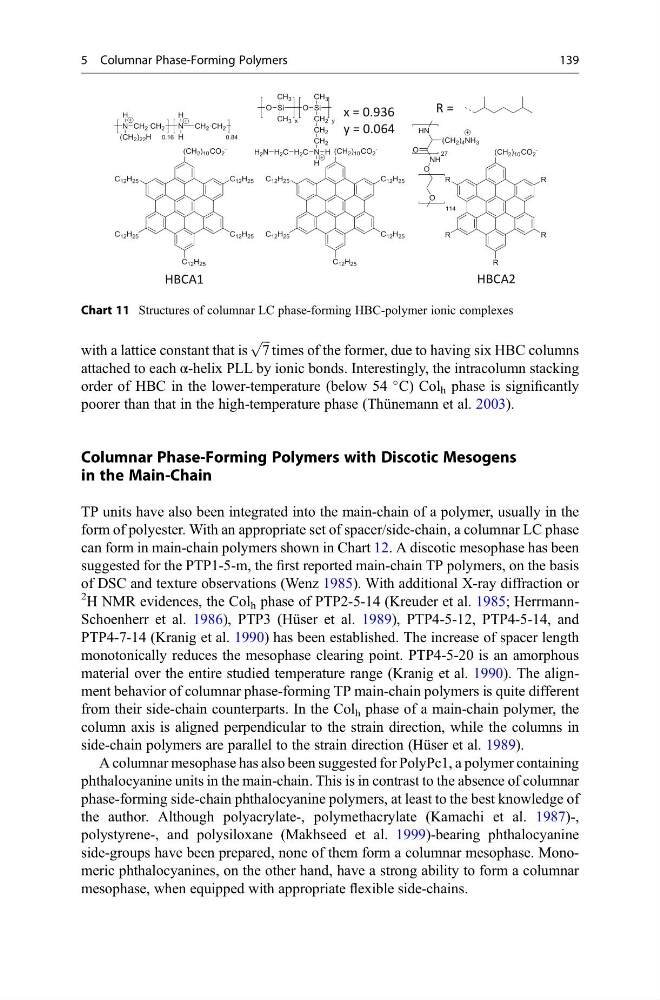
attached to each α-helix PLL by ionic bonds. Interestingly, the intracolumn stacking
order of HBC in the lower-temperature (below 54
C) Col h phase is significantly
poorer than that in the high-temperature phase (Thünemann et al. 2003).
Columnar Phase-Forming Polymers with Discotic Mesogens
in the Main-Chain
TP units have also been integrated into the main-chain of a polymer, usually in the
form of polyester. With an appropriate set of spacer/side-chain, a columnar LC phase
can form in main-chain polymers shown in Chart 12. A discotic mesophase has been
suggested for the PTP1-5-m, the first reported main-chain TP polymers, on the basis
of DSC and texture observations (Wenz 1985). With additional X-ray diffraction or
2 H NMR evidences, the Col h phase of PTP2-5-14 (Kreuder et al. 1985; HerrmannSchoenherr et al. 1986), PTP3 (Hüser et al. 1989), PTP4-5-12, PTP4-5-14, and
PTP4-7-14 (Kranig et al. 1990) has been established. The increase of spacer length
monotonically reduces the mesophase clearing point. PTP4-5-20 is an amorphous
material over the entire studied temperature range (Kranig et al. 1990). The alignment behavior of columnar phase-forming TP main-chain polymers is quite different
from their side-chain counterparts. In the Col h phase of a main-chain polymer, the
column axis is aligned perpendicular to the strain direction, while the columns in
side-chain polymers are parallel to the strain direction (Hüser et al. 1989).
A columnar mesophase has also been suggested for PolyPc1, a polymer containing
phthalocyanine units in the main-chain. This is in contrast to the absence of columnar
phase-forming side-chain phthalocyanine polymers, at least to the best knowledge of
the author. Although polyacrylate-, polymethacrylate (Kamachi et al. 1987)-,
polystyrene-, and polysiloxane (Makhseed et al. 1999)-bearing phthalocyanine
side-groups have been prepared, none of them form a columnar mesophase. Monomeric phthalocyanines, on the other hand, have a strong ability to form a columnar
mesophase, when equipped with appropriate flexible side-chains.
x = 0.936
y = 0.064
R =
HBCA1
HBCA2
Chart 11 Structures of columnar LC phase-forming HBC-polymer ionic complexes
5 Columnar Phase-Forming Polymers
139
ffiffi ffi
7
p
times of the former, due to having six HBC columns
attached to each α-helix PLL by ionic bonds. Interestingly, the intracolumn stacking
order of HBC in the lower-temperature (below 54
C) Col h phase is significantly
poorer than that in the high-temperature phase (Thünemann et al. 2003).
Columnar Phase-Forming Polymers with Discotic Mesogens
in the Main-Chain
TP units have also been integrated into the main-chain of a polymer, usually in the
form of polyester. With an appropriate set of spacer/side-chain, a columnar LC phase
can form in main-chain polymers shown in Chart 12. A discotic mesophase has been
suggested for the PTP1-5-m, the first reported main-chain TP polymers, on the basis
of DSC and texture observations (Wenz 1985). With additional X-ray diffraction or
2 H NMR evidences, the Col h phase of PTP2-5-14 (Kreuder et al. 1985; HerrmannSchoenherr et al. 1986), PTP3 (Hüser et al. 1989), PTP4-5-12, PTP4-5-14, and
PTP4-7-14 (Kranig et al. 1990) has been established. The increase of spacer length
monotonically reduces the mesophase clearing point. PTP4-5-20 is an amorphous
material over the entire studied temperature range (Kranig et al. 1990). The alignment behavior of columnar phase-forming TP main-chain polymers is quite different
from their side-chain counterparts. In the Col h phase of a main-chain polymer, the
column axis is aligned perpendicular to the strain direction, while the columns in
side-chain polymers are parallel to the strain direction (Hüser et al. 1989).
A columnar mesophase has also been suggested for PolyPc1, a polymer containing
phthalocyanine units in the main-chain. This is in contrast to the absence of columnar
phase-forming side-chain phthalocyanine polymers, at least to the best knowledge of
the author. Although polyacrylate-, polymethacrylate (Kamachi et al. 1987)-,
polystyrene-, and polysiloxane (Makhseed et al. 1999)-bearing phthalocyanine
side-groups have been prepared, none of them form a columnar mesophase. Monomeric phthalocyanines, on the other hand, have a strong ability to form a columnar
mesophase, when equipped with appropriate flexible side-chains.
x = 0.936
y = 0.064
R =
HBCA1
HBCA2
Chart 11 Structures of columnar LC phase-forming HBC-polymer ionic complexes
5 Columnar Phase-Forming Polymers
139