

Other Discotic Side-Chain Polymers
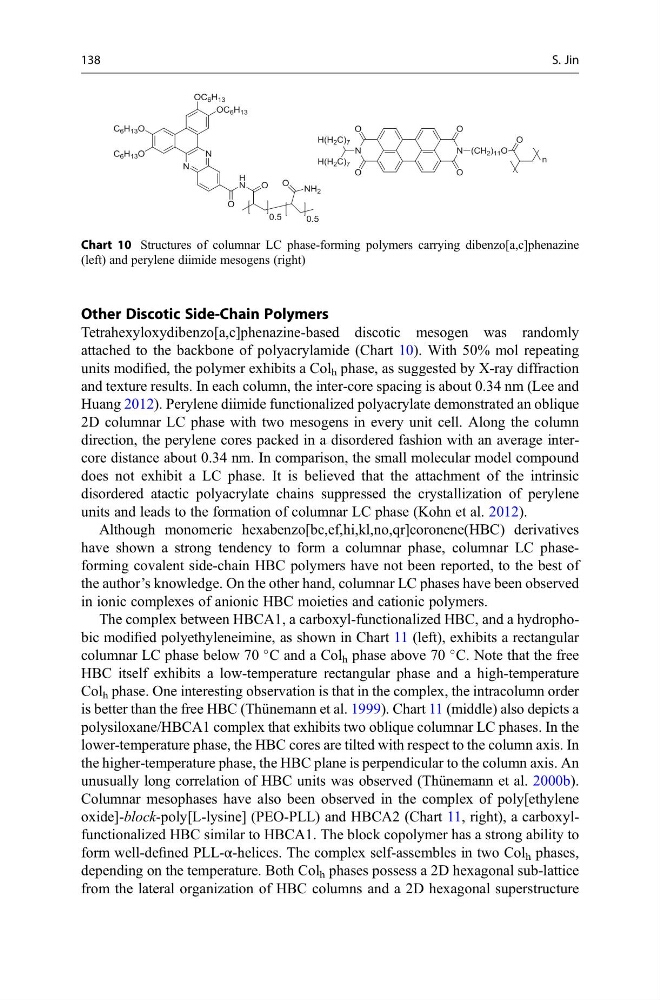
Tetrahexyloxydibenzo[a,c]phenazine-based discotic mesogen was randomly
attached to the backbone of polyacrylamide (Chart 10). With 50% mol repeating
units modified, the polymer exhibits a Col h phase, as suggested by X-ray diffraction
and texture results. In each column, the inter-core spacing is about 0.34 nm (Lee and
Huang 2012). Perylene diimide functionalized polyacrylate demonstrated an oblique
2D columnar LC phase with two mesogens in every unit cell. Along the column
direction, the perylene cores packed in a disordered fashion with an average intercore distance about 0.34 nm. In comparison, the small molecular model compound
does not exhibit a LC phase. It is believed that the attachment of the intrinsic
disordered atactic polyacrylate chains suppressed the crystallization of perylene
units and leads to the formation of columnar LC phase (Kohn et al. 2012).
Although monomeric hexabenzo[bc,ef,hi,kl,no,qr]coronene(HBC) derivatives
have shown a strong tendency to form a columnar phase, columnar LC phaseforming covalent side-chain HBC polymers have not been reported, to the best of
the author’s knowledge. On the other hand, columnar LC phases have been observed
in ionic complexes of anionic HBC moieties and cationic polymers.
The complex between HBCA1, a carboxyl-functionalized HBC, and a hydrophobic modified polyethyleneimine, as shown in Chart 11 (left), exhibits a rectangular
columnar LC phase below 70
C and a Col h phase above 70
C. Note that the free
HBC itself exhibits a low-temperature rectangular phase and a high-temperature
Col h phase. One interesting observation is that in the complex, the intracolumn order
is better than the free HBC (Thünemann et al. 1999). Chart 11 (middle) also depicts a
polysiloxane/HBCA1 complex that exhibits two oblique columnar LC phases. In the
lower-temperature phase, the HBC cores are tilted with respect to the column axis. In
the higher-temperature phase, the HBC plane is perpendicular to the column axis. An
unusually long correlation of HBC units was observed (Thünemann et al. 2000b).
Columnar mesophases have also been observed in the complex of poly[ethylene
oxide]-block-poly[L-lysine] (PEO-PLL) and HBCA2 (Chart 11, right), a carboxylfunctionalized HBC similar to HBCA1. The block copolymer has a strong ability to
form well-defined PLL-α-helices. The complex self-assembles in two Col h phases,
depending on the temperature. Both Col h phases possess a 2D hexagonal sub-lattice
from the lateral organization of HBC columns and a 2D hexagonal superstructure
Chart 10 Structures of columnar LC phase-forming polymers carrying dibenzo[a,c]phenazine
(left) and perylene diimide mesogens (right)
138
S. Jin
Tetrahexyloxydibenzo[a,c]phenazine-based discotic mesogen was randomly
attached to the backbone of polyacrylamide (Chart 10). With 50% mol repeating
units modified, the polymer exhibits a Col h phase, as suggested by X-ray diffraction
and texture results. In each column, the inter-core spacing is about 0.34 nm (Lee and
Huang 2012). Perylene diimide functionalized polyacrylate demonstrated an oblique
2D columnar LC phase with two mesogens in every unit cell. Along the column
direction, the perylene cores packed in a disordered fashion with an average intercore distance about 0.34 nm. In comparison, the small molecular model compound
does not exhibit a LC phase. It is believed that the attachment of the intrinsic
disordered atactic polyacrylate chains suppressed the crystallization of perylene
units and leads to the formation of columnar LC phase (Kohn et al. 2012).
Although monomeric hexabenzo[bc,ef,hi,kl,no,qr]coronene(HBC) derivatives
have shown a strong tendency to form a columnar phase, columnar LC phaseforming covalent side-chain HBC polymers have not been reported, to the best of
the author’s knowledge. On the other hand, columnar LC phases have been observed
in ionic complexes of anionic HBC moieties and cationic polymers.
The complex between HBCA1, a carboxyl-functionalized HBC, and a hydrophobic modified polyethyleneimine, as shown in Chart 11 (left), exhibits a rectangular
columnar LC phase below 70
C and a Col h phase above 70
C. Note that the free
HBC itself exhibits a low-temperature rectangular phase and a high-temperature
Col h phase. One interesting observation is that in the complex, the intracolumn order
is better than the free HBC (Thünemann et al. 1999). Chart 11 (middle) also depicts a
polysiloxane/HBCA1 complex that exhibits two oblique columnar LC phases. In the
lower-temperature phase, the HBC cores are tilted with respect to the column axis. In
the higher-temperature phase, the HBC plane is perpendicular to the column axis. An
unusually long correlation of HBC units was observed (Thünemann et al. 2000b).
Columnar mesophases have also been observed in the complex of poly[ethylene
oxide]-block-poly[L-lysine] (PEO-PLL) and HBCA2 (Chart 11, right), a carboxylfunctionalized HBC similar to HBCA1. The block copolymer has a strong ability to
form well-defined PLL-α-helices. The complex self-assembles in two Col h phases,
depending on the temperature. Both Col h phases possess a 2D hexagonal sub-lattice
from the lateral organization of HBC columns and a 2D hexagonal superstructure
Chart 10 Structures of columnar LC phase-forming polymers carrying dibenzo[a,c]phenazine
(left) and perylene diimide mesogens (right)
138
S. Jin