

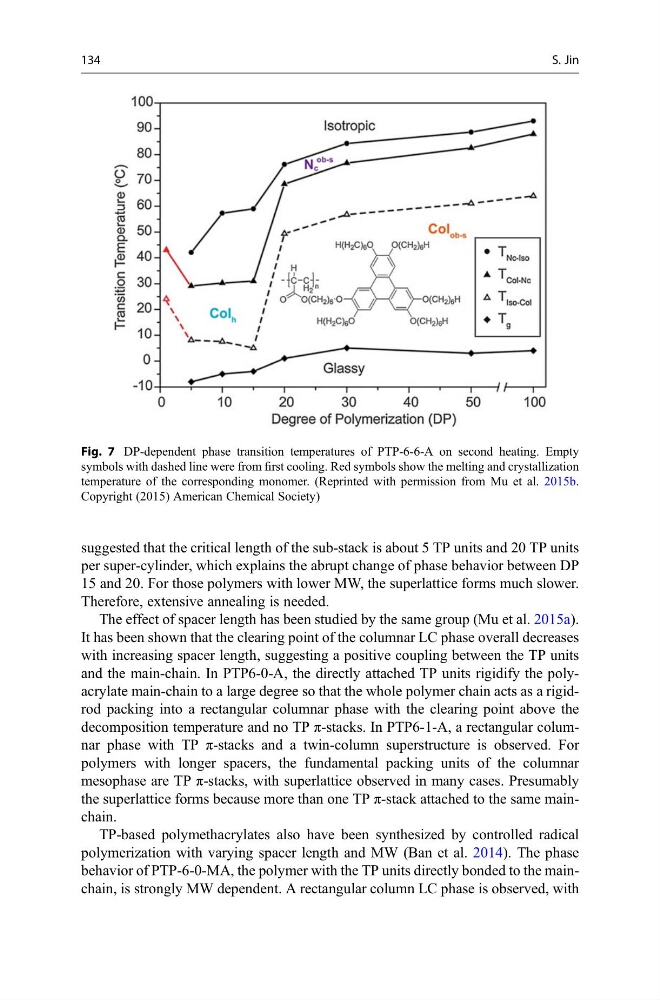
suggested that the critical length of the sub-stack is about 5 TP units and 20 TP units
per super-cylinder, which explains the abrupt change of phase behavior between DP
15 and 20. For those polymers with lower MW, the superlattice forms much slower.
Therefore, extensive annealing is needed.
The effect of spacer length has been studied by the same group (Mu et al. 2015a).
It has been shown that the clearing point of the columnar LC phase overall decreases
with increasing spacer length, suggesting a positive coupling between the TP units
and the main-chain. In PTP6-0-A, the directly attached TP units rigidify the polyacrylate main-chain to a large degree so that the whole polymer chain acts as a rigidrod packing into a rectangular columnar phase with the clearing point above the
decomposition temperature and no TP π-stacks. In PTP6-1-A, a rectangular columnar phase with TP π-stacks and a twin-column superstructure is observed. For
polymers with longer spacers, the fundamental packing units of the columnar
mesophase are TP π-stacks, with superlattice observed in many cases. Presumably
the superlattice forms because more than one TP π-stack attached to the same mainchain.
TP-based polymethacrylates also have been synthesized by controlled radical
polymerization with varying spacer length and MW (Ban et al. 2014). The phase
behavior of PTP-6-0-MA, the polymer with the TP units directly bonded to the mainchain, is strongly MW dependent. A rectangular column LC phase is observed, with
Fig. 7 DP-dependent phase transition temperatures of PTP-6-6-A on second heating. Empty
symbols with dashed line were from first cooling. Red symbols show the melting and crystallization
temperature of the corresponding monomer. (Reprinted with permission from Mu et al. 2015b.
Copyright (2015) American Chemical Society)
134
S. Jin
per super-cylinder, which explains the abrupt change of phase behavior between DP
15 and 20. For those polymers with lower MW, the superlattice forms much slower.
Therefore, extensive annealing is needed.
The effect of spacer length has been studied by the same group (Mu et al. 2015a).
It has been shown that the clearing point of the columnar LC phase overall decreases
with increasing spacer length, suggesting a positive coupling between the TP units
and the main-chain. In PTP6-0-A, the directly attached TP units rigidify the polyacrylate main-chain to a large degree so that the whole polymer chain acts as a rigidrod packing into a rectangular columnar phase with the clearing point above the
decomposition temperature and no TP π-stacks. In PTP6-1-A, a rectangular columnar phase with TP π-stacks and a twin-column superstructure is observed. For
polymers with longer spacers, the fundamental packing units of the columnar
mesophase are TP π-stacks, with superlattice observed in many cases. Presumably
the superlattice forms because more than one TP π-stack attached to the same mainchain.
TP-based polymethacrylates also have been synthesized by controlled radical
polymerization with varying spacer length and MW (Ban et al. 2014). The phase
behavior of PTP-6-0-MA, the polymer with the TP units directly bonded to the mainchain, is strongly MW dependent. A rectangular column LC phase is observed, with
Fig. 7 DP-dependent phase transition temperatures of PTP-6-6-A on second heating. Empty
symbols with dashed line were from first cooling. Red symbols show the melting and crystallization
temperature of the corresponding monomer. (Reprinted with permission from Mu et al. 2015b.
Copyright (2015) American Chemical Society)
134
S. Jin