

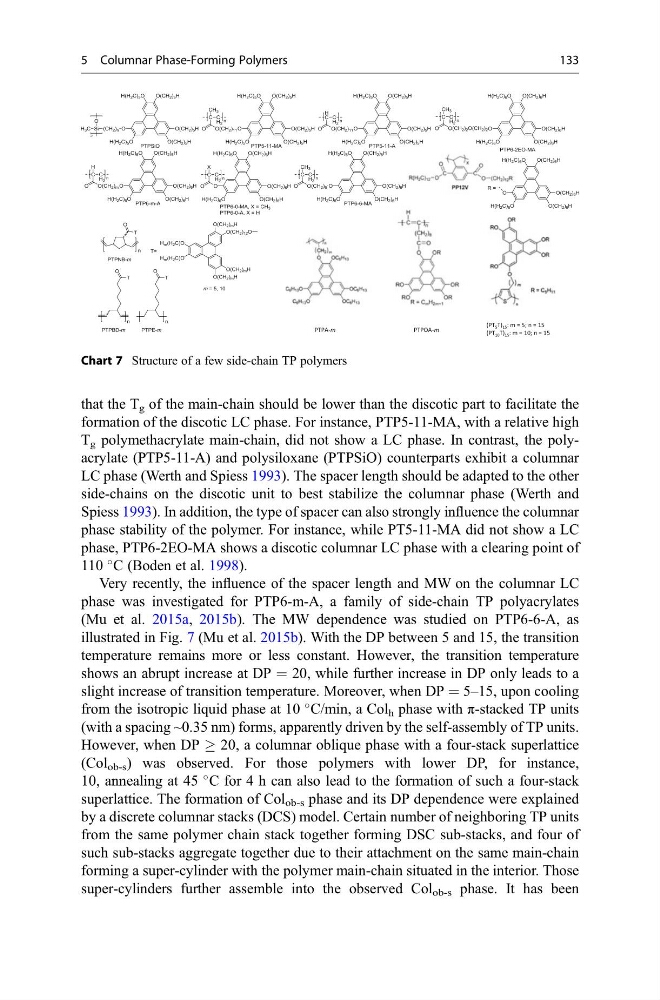
that the T g of the main-chain should be lower than the discotic part to facilitate the
formation of the discotic LC phase. For instance, PTP5-11-MA, with a relative high
T g polymethacrylate main-chain, did not show a LC phase. In contrast, the polyacrylate (PTP5-11-A) and polysiloxane (PTPSiO) counterparts exhibit a columnar
LC phase (Werth and Spiess 1993). The spacer length should be adapted to the other
side-chains on the discotic unit to best stabilize the columnar phase (Werth and
Spiess 1993). In addition, the type of spacer can also strongly influence the columnar
phase stability of the polymer. For instance, while PT5-11-MA did not show a LC
phase, PTP6-2EO-MA shows a discotic columnar LC phase with a clearing point of
110
C (Boden et al. 1998).
Very recently, the influence of the spacer length and MW on the columnar LC
phase was investigated for PTP6-m-A, a family of side-chain TP polyacrylates
(Mu et al. 2015a, 2015b). The MW dependence was studied on PTP6-6-A, as
illustrated in Fig. 7 (Mu et al. 2015b). With the DP between 5 and 15, the transition
temperature remains more or less constant. However, the transition temperature
shows an abrupt increase at DP = 20, while further increase in DP only leads to a
slight increase of transition temperature. Moreover, when DP = 5–15, upon cooling
from the isotropic liquid phase at 10
C/min, a Col h phase with π-stacked TP units
(with a spacing ~0.35 nm) forms, apparently driven by the self-assembly of TP units.
However, when DP ! 20, a columnar oblique phase with a four-stack superlattice
(Col ob-s ) was observed. For those polymers with lower DP, for instance,
10, annealing at 45
C for 4 h can also lead to the formation of such a four-stack
superlattice. The formation of Col ob-s phase and its DP dependence were explained
by a discrete columnar stacks (DCS) model. Certain number of neighboring TP units
from the same polymer chain stack together forming DSC sub-stacks, and four of
such sub-stacks aggregate together due to their attachment on the same main-chain
forming a super-cylinder with the polymer main-chain situated in the interior. Those
super-cylinders further assemble into the observed Col ob-s phase. It has been
PTPA-m
PTPOA-m
(PT 5 T) 15 : m = 5; n = 15
(PT 10 T) 15 : m = 10; n = 15
Chart 7 Structure of a few side-chain TP polymers
5 Columnar Phase-Forming Polymers
133
formation of the discotic LC phase. For instance, PTP5-11-MA, with a relative high
T g polymethacrylate main-chain, did not show a LC phase. In contrast, the polyacrylate (PTP5-11-A) and polysiloxane (PTPSiO) counterparts exhibit a columnar
LC phase (Werth and Spiess 1993). The spacer length should be adapted to the other
side-chains on the discotic unit to best stabilize the columnar phase (Werth and
Spiess 1993). In addition, the type of spacer can also strongly influence the columnar
phase stability of the polymer. For instance, while PT5-11-MA did not show a LC
phase, PTP6-2EO-MA shows a discotic columnar LC phase with a clearing point of
110
C (Boden et al. 1998).
Very recently, the influence of the spacer length and MW on the columnar LC
phase was investigated for PTP6-m-A, a family of side-chain TP polyacrylates
(Mu et al. 2015a, 2015b). The MW dependence was studied on PTP6-6-A, as
illustrated in Fig. 7 (Mu et al. 2015b). With the DP between 5 and 15, the transition
temperature remains more or less constant. However, the transition temperature
shows an abrupt increase at DP = 20, while further increase in DP only leads to a
slight increase of transition temperature. Moreover, when DP = 5–15, upon cooling
from the isotropic liquid phase at 10
C/min, a Col h phase with π-stacked TP units
(with a spacing ~0.35 nm) forms, apparently driven by the self-assembly of TP units.
However, when DP ! 20, a columnar oblique phase with a four-stack superlattice
(Col ob-s ) was observed. For those polymers with lower DP, for instance,
10, annealing at 45
C for 4 h can also lead to the formation of such a four-stack
superlattice. The formation of Col ob-s phase and its DP dependence were explained
by a discrete columnar stacks (DCS) model. Certain number of neighboring TP units
from the same polymer chain stack together forming DSC sub-stacks, and four of
such sub-stacks aggregate together due to their attachment on the same main-chain
forming a super-cylinder with the polymer main-chain situated in the interior. Those
super-cylinders further assemble into the observed Col ob-s phase. It has been
PTPA-m
PTPOA-m
(PT 5 T) 15 : m = 5; n = 15
(PT 10 T) 15 : m = 10; n = 15
Chart 7 Structure of a few side-chain TP polymers
5 Columnar Phase-Forming Polymers
133