

Responsive Gels
LCE swollen by N-LC solvents undergo dimensional change depending on temperature variation and electric fields due to molecular realignment of mesogens. Below
the N-to-I transition (T NI ), the N ordering inside the gels trigger a volumetric
reduction along the director. The response takes place either from the networks or
the LMWLC. Under the influence of an external electric field, the reorientation
increases or reduces the film thickness along the field direction. The response time
depends on the field strength and the blending composition (Urayama et al. 2006).
LC gel polymers are obtained by the photopolymerization of the RM with N-LC
solution in the planar anchoring condition. The polymer networks are fully swollen
in the N-LC molecules. When the sufficiently high electric field is applied to the
suspended gel film, the deformation takes place dominantly in the plane where the
LC director rotates. The macroscopic strain is strongly correlated to the degree of
reorientation for mesogenic directors.
Conclusions and Future Directions
The basic principles and recent interest of anisotropic LC networks have been
reviewed. The anisotropic properties of the LC molecules can be successfully
stabilized after the cross-linking reaction of the pre-ordered RM. It is one of the
big processing advantages that the anisotropic LC thin film is easily fabricated over a
wide area using conventional coating methods. Since RM exhibits anisotropic
property, self-assembled structures, high solvating power, and low viscosity, various
functional materials can be incorporated with RM for the development of advanced
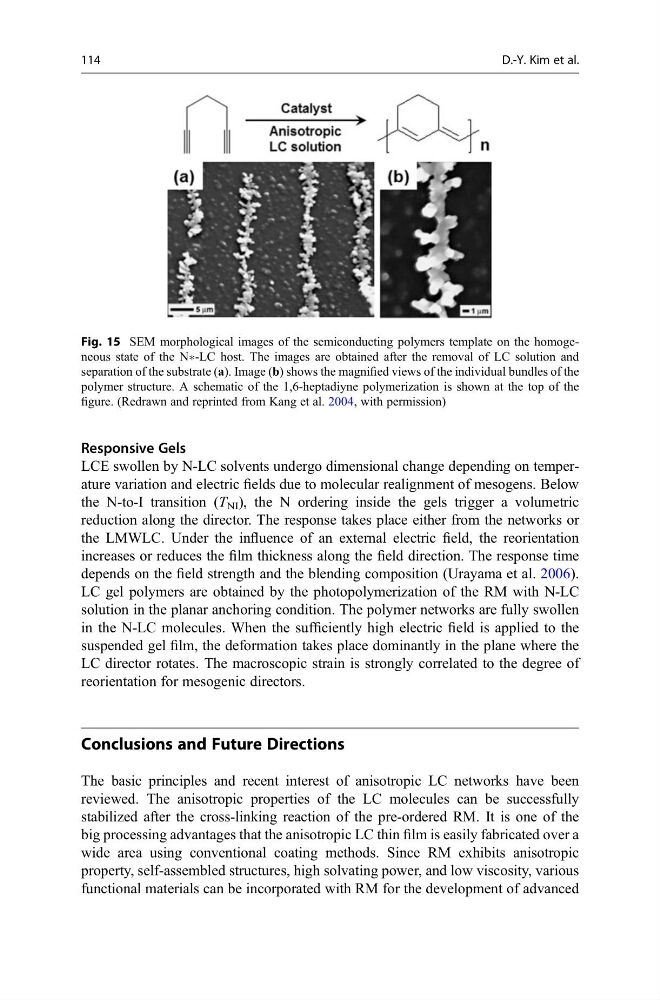
Fig. 15 SEM morphological images of the semiconducting polymers template on the homogeneous state of the NÃ-LC host. The images are obtained after the removal of LC solution and
separation of the substrate (a). Image (b) shows the magnified views of the individual bundles of the
polymer structure. A schematic of the 1,6-heptadiyne polymerization is shown at the top of the
figure. (Redrawn and reprinted from Kang et al. 2004, with permission)
114
D.-Y. Kim et al.
LCE swollen by N-LC solvents undergo dimensional change depending on temperature variation and electric fields due to molecular realignment of mesogens. Below
the N-to-I transition (T NI ), the N ordering inside the gels trigger a volumetric
reduction along the director. The response takes place either from the networks or
the LMWLC. Under the influence of an external electric field, the reorientation
increases or reduces the film thickness along the field direction. The response time
depends on the field strength and the blending composition (Urayama et al. 2006).
LC gel polymers are obtained by the photopolymerization of the RM with N-LC
solution in the planar anchoring condition. The polymer networks are fully swollen
in the N-LC molecules. When the sufficiently high electric field is applied to the
suspended gel film, the deformation takes place dominantly in the plane where the
LC director rotates. The macroscopic strain is strongly correlated to the degree of
reorientation for mesogenic directors.
Conclusions and Future Directions
The basic principles and recent interest of anisotropic LC networks have been
reviewed. The anisotropic properties of the LC molecules can be successfully
stabilized after the cross-linking reaction of the pre-ordered RM. It is one of the
big processing advantages that the anisotropic LC thin film is easily fabricated over a
wide area using conventional coating methods. Since RM exhibits anisotropic
property, self-assembled structures, high solvating power, and low viscosity, various
functional materials can be incorporated with RM for the development of advanced
Fig. 15 SEM morphological images of the semiconducting polymers template on the homogeneous state of the NÃ-LC host. The images are obtained after the removal of LC solution and
separation of the substrate (a). Image (b) shows the magnified views of the individual bundles of the
polymer structure. A schematic of the 1,6-heptadiyne polymerization is shown at the top of the
figure. (Redrawn and reprinted from Kang et al. 2004, with permission)
114
D.-Y. Kim et al.