

Discotic Dendritic Polymers Based on Triphenylene
PPI
PPI
N
H
O
O
C 10 H 21 O
OC 10 H 21
OC 10 H 21
OC 10 H 21
OC 10 H 21
=
N
N
N
N
N
N
H 2 N
NH 2
H 2 N
H 2 N
H 2 N
H 2 N
NH 2
NH 2
n
n = 4, 8, 16, 32, or 64
n =8
83
In order to minimize the free energy associated with them, dendrimers tend to adopt
the spherical structure. However, incorporation of anisotropic mesogenic units at the
periphery deviate them from this spherical structure due to the strong interactions
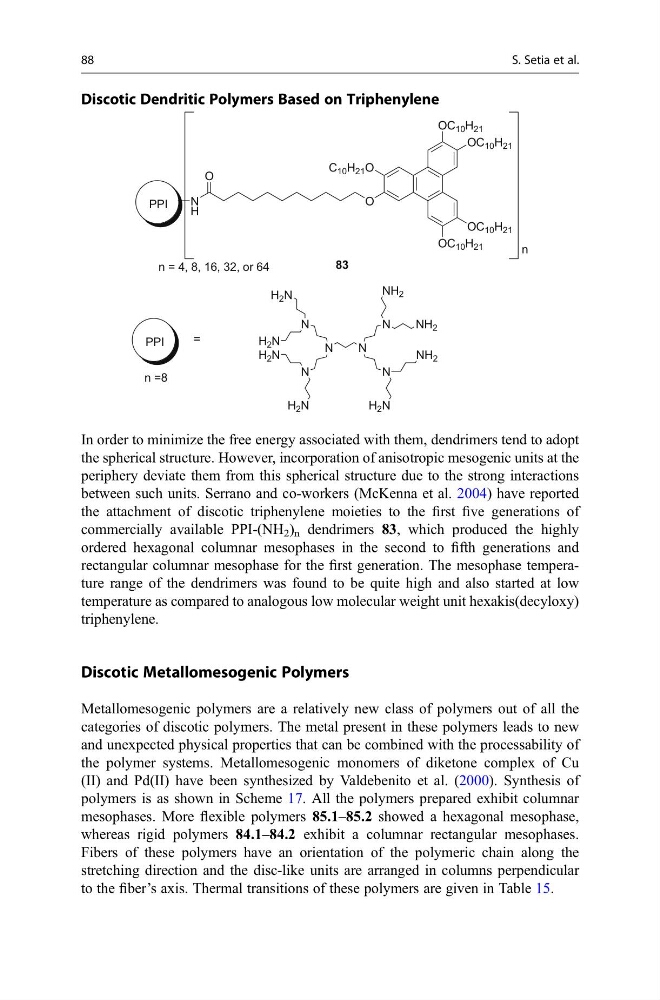
between such units. Serrano and co-workers (McKenna et al. 2004) have reported
the attachment of discotic triphenylene moieties to the first five generations of
commercially available PPI-(NH 2 ) n dendrimers 83, which produced the highly
ordered hexagonal columnar mesophases in the second to fifth generations and
rectangular columnar mesophase for the first generation. The mesophase temperature range of the dendrimers was found to be quite high and also started at low
temperature as compared to analogous low molecular weight unit hexakis(decyloxy)
triphenylene.
Discotic Metallomesogenic Polymers
Metallomesogenic polymers are a relatively new class of polymers out of all the
categories of discotic polymers. The metal present in these polymers leads to new
and unexpected physical properties that can be combined with the processability of
the polymer systems. Metallomesogenic monomers of diketone complex of Cu
(II) and Pd(II) have been synthesized by Valdebenito et al. (2000). Synthesis of
polymers is as shown in Scheme 17. All the polymers prepared exhibit columnar
mesophases. More flexible polymers 85.1–85.2 showed a hexagonal mesophase,
whereas rigid polymers 84.1–84.2 exhibit a columnar rectangular mesophases.
Fibers of these polymers have an orientation of the polymeric chain along the
stretching direction and the disc-like units are arranged in columns perpendicular
to the fiber’s axis. Thermal transitions of these polymers are given in Table 15.
88
S. Setia et al.
PPI
PPI
N
H
O
O
C 10 H 21 O
OC 10 H 21
OC 10 H 21
OC 10 H 21
OC 10 H 21
=
N
N
N
N
N
N
H 2 N
NH 2
H 2 N
H 2 N
H 2 N
H 2 N
NH 2
NH 2
n
n = 4, 8, 16, 32, or 64
n =8
83
In order to minimize the free energy associated with them, dendrimers tend to adopt
the spherical structure. However, incorporation of anisotropic mesogenic units at the
periphery deviate them from this spherical structure due to the strong interactions
between such units. Serrano and co-workers (McKenna et al. 2004) have reported
the attachment of discotic triphenylene moieties to the first five generations of
commercially available PPI-(NH 2 ) n dendrimers 83, which produced the highly
ordered hexagonal columnar mesophases in the second to fifth generations and
rectangular columnar mesophase for the first generation. The mesophase temperature range of the dendrimers was found to be quite high and also started at low
temperature as compared to analogous low molecular weight unit hexakis(decyloxy)
triphenylene.
Discotic Metallomesogenic Polymers
Metallomesogenic polymers are a relatively new class of polymers out of all the
categories of discotic polymers. The metal present in these polymers leads to new
and unexpected physical properties that can be combined with the processability of
the polymer systems. Metallomesogenic monomers of diketone complex of Cu
(II) and Pd(II) have been synthesized by Valdebenito et al. (2000). Synthesis of
polymers is as shown in Scheme 17. All the polymers prepared exhibit columnar
mesophases. More flexible polymers 85.1–85.2 showed a hexagonal mesophase,
whereas rigid polymers 84.1–84.2 exhibit a columnar rectangular mesophases.
Fibers of these polymers have an orientation of the polymeric chain along the
stretching direction and the disc-like units are arranged in columns perpendicular
to the fiber’s axis. Thermal transitions of these polymers are given in Table 15.
88
S. Setia et al.