

Discotic Hyperbranched Polymers Based on Triphenylene
Triphenylene-based hyperbranched polymers were reported by Zhang et al. (2007).
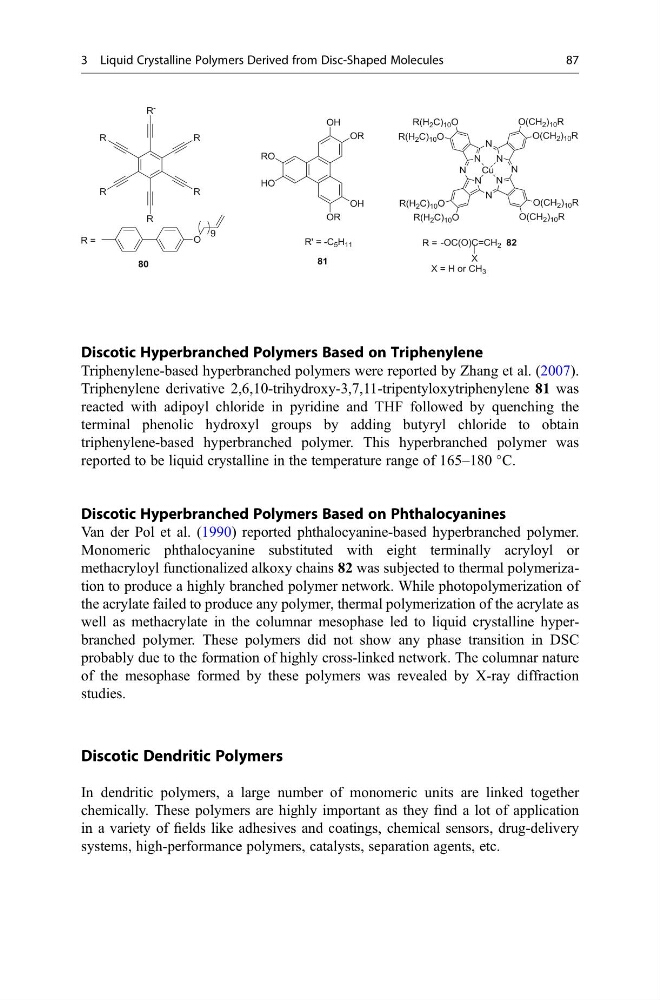
Triphenylene derivative 2,6,10-trihydroxy-3,7,11-tripentyloxytriphenylene 81 was
reacted with adipoyl chloride in pyridine and THF followed by quenching the
terminal phenolic hydroxyl groups by adding butyryl chloride to obtain
triphenylene-based hyperbranched polymer. This hyperbranched polymer was
reported to be liquid crystalline in the temperature range of 165–180
C.
Discotic Hyperbranched Polymers Based on Phthalocyanines
Van der Pol et al. (1990) reported phthalocyanine-based hyperbranched polymer.
Monomeric phthalocyanine substituted with eight terminally acryloyl or
methacryloyl functionalized alkoxy chains 82 was subjected to thermal polymerization to produce a highly branched polymer network. While photopolymerization of
the acrylate failed to produce any polymer, thermal polymerization of the acrylate as
well as methacrylate in the columnar mesophase led to liquid crystalline hyperbranched polymer. These polymers did not show any phase transition in DSC
probably due to the formation of highly cross-linked network. The columnar nature
of the mesophase formed by these polymers was revealed by X-ray diffraction
studies.
Discotic Dendritic Polymers
In dendritic polymers, a large number of monomeric units are linked together
chemically. These polymers are highly important as they find a lot of application
in a variety of fields like adhesives and coatings, chemical sensors, drug-delivery
systems, high-performance polymers, catalysts, separation agents, etc.
3 Liquid Crystalline Polymers Derived from Disc-Shaped Molecules
87
Triphenylene-based hyperbranched polymers were reported by Zhang et al. (2007).
Triphenylene derivative 2,6,10-trihydroxy-3,7,11-tripentyloxytriphenylene 81 was
reacted with adipoyl chloride in pyridine and THF followed by quenching the
terminal phenolic hydroxyl groups by adding butyryl chloride to obtain
triphenylene-based hyperbranched polymer. This hyperbranched polymer was
reported to be liquid crystalline in the temperature range of 165–180
C.
Discotic Hyperbranched Polymers Based on Phthalocyanines
Van der Pol et al. (1990) reported phthalocyanine-based hyperbranched polymer.
Monomeric phthalocyanine substituted with eight terminally acryloyl or
methacryloyl functionalized alkoxy chains 82 was subjected to thermal polymerization to produce a highly branched polymer network. While photopolymerization of
the acrylate failed to produce any polymer, thermal polymerization of the acrylate as
well as methacrylate in the columnar mesophase led to liquid crystalline hyperbranched polymer. These polymers did not show any phase transition in DSC
probably due to the formation of highly cross-linked network. The columnar nature
of the mesophase formed by these polymers was revealed by X-ray diffraction
studies.
Discotic Dendritic Polymers
In dendritic polymers, a large number of monomeric units are linked together
chemically. These polymers are highly important as they find a lot of application
in a variety of fields like adhesives and coatings, chemical sensors, drug-delivery
systems, high-performance polymers, catalysts, separation agents, etc.
3 Liquid Crystalline Polymers Derived from Disc-Shaped Molecules
87