

71
3
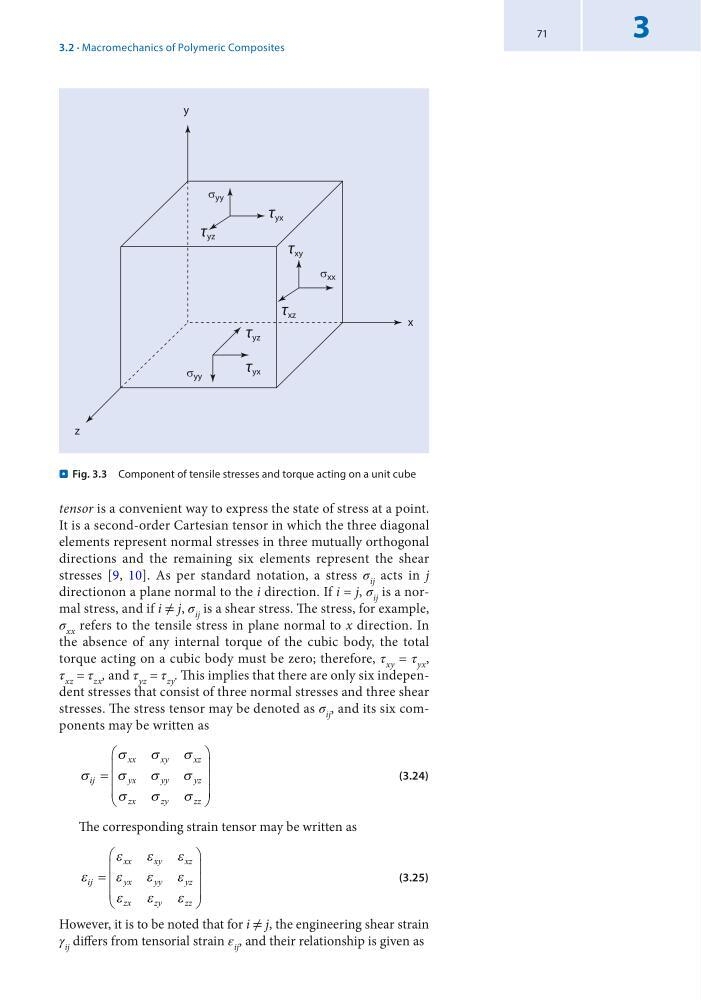
tensor is a convenient way to express the state of stress at a point.
It is a second-order Cartesian tensor in which the three diagonal
elements represent normal stresses in three mutually orthogonal
directions and the remaining six elements represent the shear
stresses [9, 10]. As per standard notation, a stress σ ij acts in j
directionon a plane normal to the i direction. If i = j, σ ij is a normal stress, and if i ≠ j, σ ij is a shear stress. The stress, for example,
σ xx refers to the tensile stress in plane normal to x direction. In
the absence of any internal torque of the cubic body, the total
torque acting on a cubic body must be zero; therefore, τ xy = τ yx ,
τ xz = τ zx , and τ yz = τ zy . This implies that there are only six independent stresses that consist of three normal stresses and three shear
stresses. The stress tensor may be denoted as σ ij , and its six components may be written as
σ
σ
σ
σ
σ
σ
σ
σ
σ
σ
ij
xx
xy
xz
yx
yy
yz
zx
zy
zz
=
(3.24)
The corresponding strain tensor may be written as
ε
ε
ε
ε
ε
ε
ε
ε
ε
ε
ij
xx
xy
xz
yx
yy
yz
zx
zy
zz
=
(3.25)
However, it is to be noted that for i ≠ j, the engineering shear strain
γ ij differs from tensorial strain ε ij , and their relationship is given as
y
x
z
s yy
s xx
s yy
τ yx
τ xy
τ xz
τ yz
τ yz
τ yx
. Fig. 3.3 Component of tensile stresses and torque acting on a unit cube
3.2 · Macromechanics of Polymeric Composites
3
tensor is a convenient way to express the state of stress at a point.
It is a second-order Cartesian tensor in which the three diagonal
elements represent normal stresses in three mutually orthogonal
directions and the remaining six elements represent the shear
stresses [9, 10]. As per standard notation, a stress σ ij acts in j
directionon a plane normal to the i direction. If i = j, σ ij is a normal stress, and if i ≠ j, σ ij is a shear stress. The stress, for example,
σ xx refers to the tensile stress in plane normal to x direction. In
the absence of any internal torque of the cubic body, the total
torque acting on a cubic body must be zero; therefore, τ xy = τ yx ,
τ xz = τ zx , and τ yz = τ zy . This implies that there are only six independent stresses that consist of three normal stresses and three shear
stresses. The stress tensor may be denoted as σ ij , and its six components may be written as
σ
σ
σ
σ
σ
σ
σ
σ
σ
σ
ij
xx
xy
xz
yx
yy
yz
zx
zy
zz
=
(3.24)
The corresponding strain tensor may be written as
ε
ε
ε
ε
ε
ε
ε
ε
ε
ε
ij
xx
xy
xz
yx
yy
yz
zx
zy
zz
=
(3.25)
However, it is to be noted that for i ≠ j, the engineering shear strain
γ ij differs from tensorial strain ε ij , and their relationship is given as
y
x
z
s yy
s xx
s yy
τ yx
τ xy
τ xz
τ yz
τ yz
τ yx
. Fig. 3.3 Component of tensile stresses and torque acting on a unit cube
3.2 · Macromechanics of Polymeric Composites