

36
2
stresses are created. These fatigue stresses can eventually lead to
failure—even when the maximum stress is much less than the
static failure strength of the material. Composites in general
and carbon fibre-reinforced composites in particular have
excellent fatigue resistance in comparison to metal alloys. Leaf
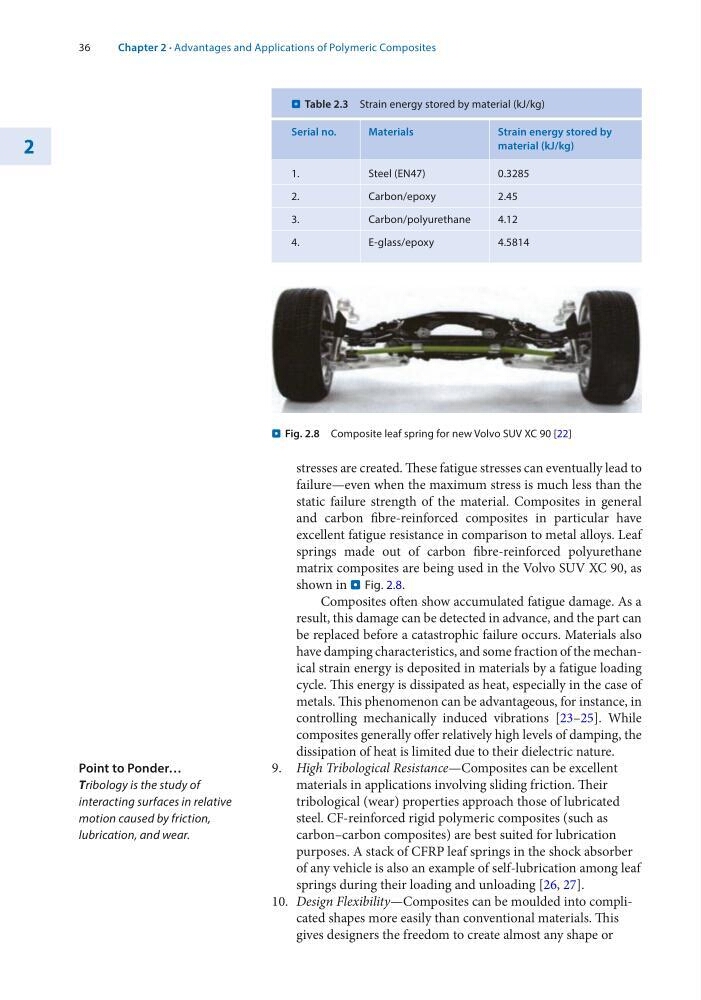
springs made out of carbon fibre-reinforced polyurethane
matrix composites are being used in the Volvo SUV XC 90, as
shown in . Fig. 2.8.
Composites often show accumulated fatigue damage. As a
result, this damage can be detected in advance, and the part can
be replaced before a catastrophic failure occurs. Materials also
have damping characteristics, and some fraction of the mechanical strain energy is deposited in materials by a fatigue loading
cycle. This energy is dissipated as heat, especially in the case of
metals. This phenomenon can be advantageous, for instance, in
controlling mechanically induced vibrations [23–25]. While
composites generally offer relatively high levels of damping, the
dissipation of heat is limited due to their dielectric nature.
9. High Tribological Resistance—Composites can be excellent
materials in applications involving sliding friction. Their
tribological (wear) properties approach those of lubricated
steel. CF-reinforced rigid polymeric composites (such as
carbon–carbon composites) are best suited for lubrication
purposes. A stack of CFRP leaf springs in the shock absorber
of any vehicle is also an example of self-lubrication among leaf
springs during their loading and unloading [26, 27].
10. Design Flexibility—Composites can be moulded into complicated shapes more easily than conventional materials. This
gives designers the freedom to create almost any shape or
Point to Ponder…
Tribology is the study of
interacting surfaces in relative
motion caused by friction,
lubrication, and wear.
. Table 2.3 Strain energy stored by material (kJ/kg)
Serial no.
Materials
Strain energy stored by
material (kJ/kg)
1.
Steel (EN47)
0.3285
2.
Carbon/epoxy
2.45
3.
Carbon/polyurethane
4.12
4.
E-glass/epoxy
4.5814
. Fig. 2.8 Composite leaf spring for new Volvo SUV XC 90 [22]
Chapter 2 · Advantages and Applications of Polymeric Composites
2
stresses are created. These fatigue stresses can eventually lead to
failure—even when the maximum stress is much less than the
static failure strength of the material. Composites in general
and carbon fibre-reinforced composites in particular have
excellent fatigue resistance in comparison to metal alloys. Leaf
springs made out of carbon fibre-reinforced polyurethane
matrix composites are being used in the Volvo SUV XC 90, as
shown in . Fig. 2.8.
Composites often show accumulated fatigue damage. As a
result, this damage can be detected in advance, and the part can
be replaced before a catastrophic failure occurs. Materials also
have damping characteristics, and some fraction of the mechanical strain energy is deposited in materials by a fatigue loading
cycle. This energy is dissipated as heat, especially in the case of
metals. This phenomenon can be advantageous, for instance, in
controlling mechanically induced vibrations [23–25]. While
composites generally offer relatively high levels of damping, the
dissipation of heat is limited due to their dielectric nature.
9. High Tribological Resistance—Composites can be excellent
materials in applications involving sliding friction. Their
tribological (wear) properties approach those of lubricated
steel. CF-reinforced rigid polymeric composites (such as
carbon–carbon composites) are best suited for lubrication
purposes. A stack of CFRP leaf springs in the shock absorber
of any vehicle is also an example of self-lubrication among leaf
springs during their loading and unloading [26, 27].
10. Design Flexibility—Composites can be moulded into complicated shapes more easily than conventional materials. This
gives designers the freedom to create almost any shape or
Point to Ponder…
Tribology is the study of
interacting surfaces in relative
motion caused by friction,
lubrication, and wear.
. Table 2.3 Strain energy stored by material (kJ/kg)
Serial no.
Materials
Strain energy stored by
material (kJ/kg)
1.
Steel (EN47)
0.3285
2.
Carbon/epoxy
2.45
3.
Carbon/polyurethane
4.12
4.
E-glass/epoxy
4.5814
. Fig. 2.8 Composite leaf spring for new Volvo SUV XC 90 [22]
Chapter 2 · Advantages and Applications of Polymeric Composites