

35
2
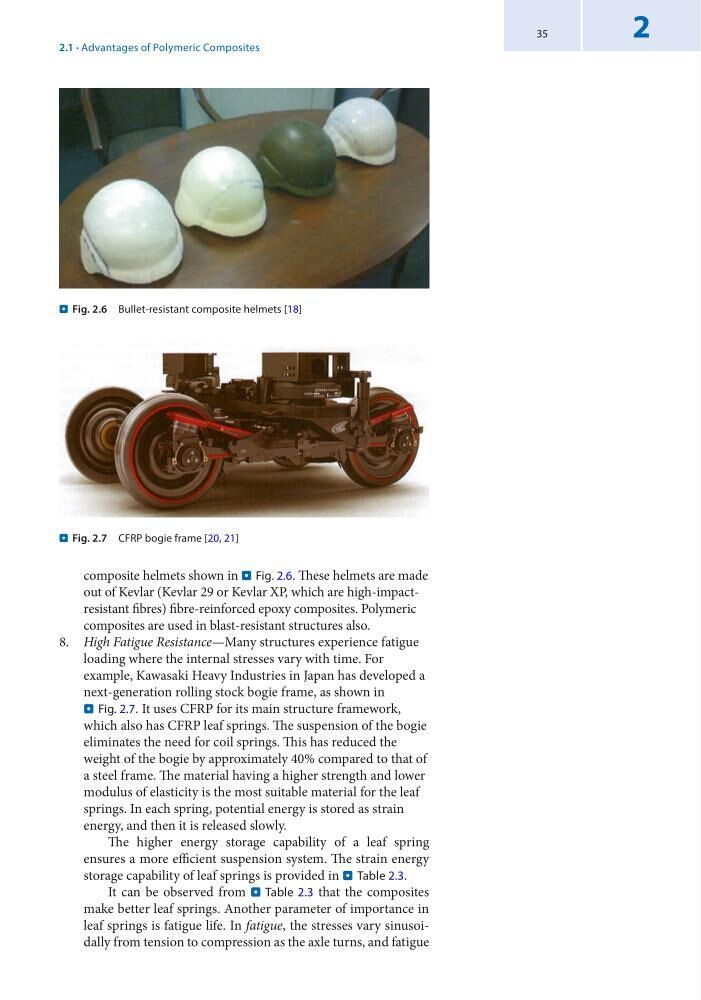
composite helmets shown in . Fig. 2.6. These helmets are made
out of Kevlar (Kevlar 29 or Kevlar XP, which are high-impactresistant fibres) fibre-reinforced epoxy composites. Polymeric
composites are used in blast-resistant structures also.
8. High Fatigue Resistance—Many structures experience fatigue
loading where the internal stresses vary with time. For
example, Kawasaki Heavy Industries in Japan has developed a
next-generation rolling stock bogie frame, as shown in
. Fig. 2.7. It uses CFRP for its main structure framework,
which also has CFRP leaf springs. The suspension of the bogie
eliminates the need for coil springs. This has reduced the
weight of the bogie by approximately 40% compared to that of
a steel frame. The material having a higher strength and lower
modulus of elasticity is the most suitable material for the leaf
springs. In each spring, potential energy is stored as strain
energy, and then it is released slowly.
The higher energy storage capability of a leaf spring
ensures a more efficient suspension system. The strain energy
storage capability of leaf springs is provided in . Table 2.3.
It can be observed from . Table 2.3 that the composites
make better leaf springs. Another parameter of importance in
leaf springs is fatigue life. In fatigue, the stresses vary sinusoidally from tension to compression as the axle turns, and fatigue
. Fig. 2.6 Bullet-resistant composite helmets [18]
. Fig. 2.7 CFRP bogie frame [20, 21]
2.1 · Advantages of Polymeric Composites
2
composite helmets shown in . Fig. 2.6. These helmets are made
out of Kevlar (Kevlar 29 or Kevlar XP, which are high-impactresistant fibres) fibre-reinforced epoxy composites. Polymeric
composites are used in blast-resistant structures also.
8. High Fatigue Resistance—Many structures experience fatigue
loading where the internal stresses vary with time. For
example, Kawasaki Heavy Industries in Japan has developed a
next-generation rolling stock bogie frame, as shown in
. Fig. 2.7. It uses CFRP for its main structure framework,
which also has CFRP leaf springs. The suspension of the bogie
eliminates the need for coil springs. This has reduced the
weight of the bogie by approximately 40% compared to that of
a steel frame. The material having a higher strength and lower
modulus of elasticity is the most suitable material for the leaf
springs. In each spring, potential energy is stored as strain
energy, and then it is released slowly.
The higher energy storage capability of a leaf spring
ensures a more efficient suspension system. The strain energy
storage capability of leaf springs is provided in . Table 2.3.
It can be observed from . Table 2.3 that the composites
make better leaf springs. Another parameter of importance in
leaf springs is fatigue life. In fatigue, the stresses vary sinusoidally from tension to compression as the axle turns, and fatigue
. Fig. 2.6 Bullet-resistant composite helmets [18]
. Fig. 2.7 CFRP bogie frame [20, 21]
2.1 · Advantages of Polymeric Composites