

32
2
2. Tailorability of Properties—Composites are anisotropic (i.e.
have different properties in different directions), and this can
be used to design a more efficient structure. Composites are
the materials in which desired properties can be tailored as
per the requirements of the load/deflection. Composites
provide the possibility to reinforce more fibres and/or variety
of fibres to achieve the desired strength or stiffness within the
specified volume or weight of the structure. These basic
properties of composites keep them above other materials.
These are the reasons composites are not referred to as
materials by engineers. Rather, they are considered structures.
Every composite structure has its own characteristic and
uniqueness in terms of desired properties due to their
anisotropy [16, 17]. This uniqueness is not possible with
isotropic materials such as metals. In many structures, the
stresses are also different in different directions. For example,
in closed-end pressure vessels (such as a rocket motor case),
the circumferential stresses are twice the axial stresses. Using
composites, such a vessel can be made twice as strong in the
circumferential direction as in the axial.
3. Improved Heat Deflection Temperature—The heat deflection
temperature is a measure of the ability of thermoplastic
composites to bear the load at elevated temperatures. The
deflection temperature is also known as the deflection
temperature under load (DTUL), heat deflection temperature,
or heat distortion temperature (HDT). The reinforcing fibres
restrict the distortion of composites under heat and load.
However, residual stresses in the composite structures cause
distortion, and such distortions are more prominent in thin
sections of polymeric composites. The deflection temperature
is a useful measure of the relative service temperature for load
bearing composites. The comparison of HDT between
composites and their matrix resin is given in . Table 2.1.
However, the deflection temperature test is a short-term
test and should not be used alone for product design. Other
factors such as the time of exposure to elevated temperature,
the rate of temperature increase, and the part geometry all
affect the performance.
a
b
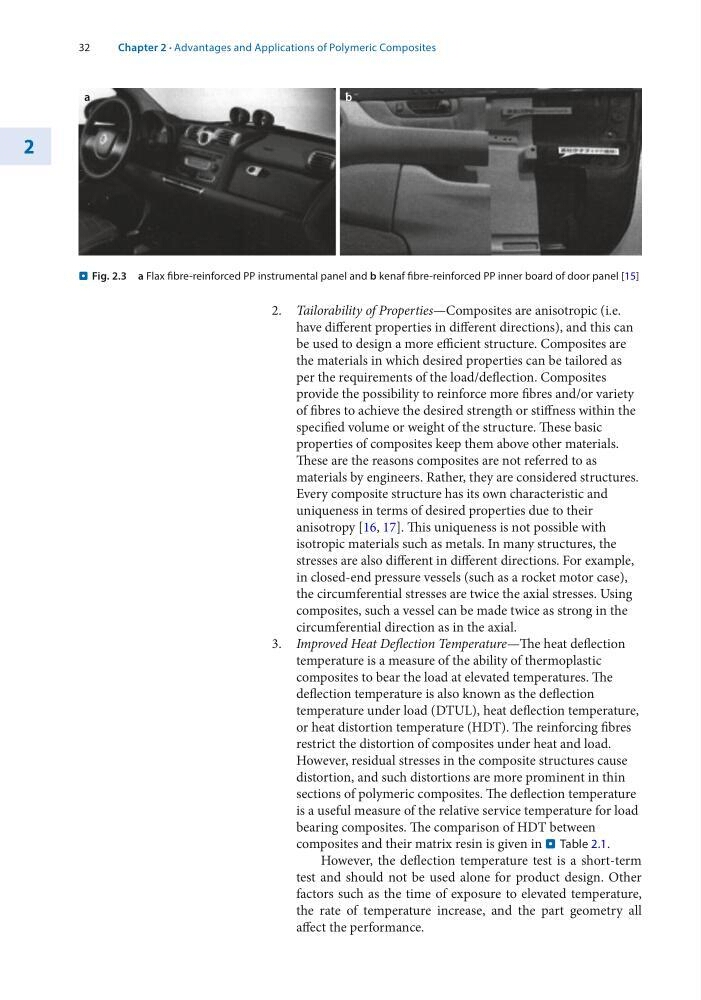
. Fig. 2.3 a Flax fibre-reinforced PP instrumental panel and b kenaf fibre-reinforced PP inner board of door panel [15]
Chapter 2 · Advantages and Applications of Polymeric Composites
2
2. Tailorability of Properties—Composites are anisotropic (i.e.
have different properties in different directions), and this can
be used to design a more efficient structure. Composites are
the materials in which desired properties can be tailored as
per the requirements of the load/deflection. Composites
provide the possibility to reinforce more fibres and/or variety
of fibres to achieve the desired strength or stiffness within the
specified volume or weight of the structure. These basic
properties of composites keep them above other materials.
These are the reasons composites are not referred to as
materials by engineers. Rather, they are considered structures.
Every composite structure has its own characteristic and
uniqueness in terms of desired properties due to their
anisotropy [16, 17]. This uniqueness is not possible with
isotropic materials such as metals. In many structures, the
stresses are also different in different directions. For example,
in closed-end pressure vessels (such as a rocket motor case),
the circumferential stresses are twice the axial stresses. Using
composites, such a vessel can be made twice as strong in the
circumferential direction as in the axial.
3. Improved Heat Deflection Temperature—The heat deflection
temperature is a measure of the ability of thermoplastic
composites to bear the load at elevated temperatures. The
deflection temperature is also known as the deflection
temperature under load (DTUL), heat deflection temperature,
or heat distortion temperature (HDT). The reinforcing fibres
restrict the distortion of composites under heat and load.
However, residual stresses in the composite structures cause
distortion, and such distortions are more prominent in thin
sections of polymeric composites. The deflection temperature
is a useful measure of the relative service temperature for load
bearing composites. The comparison of HDT between
composites and their matrix resin is given in . Table 2.1.
However, the deflection temperature test is a short-term
test and should not be used alone for product design. Other
factors such as the time of exposure to elevated temperature,
the rate of temperature increase, and the part geometry all
affect the performance.
a
b
. Fig. 2.3 a Flax fibre-reinforced PP instrumental panel and b kenaf fibre-reinforced PP inner board of door panel [15]
Chapter 2 · Advantages and Applications of Polymeric Composites