

31
2
Less weight in the composite structure for automobiles and
aircrafts means better fuel efficiency. Fuselage and airframes of
modern airplanes (such as the Boeing 787 Dreamliner, B-52
bomber, etc.) are built using carbon fibre-reinforced epoxy composites. In automotive industries, natural fibre-reinforced composites (NFRC) are also becoming popular. Mercedes Benz S class
is using 27 parts made out of NFRC. Flax fibre-reinforced PP
instrumental panel is shown in . Fig. 2.3a. Even cotton fibrereinforced composites also are being used in automotive industries. In the Toyota Lexus and Camry Mark X, kenaf
fibre-reinforced PP is used in the inner board of door panels, as
shown in . Fig. 2.3b. This has reduced the weight of door panels
by 20%.
2000
1800
1600
1400
1200
1000
800
600
400
200
0
Woods
ALAlloys
Titanium
Steels
E-Glass composites
S-Glass composites
Aramid composites
HS Carbon composites
IM Carbon composites
Woods
Tensile Modulus (MPa)
Speciic Tensile Strength
ALAlloys
Titanium
Steels
E-Glass composites
S-Glass composites
Aramid composites
HS Carbon composites
IM Carbon composites
2800
2400
2000
1600
1200
800
400
0
a
b
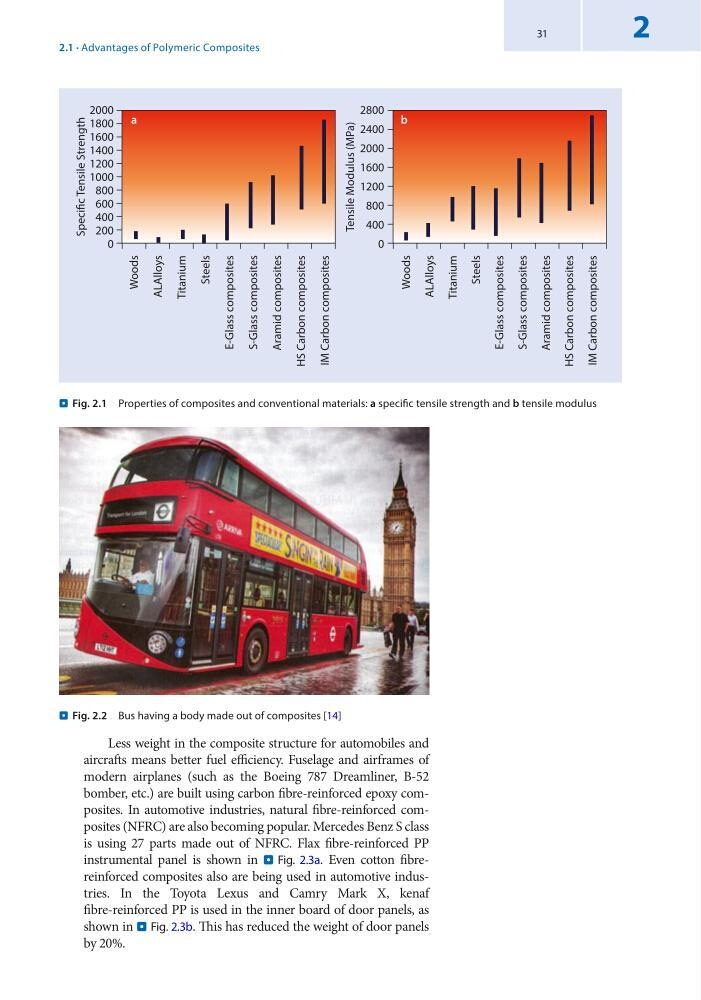
. Fig. 2.1 Properties of composites and conventional materials: a specific tensile strength and b tensile modulus
. Fig. 2.2 Bus having a body made out of composites [14]
2.1 · Advantages of Polymeric Composites
2
Less weight in the composite structure for automobiles and
aircrafts means better fuel efficiency. Fuselage and airframes of
modern airplanes (such as the Boeing 787 Dreamliner, B-52
bomber, etc.) are built using carbon fibre-reinforced epoxy composites. In automotive industries, natural fibre-reinforced composites (NFRC) are also becoming popular. Mercedes Benz S class
is using 27 parts made out of NFRC. Flax fibre-reinforced PP
instrumental panel is shown in . Fig. 2.3a. Even cotton fibrereinforced composites also are being used in automotive industries. In the Toyota Lexus and Camry Mark X, kenaf
fibre-reinforced PP is used in the inner board of door panels, as
shown in . Fig. 2.3b. This has reduced the weight of door panels
by 20%.
2000
1800
1600
1400
1200
1000
800
600
400
200
0
Woods
ALAlloys
Titanium
Steels
E-Glass composites
S-Glass composites
Aramid composites
HS Carbon composites
IM Carbon composites
Woods
Tensile Modulus (MPa)
Speciic Tensile Strength
ALAlloys
Titanium
Steels
E-Glass composites
S-Glass composites
Aramid composites
HS Carbon composites
IM Carbon composites
2800
2400
2000
1600
1200
800
400
0
a
b
. Fig. 2.1 Properties of composites and conventional materials: a specific tensile strength and b tensile modulus
. Fig. 2.2 Bus having a body made out of composites [14]
2.1 · Advantages of Polymeric Composites