

23
1
It is to be noted that most composites are susceptible to ignition.
This results in a flame spreading and the generation of heat and
toxic smoke. The reinforcing fibres retard the combustibility of
composites using the reinforcement of non-combustible fibres
(such as glass fibre). The fibres act as separating agents for the resin,
thus restricting the amount of polymer available to fuel the fire.
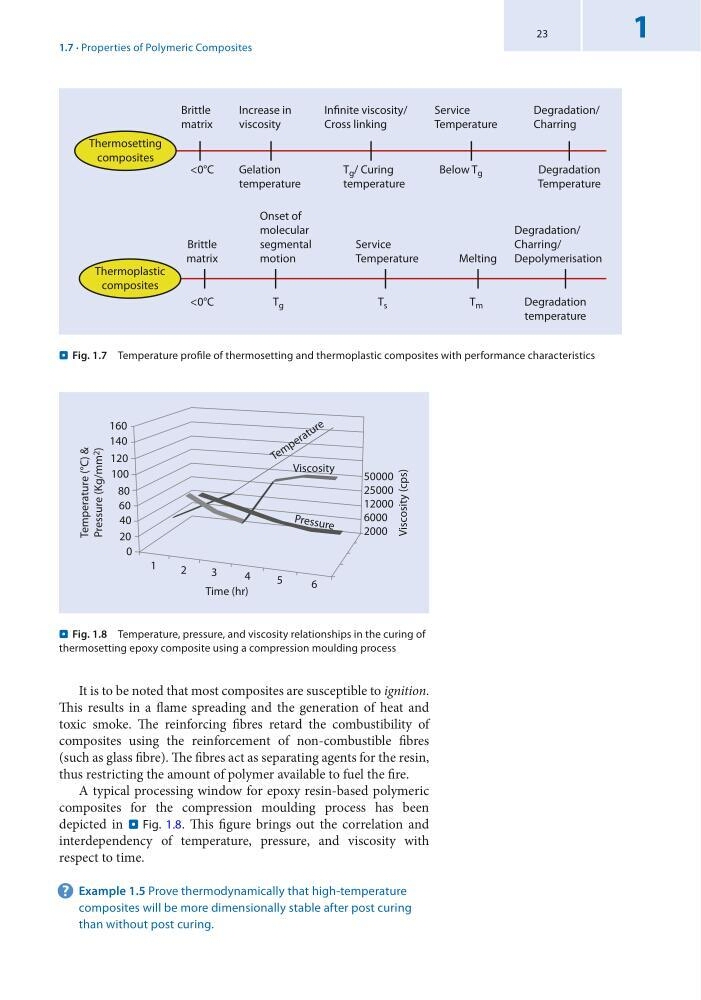
A typical processing window for epoxy resin-based polymeric
composites for the compression moulding process has been
depicted in . Fig. 1.8. This figure brings out the correlation and
interdependency of temperature, pressure, and viscosity with
respect to time.
? Example 1.5 Prove thermodynamically that high-temperature
composites will be more dimensionally stable after post curing
than without post curing.
Thermosetting
composites
Thermoplastic
composites
Service
Temperature
Degradation/
Charring/
Depolymerisation
Degradation
temperature
Degradation
Temperature
Degradation/
Charring
Service
Temperature
Innnite viscosity/
Cross linking
Increase in
viscosity
Gelation
temperature
T g / Curing
temperature
Below T g
T m
T s
T g
<0°C
<0°C
Melting
Brittle
matrix
Brittle
matrix
Onset of
molecular
segmental
motion
. Fig. 1.7 Temperature profile of thermosetting and thermoplastic composites with performance characteristics
50000
25000
12000
6000
2000
0
1
2
3
Time (hr)
Pr es su re
4
5
Viscosity
T e m p e r a t u r e
6
20
40
60
80
100
120
140
160
Viscosity (cps)
Temperature (°C) &
Pressure (Kg/mm 2
)
. Fig. 1.8 Temperature, pressure, and viscosity relationships in the curing of
thermosetting epoxy composite using a compression moulding process
1.7 · Properties of Polymeric Composites
1
It is to be noted that most composites are susceptible to ignition.
This results in a flame spreading and the generation of heat and
toxic smoke. The reinforcing fibres retard the combustibility of
composites using the reinforcement of non-combustible fibres
(such as glass fibre). The fibres act as separating agents for the resin,
thus restricting the amount of polymer available to fuel the fire.
A typical processing window for epoxy resin-based polymeric
composites for the compression moulding process has been
depicted in . Fig. 1.8. This figure brings out the correlation and
interdependency of temperature, pressure, and viscosity with
respect to time.
? Example 1.5 Prove thermodynamically that high-temperature
composites will be more dimensionally stable after post curing
than without post curing.
Thermosetting
composites
Thermoplastic
composites
Service
Temperature
Degradation/
Charring/
Depolymerisation
Degradation
temperature
Degradation
Temperature
Degradation/
Charring
Service
Temperature
Innnite viscosity/
Cross linking
Increase in
viscosity
Gelation
temperature
T g / Curing
temperature
Below T g
T m
T s
T g
<0°C
<0°C
Melting
Brittle
matrix
Brittle
matrix
Onset of
molecular
segmental
motion
. Fig. 1.7 Temperature profile of thermosetting and thermoplastic composites with performance characteristics
50000
25000
12000
6000
2000
0
1
2
3
Time (hr)
Pr es su re
4
5
Viscosity
T e m p e r a t u r e
6
20
40
60
80
100
120
140
160
Viscosity (cps)
Temperature (°C) &
Pressure (Kg/mm 2
)
. Fig. 1.8 Temperature, pressure, and viscosity relationships in the curing of
thermosetting epoxy composite using a compression moulding process
1.7 · Properties of Polymeric Composites