

22
1
tion. The thermal conduction behaviour of composites having
cylindrically orthotropic fibre and an isotropic matrix is fully characterized by the values of its in-plane and through-thickness thermal conductivity [18].
When thermosetting polymers are heated, they will pass
through a glass transition temperature, T g , and eventually thermal
decomposition will occur. The properties of thermosetting polymers used in composites are influenced by a high temperature.
Therefore, above T g , the matrix will soften, and the composite experiences a reduction in both modulus and strength. In addition, susceptibility to moisture absorption in the thermosetting matrices is
high due to microporosity. As a result, composites are used at temperatures below T g of the polymer matrix. Thermal decomposition
is induced by oxidation. The most common matrix resins are epoxy
resins. Epoxies are generally stable up to their T g , which is 150–
180 °C. Oxidation can lead to a change of colour and microcracks.
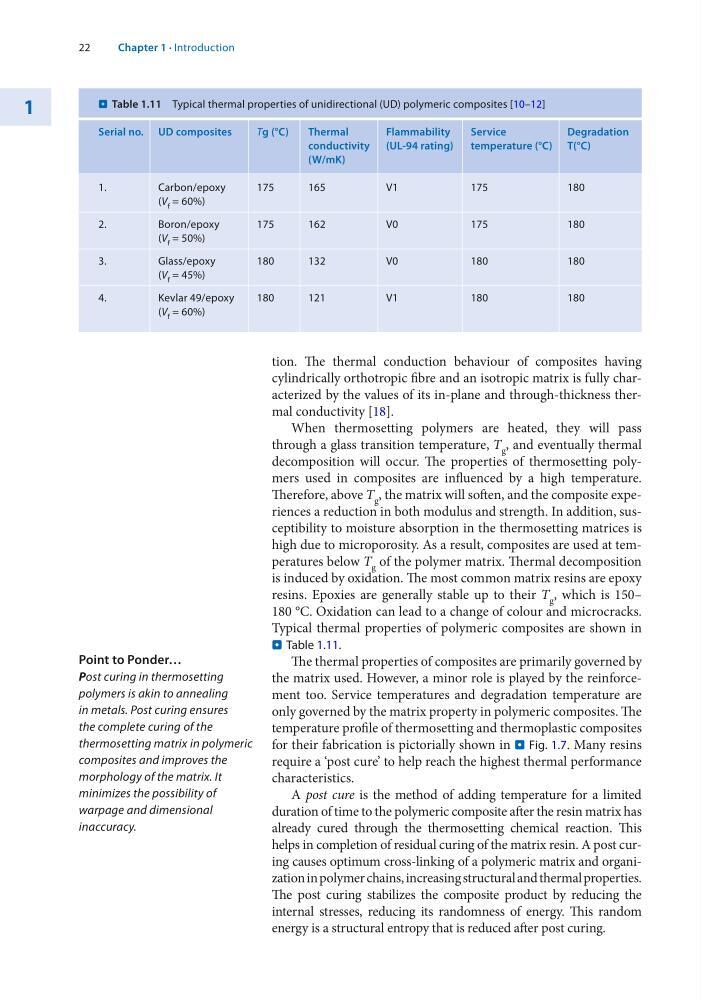
Typical thermal properties of polymeric composites are shown in
. Table 1.11.
The thermal properties of composites are primarily governed by
the matrix used. However, a minor role is played by the reinforcement too. Service temperatures and degradation temperature are
only governed by the matrix property in polymeric composites. The
temperature profile of thermosetting and thermoplastic composites
for their fabrication is pictorially shown in . Fig. 1.7. Many resins
require a ‘post cure’ to help reach the highest thermal performance
characteristics.
A post cure is the method of adding temperature for a limited
duration of time to the polymeric composite after the resin matrix has
already cured through the thermosetting chemical reaction. This
helps in completion of residual curing of the matrix resin. A post curing causes optimum cross-linking of a polymeric matrix and organization in polymer chains, increasing structural and thermal properties.
The post curing stabilizes the composite product by reducing the
internal stresses, reducing its randomness of energy. This random
energy is a structural entropy that is reduced after post curing.
Point to Ponder…
Post curing in thermosetting
polymers is akin to annealing
in metals. Post curing ensures
the complete curing of the
thermosetting matrix in polymeric
composites and improves the
morphology of the matrix. It
minimizes the possibility of
warpage and dimensional
inaccuracy.
. Table 1.11 Typical thermal properties of unidirectional (UD) polymeric composites [10–12]
Serial no. UD composites
Tg (°C)
Thermal
conductivity
(W/mK)
Flammability
(UL-94 rating)
Service
temperature (°C)
Degradation
T(°C)
1.
Carbon/epoxy
(V f = 60%)
175
165
V1
175
180
2.
Boron/epoxy
(V f = 50%)
175
162
V0
175
180
3.
Glass/epoxy
(V f = 45%)
180
132
V0
180
180
4.
Kevlar 49/epoxy
(V f = 60%)
180
121
V1
180
180
Chapter 1 · Introduction
1
tion. The thermal conduction behaviour of composites having
cylindrically orthotropic fibre and an isotropic matrix is fully characterized by the values of its in-plane and through-thickness thermal conductivity [18].
When thermosetting polymers are heated, they will pass
through a glass transition temperature, T g , and eventually thermal
decomposition will occur. The properties of thermosetting polymers used in composites are influenced by a high temperature.
Therefore, above T g , the matrix will soften, and the composite experiences a reduction in both modulus and strength. In addition, susceptibility to moisture absorption in the thermosetting matrices is
high due to microporosity. As a result, composites are used at temperatures below T g of the polymer matrix. Thermal decomposition
is induced by oxidation. The most common matrix resins are epoxy
resins. Epoxies are generally stable up to their T g , which is 150–
180 °C. Oxidation can lead to a change of colour and microcracks.
Typical thermal properties of polymeric composites are shown in
. Table 1.11.
The thermal properties of composites are primarily governed by
the matrix used. However, a minor role is played by the reinforcement too. Service temperatures and degradation temperature are
only governed by the matrix property in polymeric composites. The
temperature profile of thermosetting and thermoplastic composites
for their fabrication is pictorially shown in . Fig. 1.7. Many resins
require a ‘post cure’ to help reach the highest thermal performance
characteristics.
A post cure is the method of adding temperature for a limited
duration of time to the polymeric composite after the resin matrix has
already cured through the thermosetting chemical reaction. This
helps in completion of residual curing of the matrix resin. A post curing causes optimum cross-linking of a polymeric matrix and organization in polymer chains, increasing structural and thermal properties.
The post curing stabilizes the composite product by reducing the
internal stresses, reducing its randomness of energy. This random
energy is a structural entropy that is reduced after post curing.
Point to Ponder…
Post curing in thermosetting
polymers is akin to annealing
in metals. Post curing ensures
the complete curing of the
thermosetting matrix in polymeric
composites and improves the
morphology of the matrix. It
minimizes the possibility of
warpage and dimensional
inaccuracy.
. Table 1.11 Typical thermal properties of unidirectional (UD) polymeric composites [10–12]
Serial no. UD composites
Tg (°C)
Thermal
conductivity
(W/mK)
Flammability
(UL-94 rating)
Service
temperature (°C)
Degradation
T(°C)
1.
Carbon/epoxy
(V f = 60%)
175
165
V1
175
180
2.
Boron/epoxy
(V f = 50%)
175
162
V0
175
180
3.
Glass/epoxy
(V f = 45%)
180
132
V0
180
180
4.
Kevlar 49/epoxy
(V f = 60%)
180
121
V1
180
180
Chapter 1 · Introduction