

20
1
6. Impart rigidity to the composite product
7. Provide a surface for adhesive bonding or mechanical fastening
8. Provide a machineable surface
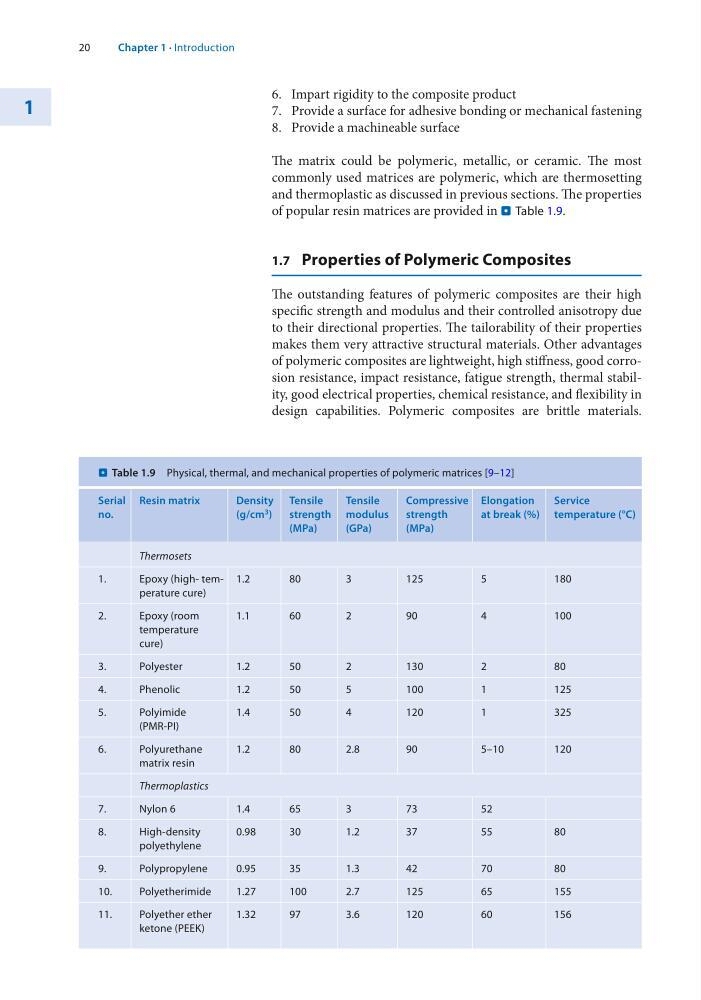
The matrix could be polymeric, metallic, or ceramic. The most
commonly used matrices are polymeric, which are thermosetting
and thermoplastic as discussed in previous sections. The properties
of popular resin matrices are provided in . Table 1.9.
1.7 Properties of Polymeric Composites
The outstanding features of polymeric composites are their high
specific strength and modulus and their controlled anisotropy due
to their directional properties. The tailorability of their properties
makes them very attractive structural materials. Other advantages
of polymeric composites are lightweight, high stiffness, good corrosion resistance, impact resistance, fatigue strength, thermal stability, good electrical properties, chemical resistance, and flexibility in
design capabilities. Polymeric composites are brittle materials.
. Table 1.9 Physical, thermal, and mechanical properties of polymeric matrices [9–12]
Serial
no.
Resin matrix
Density
(g/cm 3 )
Tensile
strength
(MPa)
Tensile
modulus
(GPa)
Compressive
strength
(MPa)
Elongation
at break (%)
Service
temperature (°C)
Thermosets
1.
Epoxy (high- temperature cure)
1.2
80
3
125
5
180
2.
Epoxy (room
temperature
cure)
1.1
60
2
90
4
100
3.
Polyester
1.2
50
2
130
2
80
4.
Phenolic
1.2
50
5
100
1
125
5.
Polyimide
(PMR-PI)
1.4
50
4
120
1
325
6.
Polyurethane
matrix resin
1.2
80
2.8
90
5–10
120
Thermoplastics
7.
Nylon 6
1.4
65
3
73
52
8.
High-density
polyethylene
0.98
30
1.2
37
55
80
9.
Polypropylene
0.95
35
1.3
42
70
80
10.
Polyetherimide
1.27
100
2.7
125
65
155
11.
Polyether ether
ketone (PEEK)
1.32
97
3.6
120
60
156
Chapter 1 · Introduction
1
6. Impart rigidity to the composite product
7. Provide a surface for adhesive bonding or mechanical fastening
8. Provide a machineable surface
The matrix could be polymeric, metallic, or ceramic. The most
commonly used matrices are polymeric, which are thermosetting
and thermoplastic as discussed in previous sections. The properties
of popular resin matrices are provided in . Table 1.9.
1.7 Properties of Polymeric Composites
The outstanding features of polymeric composites are their high
specific strength and modulus and their controlled anisotropy due
to their directional properties. The tailorability of their properties
makes them very attractive structural materials. Other advantages
of polymeric composites are lightweight, high stiffness, good corrosion resistance, impact resistance, fatigue strength, thermal stability, good electrical properties, chemical resistance, and flexibility in
design capabilities. Polymeric composites are brittle materials.
. Table 1.9 Physical, thermal, and mechanical properties of polymeric matrices [9–12]
Serial
no.
Resin matrix
Density
(g/cm 3 )
Tensile
strength
(MPa)
Tensile
modulus
(GPa)
Compressive
strength
(MPa)
Elongation
at break (%)
Service
temperature (°C)
Thermosets
1.
Epoxy (high- temperature cure)
1.2
80
3
125
5
180
2.
Epoxy (room
temperature
cure)
1.1
60
2
90
4
100
3.
Polyester
1.2
50
2
130
2
80
4.
Phenolic
1.2
50
5
100
1
125
5.
Polyimide
(PMR-PI)
1.4
50
4
120
1
325
6.
Polyurethane
matrix resin
1.2
80
2.8
90
5–10
120
Thermoplastics
7.
Nylon 6
1.4
65
3
73
52
8.
High-density
polyethylene
0.98
30
1.2
37
55
80
9.
Polypropylene
0.95
35
1.3
42
70
80
10.
Polyetherimide
1.27
100
2.7
125
65
155
11.
Polyether ether
ketone (PEEK)
1.32
97
3.6
120
60
156
Chapter 1 · Introduction