

260
9
covalent bond); therefore, the energy required to cause this
movement is much higher. For example, T g of a thermosetting polyester such as vinyl ester resin is 180 °C, whereas T g of thermoplastic
polyester such as polybutylene terephthalate (PBT)) is 66 °C. The
presence of covalent bonds makes the cross-linked network in a
thermosetting matrix. This makes T g of a thermosetting matrix
equal to its curing temperature. This is the precisely the reason that
T g in a thermosetting resin is high and merged with the curing temperature. The mechanism of thermal degradation remains same, as
discussed previously for thermoplastic matrices.
9.5.2 Processability in Structure–Thermal
Property Relationship
The processability of polymeric composites influences the structure
and thermal property relationship. The reinforcement causes a
physical barrier to the translational movement of the matrix; therefore, it affects its glass transition tempeature (T g ) , melt properties,
and thermal degradation. The reactivity of the reinforcement and
matrices along with interphase has a profound effect on translational movement too. The interphase influences the performance of
secondary bonds in thermoplastic matrices and the performance of
covalent bonds in thermosetting matrices. The thermal behaviour
of the matrix changes in the presence of reinforcement.
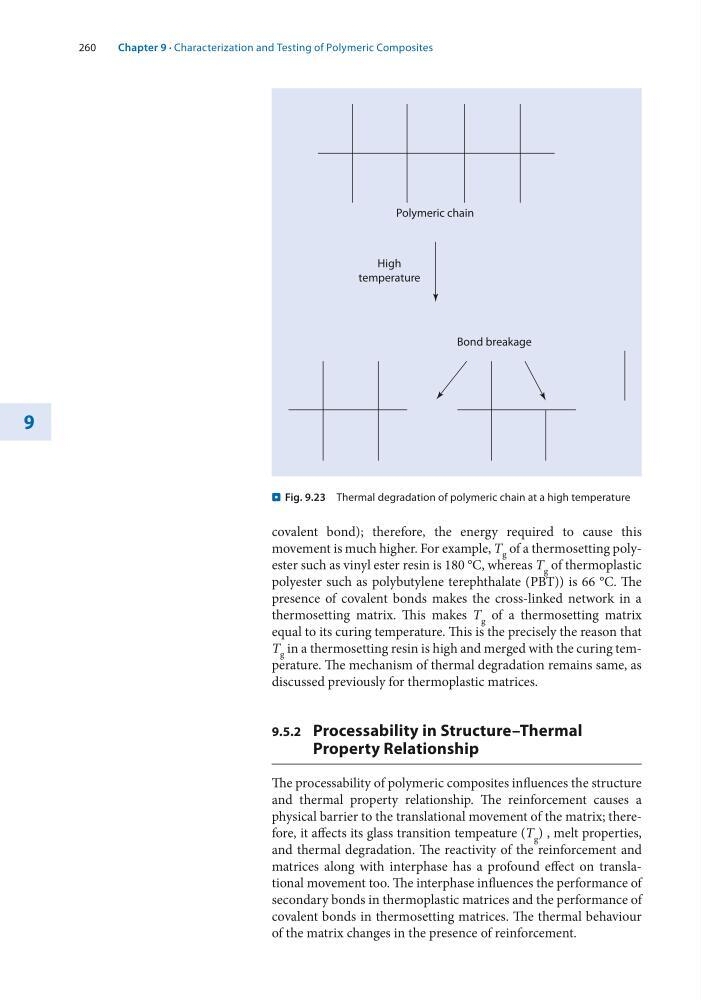
Polymeric chain
High
temperature
Bond breakage
. Fig. 9.23 Thermal degradation of polymeric chain at a high temperature
Chapter 9 · Characterization and Testing of Polymeric Composites
9
covalent bond); therefore, the energy required to cause this
movement is much higher. For example, T g of a thermosetting polyester such as vinyl ester resin is 180 °C, whereas T g of thermoplastic
polyester such as polybutylene terephthalate (PBT)) is 66 °C. The
presence of covalent bonds makes the cross-linked network in a
thermosetting matrix. This makes T g of a thermosetting matrix
equal to its curing temperature. This is the precisely the reason that
T g in a thermosetting resin is high and merged with the curing temperature. The mechanism of thermal degradation remains same, as
discussed previously for thermoplastic matrices.
9.5.2 Processability in Structure–Thermal
Property Relationship
The processability of polymeric composites influences the structure
and thermal property relationship. The reinforcement causes a
physical barrier to the translational movement of the matrix; therefore, it affects its glass transition tempeature (T g ) , melt properties,
and thermal degradation. The reactivity of the reinforcement and
matrices along with interphase has a profound effect on translational movement too. The interphase influences the performance of
secondary bonds in thermoplastic matrices and the performance of
covalent bonds in thermosetting matrices. The thermal behaviour
of the matrix changes in the presence of reinforcement.
Polymeric chain
High
temperature
Bond breakage
. Fig. 9.23 Thermal degradation of polymeric chain at a high temperature
Chapter 9 · Characterization and Testing of Polymeric Composites