

259
9
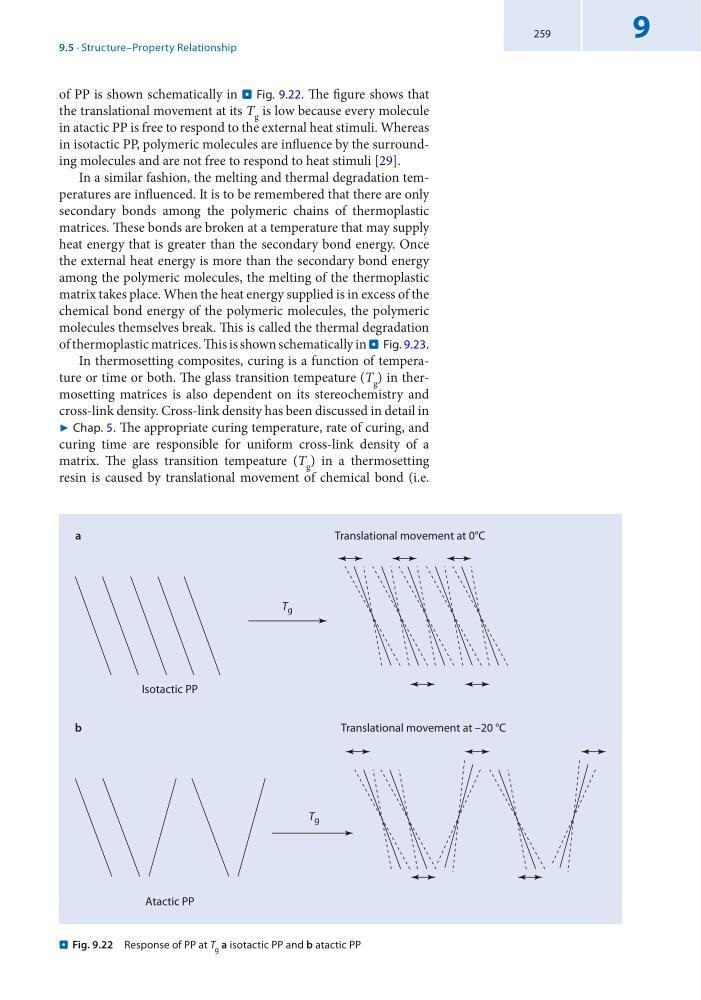
of PP is shown schematically in . Fig. 9.22. The figure shows that
the translational movement at its T g is low because every molecule
in atactic PP is free to respond to the external heat stimuli. Whereas
in isotactic PP, polymeric molecules are influence by the surrounding molecules and are not free to respond to heat stimuli [29].
In a similar fashion, the melting and thermal degradation temperatures are influenced. It is to be remembered that there are only
secondary bonds among the polymeric chains of thermoplastic
matrices. These bonds are broken at a temperature that may supply
heat energy that is greater than the secondary bond energy. Once
the external heat energy is more than the secondary bond energy
among the polymeric molecules, the melting of the thermoplastic
matrix takes place. When the heat energy supplied is in excess of the
chemical bond energy of the polymeric molecules, the polymeric
molecules themselves break. This is called the thermal degradation
of thermoplastic matrices. This is shown schematically in . Fig. 9.23.
In thermosetting composites, curing is a function of temperature or time or both. The glass transition tempeature (T g ) in thermosetting matrices is also dependent on its stereochemistry and
cross-link density. Cross-link density has been discussed in detail in
7 Chap. 5. The appropriate curing temperature, rate of curing, and
curing time are responsible for uniform cross-link density of a
matrix. The glass transition tempeature (T g ) in a thermosetting
resin is caused by translational movement of chemical bond (i.e.
Isotactic PP
Translational movement at 0°C
Translational movement at –20 °C
a
b
T g
T g
Atactic PP
. Fig. 9.22 Response of PP at T g a isotactic PP and b atactic PP
9.5 · Structure–Property Relationship
9
of PP is shown schematically in . Fig. 9.22. The figure shows that
the translational movement at its T g is low because every molecule
in atactic PP is free to respond to the external heat stimuli. Whereas
in isotactic PP, polymeric molecules are influence by the surrounding molecules and are not free to respond to heat stimuli [29].
In a similar fashion, the melting and thermal degradation temperatures are influenced. It is to be remembered that there are only
secondary bonds among the polymeric chains of thermoplastic
matrices. These bonds are broken at a temperature that may supply
heat energy that is greater than the secondary bond energy. Once
the external heat energy is more than the secondary bond energy
among the polymeric molecules, the melting of the thermoplastic
matrix takes place. When the heat energy supplied is in excess of the
chemical bond energy of the polymeric molecules, the polymeric
molecules themselves break. This is called the thermal degradation
of thermoplastic matrices. This is shown schematically in . Fig. 9.23.
In thermosetting composites, curing is a function of temperature or time or both. The glass transition tempeature (T g ) in thermosetting matrices is also dependent on its stereochemistry and
cross-link density. Cross-link density has been discussed in detail in
7 Chap. 5. The appropriate curing temperature, rate of curing, and
curing time are responsible for uniform cross-link density of a
matrix. The glass transition tempeature (T g ) in a thermosetting
resin is caused by translational movement of chemical bond (i.e.
Isotactic PP
Translational movement at 0°C
Translational movement at –20 °C
a
b
T g
T g
Atactic PP
. Fig. 9.22 Response of PP at T g a isotactic PP and b atactic PP
9.5 · Structure–Property Relationship