

232
9
absorbed or released heat is recorded in the form of peaks with
reference to temperature in the DSC thermogram. The samples
are usually prepared in the weight range of 5–7 mg. The test
may be carried out from –170 °C to as high as 800 °C. The
results are obtained in the form of heat flow (mcal/sec) and
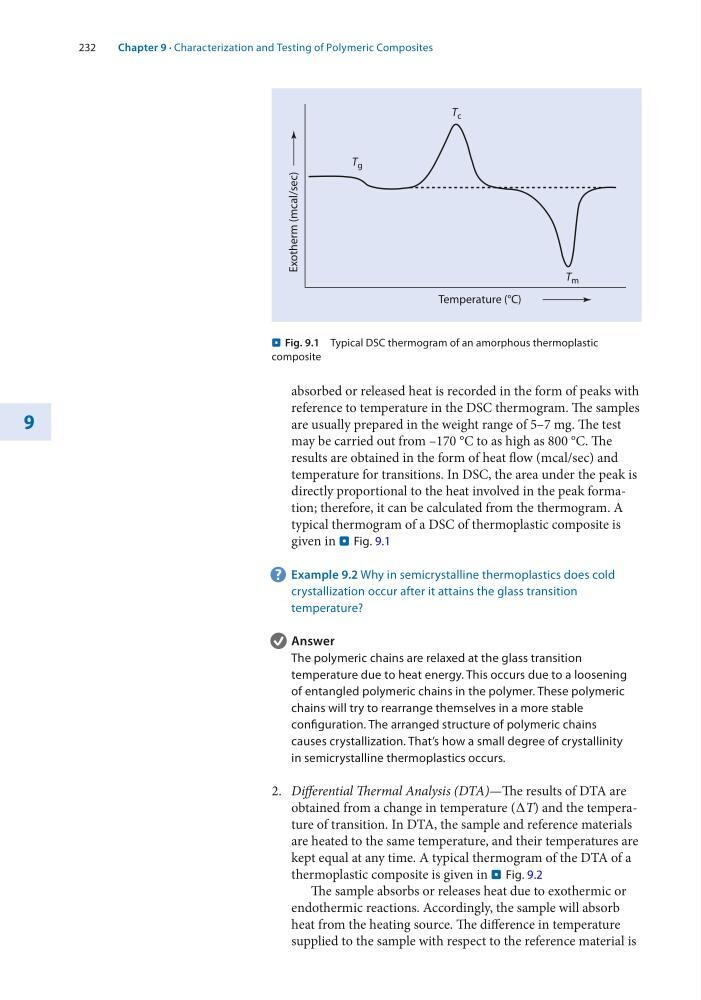
temperature for transitions. In DSC, the area under the peak is
directly proportional to the heat involved in the peak formation; therefore, it can be calculated from the thermogram. A
typical thermogram of a DSC of thermoplastic composite is
given in . Fig. 9.1
? Example 9.2 Why in semicrystalline thermoplastics does cold
crystallization occur after it attains the glass transition
temperature?
v Answer
The polymeric chains are relaxed at the glass transition
temperature due to heat energy. This occurs due to a loosening
of entangled polymeric chains in the polymer. These polymeric
chains will try to rearrange themselves in a more stable
configuration. The arranged structure of polymeric chains
causes crystallization. That’s how a small degree of crystallinity
in semicrystalline thermoplastics occurs.
2. Differential Thermal Analysis (DTA)—The results of DTA are
obtained from a change in temperature (∆T) and the temperature of transition. In DTA, the sample and reference materials
are heated to the same temperature, and their temperatures are
kept equal at any time. A typical thermogram of the DTA of a
thermoplastic composite is given in . Fig. 9.2
The sample absorbs or releases heat due to exothermic or
endothermic reactions. Accordingly, the sample will absorb
heat from the heating source. The difference in temperature
supplied to the sample with respect to the reference material is
T m
T g
T c
Temperature (°C)
Exotherm (mcal/sec)
. Fig. 9.1 Typical DSC thermogram of an amorphous thermoplastic
composite
Chapter 9 · Characterization and Testing of Polymeric Composites
9
absorbed or released heat is recorded in the form of peaks with
reference to temperature in the DSC thermogram. The samples
are usually prepared in the weight range of 5–7 mg. The test
may be carried out from –170 °C to as high as 800 °C. The
results are obtained in the form of heat flow (mcal/sec) and
temperature for transitions. In DSC, the area under the peak is
directly proportional to the heat involved in the peak formation; therefore, it can be calculated from the thermogram. A
typical thermogram of a DSC of thermoplastic composite is
given in . Fig. 9.1
? Example 9.2 Why in semicrystalline thermoplastics does cold
crystallization occur after it attains the glass transition
temperature?
v Answer
The polymeric chains are relaxed at the glass transition
temperature due to heat energy. This occurs due to a loosening
of entangled polymeric chains in the polymer. These polymeric
chains will try to rearrange themselves in a more stable
configuration. The arranged structure of polymeric chains
causes crystallization. That’s how a small degree of crystallinity
in semicrystalline thermoplastics occurs.
2. Differential Thermal Analysis (DTA)—The results of DTA are
obtained from a change in temperature (∆T) and the temperature of transition. In DTA, the sample and reference materials
are heated to the same temperature, and their temperatures are
kept equal at any time. A typical thermogram of the DTA of a
thermoplastic composite is given in . Fig. 9.2
The sample absorbs or releases heat due to exothermic or
endothermic reactions. Accordingly, the sample will absorb
heat from the heating source. The difference in temperature
supplied to the sample with respect to the reference material is
T m
T g
T c
Temperature (°C)
Exotherm (mcal/sec)
. Fig. 9.1 Typical DSC thermogram of an amorphous thermoplastic
composite
Chapter 9 · Characterization and Testing of Polymeric Composites