

12
1
persed phase. Ceramic matrix composites improve the fracture
toughness of ceramics by reinforcing soft ceramic fibres in a hard
and brittle ceramic matrix. In CMC, carbon, alumina, silicon carbide, etc. are reinforced in glass, glass ceramic, oxide ceramic, and
other matrices. Among various techniques for their processing,
slurry infiltration followed by sintering is the most common processing method for CMCs. In this technique, fibre is drawn
through a slurry of ceramic, thereby coating the fibre with ceramic.
This ceramic- coated fibre is dried to make a ceramic-coated fibre
prepreg. This prepreg is placed in the mould and sintered at a high
temperature to get CMC. The prepregging of fibres is easily processable; however, the prepregging of fabrics is difficult for CMCs.
Other technologies for making CMCs are the sol–gel process, in
situ chemical reactions, polymer pyrolysis (which yields carbon–
carbon composites), etc. Examples of these are silicon carbide
fibre-reinforced silica composites, boron nitride fibre-reinforced
silica composites, etc.
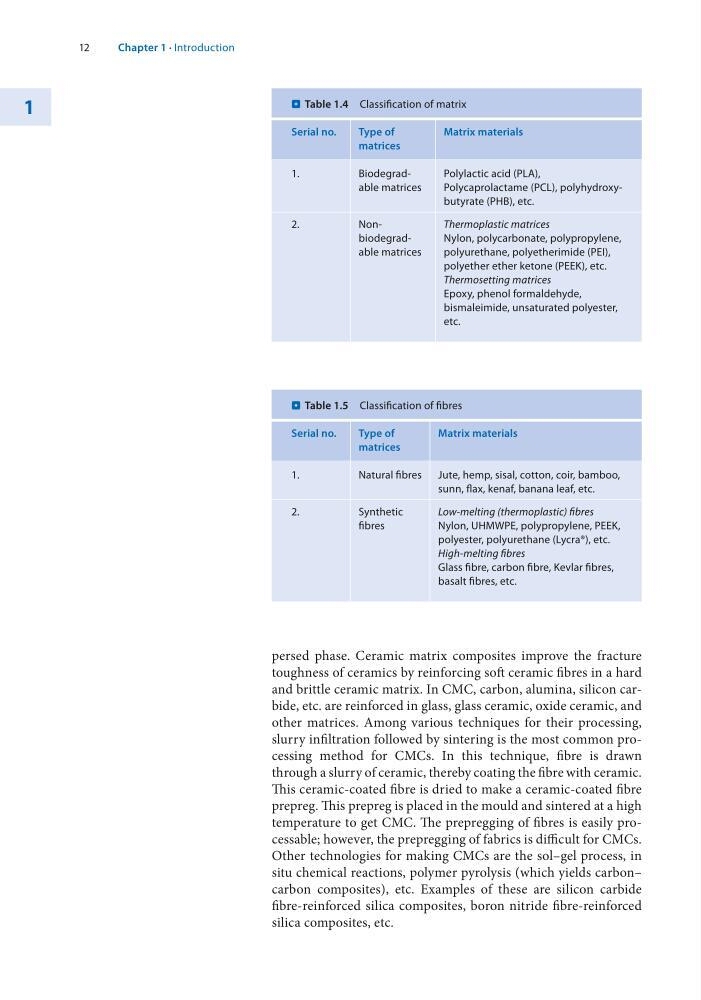
. Table 1.4 Classification of matrix
Serial no.
Type of
matrices
Matrix materials
1.
Biodegradable matrices
Polylactic acid (PLA),
Polycaprolactame (PCL), polyhydroxybutyrate (PHB), etc.
2.
biodegradable matrices
Thermoplastic matrices
Nylon, polycarbonate, polypropylene,
polyurethane, polyetherimide (PEI),
polyether ether ketone (PEEK), etc.
Thermosetting matrices
Epoxy, phenol formaldehyde,
bismaleimide, unsaturated polyester,
etc.
. Table 1.5 Classification of fibres
Serial no.
Type of
matrices
Matrix materials
1.
Natural fibres Jute, hemp, sisal, cotton, coir, bamboo,
sunn, flax, kenaf, banana leaf, etc.
2.
Synthetic
fibres
Low-melting (thermoplastic) fibres
Nylon, UHMWPE, polypropylene, PEEK,
polyester, polyurethane (Lycra®), etc.
High-melting fibres
Glass fibre, carbon fibre, Kevlar fibres,
basalt fibres, etc.
Chapter 1 · Introduction
1
persed phase. Ceramic matrix composites improve the fracture
toughness of ceramics by reinforcing soft ceramic fibres in a hard
and brittle ceramic matrix. In CMC, carbon, alumina, silicon carbide, etc. are reinforced in glass, glass ceramic, oxide ceramic, and
other matrices. Among various techniques for their processing,
slurry infiltration followed by sintering is the most common processing method for CMCs. In this technique, fibre is drawn
through a slurry of ceramic, thereby coating the fibre with ceramic.
This ceramic- coated fibre is dried to make a ceramic-coated fibre
prepreg. This prepreg is placed in the mould and sintered at a high
temperature to get CMC. The prepregging of fibres is easily processable; however, the prepregging of fabrics is difficult for CMCs.
Other technologies for making CMCs are the sol–gel process, in
situ chemical reactions, polymer pyrolysis (which yields carbon–
carbon composites), etc. Examples of these are silicon carbide
fibre-reinforced silica composites, boron nitride fibre-reinforced
silica composites, etc.
. Table 1.4 Classification of matrix
Serial no.
Type of
matrices
Matrix materials
1.
Biodegradable matrices
Polylactic acid (PLA),
Polycaprolactame (PCL), polyhydroxybutyrate (PHB), etc.
2.
biodegradable matrices
Thermoplastic matrices
Nylon, polycarbonate, polypropylene,
polyurethane, polyetherimide (PEI),
polyether ether ketone (PEEK), etc.
Thermosetting matrices
Epoxy, phenol formaldehyde,
bismaleimide, unsaturated polyester,
etc.
. Table 1.5 Classification of fibres
Serial no.
Type of
matrices
Matrix materials
1.
Natural fibres Jute, hemp, sisal, cotton, coir, bamboo,
sunn, flax, kenaf, banana leaf, etc.
2.
Synthetic
fibres
Low-melting (thermoplastic) fibres
Nylon, UHMWPE, polypropylene, PEEK,
polyester, polyurethane (Lycra®), etc.
High-melting fibres
Glass fibre, carbon fibre, Kevlar fibres,
basalt fibres, etc.
Chapter 1 · Introduction