

11
1
1.4.1 Polymeric Matrix Composites (PMCs)
PMCs are established engineering materials and are being widely
used. PMCs are composed of reinforcement and matrix. Matrix is
the continuous phase, and reinforcement is the dispersed phase.
The matrix is classified into non-biodegradable and biodegradable
(green matrices), as given in . Table 1.4.
The reinforcement is classified into natural fibres and synthetic
fibres. There is worldwide interest in green composites using natural reinforcing fibres and biodegradable matrices. Natural fibres
offer a wide range of choices. The diameters of natural fibres are
much higher (jute: 25–200 μm, flax: 40–600 μm, coir: 100–450 μm,
sisal: 50–200 μm, pineapple leaf fibre (PALF): 20–80 μm, etc.) than
synthetice fibres (carbon fibre: 5–8 μm, glass fibre: 8–15 μm, Kevlar
fibre: 8–15 μm, basalt fibre: 9–13 μm, etc.). The classification of
natural fibres and synthetic fibres is provided in . Table 1.5.
The dispersed phase is also known as reinforcing phase, and it is
available in the form of filament, yarn, rovings, tows, fabric, whiskers, tapes, etc. Detailed discussion on PMCs and their processing
are described in the following chapters.
1.4.2 Ceramic Matrix Composites (CMCs)
CMCs are composed of a ceramic matrix using a continuous
phase and embedded fibres of other ceramic material as a disPolymeric Composites
Fibrous Composites
Single layer
M ultilayer
Random
orientation
Random
orientation
Preferred
orientation
Hybrid
Laminates
Continuous
Discontinuous
Short ber
composites
Long ber
composites
Unidirectional
composites
Bidirectional
composites
Preferred
orientation
Particulate Composites
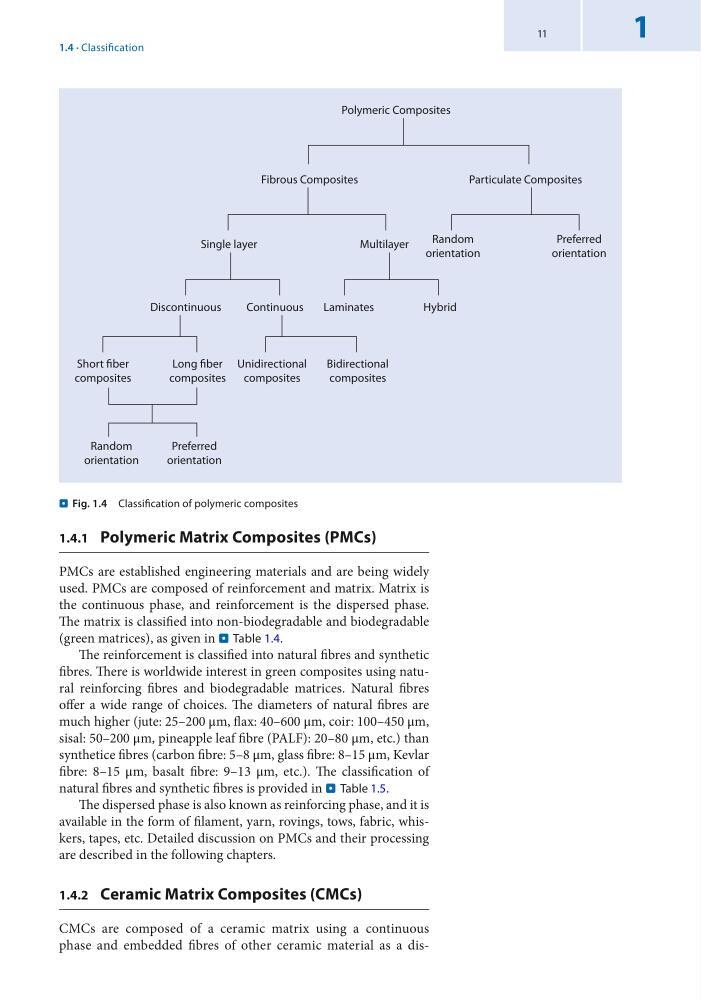
. Fig. 1.4 Classification of polymeric composites
1.4 · Classification
1
1.4.1 Polymeric Matrix Composites (PMCs)
PMCs are established engineering materials and are being widely
used. PMCs are composed of reinforcement and matrix. Matrix is
the continuous phase, and reinforcement is the dispersed phase.
The matrix is classified into non-biodegradable and biodegradable
(green matrices), as given in . Table 1.4.
The reinforcement is classified into natural fibres and synthetic
fibres. There is worldwide interest in green composites using natural reinforcing fibres and biodegradable matrices. Natural fibres
offer a wide range of choices. The diameters of natural fibres are
much higher (jute: 25–200 μm, flax: 40–600 μm, coir: 100–450 μm,
sisal: 50–200 μm, pineapple leaf fibre (PALF): 20–80 μm, etc.) than
synthetice fibres (carbon fibre: 5–8 μm, glass fibre: 8–15 μm, Kevlar
fibre: 8–15 μm, basalt fibre: 9–13 μm, etc.). The classification of
natural fibres and synthetic fibres is provided in . Table 1.5.
The dispersed phase is also known as reinforcing phase, and it is
available in the form of filament, yarn, rovings, tows, fabric, whiskers, tapes, etc. Detailed discussion on PMCs and their processing
are described in the following chapters.
1.4.2 Ceramic Matrix Composites (CMCs)
CMCs are composed of a ceramic matrix using a continuous
phase and embedded fibres of other ceramic material as a disPolymeric Composites
Fibrous Composites
Single layer
M ultilayer
Random
orientation
Random
orientation
Preferred
orientation
Hybrid
Laminates
Continuous
Discontinuous
Short ber
composites
Long ber
composites
Unidirectional
composites
Bidirectional
composites
Preferred
orientation
Particulate Composites
. Fig. 1.4 Classification of polymeric composites
1.4 · Classification