

211
8
(TMC), and wet layup compression moulding. This is a
versatile technology for processing thermosetting as well as
thermoplastic composites using any reinforcement in any size
and shape. Compression moulding tooling consists of heated
metal moulds mounted on a large press.
Moulded materials include those cast of forged steel, iron,
and aluminium. Steel moulds are hardened and sometimes
chrome plated for enhanced durability. The moulds are heated
using steam, hot oil, or electricity. Side cores, provisions for
inserts, and other refinements are often employed.
This process is akin to matched die moulding and necessarily
uses a hydraulic machine for closing and opening the mould.
This process is specifically used for thermoplastic and thermosetting matrices. Short fibres, long fibres, fabrics, or whiskers may be
used as reinforcements in compression moulding. The pressure
requirement in the compression moulding process is high, and
machines are available from 10 ton to 5000 ton hydraulic
pressure and more, depending upon the size of the product. The
quality of composite products coming out of this process is
excellent. Due to the high pressures used, the compaction and
volume fractions of reinforcement and matrix are well controlled.
Compression moulding is the universal moulding processes
in composites, and it allows better control of the processing
parameters. The one drawback of this process is that it is not
suitable for very high production rates. Although multidaylight (the height between the both the platens of hydraulic
machine), hydraulic machines are available, the number of
daylight is limited to six to ten; therefore, the production rate is
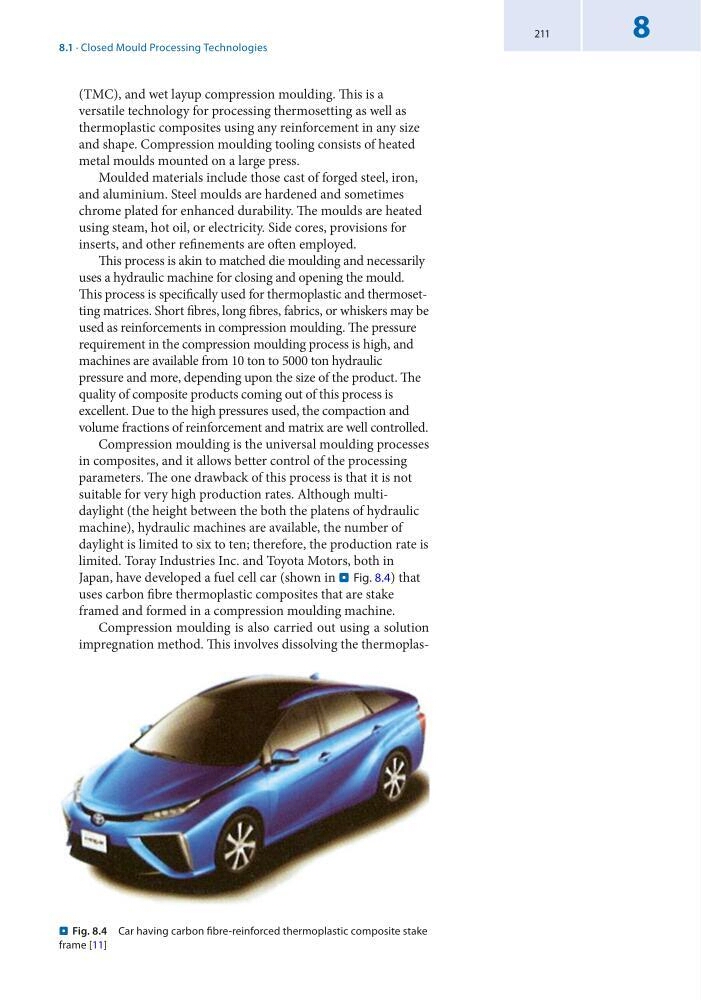
limited. Toray Industries Inc. and Toyota Motors, both in
Japan, have developed a fuel cell car (shown in . Fig. 8.4) that
uses carbon fibre thermoplastic composites that are stake
framed and formed in a compression moulding machine.
Compression moulding is also carried out using a solution
impregnation method. This involves dissolving the thermoplas. Fig. 8.4 Car having carbon fibre-reinforced thermoplastic composite stake
frame [11]
8.1 · Closed Mould Processing Technologies
8
(TMC), and wet layup compression moulding. This is a
versatile technology for processing thermosetting as well as
thermoplastic composites using any reinforcement in any size
and shape. Compression moulding tooling consists of heated
metal moulds mounted on a large press.
Moulded materials include those cast of forged steel, iron,
and aluminium. Steel moulds are hardened and sometimes
chrome plated for enhanced durability. The moulds are heated
using steam, hot oil, or electricity. Side cores, provisions for
inserts, and other refinements are often employed.
This process is akin to matched die moulding and necessarily
uses a hydraulic machine for closing and opening the mould.
This process is specifically used for thermoplastic and thermosetting matrices. Short fibres, long fibres, fabrics, or whiskers may be
used as reinforcements in compression moulding. The pressure
requirement in the compression moulding process is high, and
machines are available from 10 ton to 5000 ton hydraulic
pressure and more, depending upon the size of the product. The
quality of composite products coming out of this process is
excellent. Due to the high pressures used, the compaction and
volume fractions of reinforcement and matrix are well controlled.
Compression moulding is the universal moulding processes
in composites, and it allows better control of the processing
parameters. The one drawback of this process is that it is not
suitable for very high production rates. Although multidaylight (the height between the both the platens of hydraulic
machine), hydraulic machines are available, the number of
daylight is limited to six to ten; therefore, the production rate is
limited. Toray Industries Inc. and Toyota Motors, both in
Japan, have developed a fuel cell car (shown in . Fig. 8.4) that
uses carbon fibre thermoplastic composites that are stake
framed and formed in a compression moulding machine.
Compression moulding is also carried out using a solution
impregnation method. This involves dissolving the thermoplas. Fig. 8.4 Car having carbon fibre-reinforced thermoplastic composite stake
frame [11]
8.1 · Closed Mould Processing Technologies