

210
8
5 Processability Parameters—Matched die mould process
technologies allow the processability of all types and forms of
reinforcement and matrices. These technologies provide the
highest degree of freedom for processing composites. However,
the following are the processability parameters for the various
matched die mould technologies described previously.
5 Temperature of the core and cavity of the mould—A uniform
temperature of the core and cavity of the mould is essential for
the processability of polymeric composites using matched die
mould technologies. The heat flow rate in both the core and
the cavity must be controlled to have uniform temperature.
5 Shape and profile of the product—Sharp edges and undercuts
do not favour the processability of composites by matched
die moulding or compression moulding technologies.
5 Melting or softening of matrix resin—The processability of
composites in these processes depends upon the softening
of the matrix before curing. In the case of thermosetting
composites, the melting of the resin matrix before the
gelation is essential for the processability of the composite.
In the case of thermoplastic composites, the softening or
melting of the resin matrix is required for processability of
composite. The processability of composites also depends
upon an optimum hold time at the melting or softening
temperature so that efficient percolation of the resin around
the reinforcement takes place when the viscosity is the least.
8.1.2 Compression Moulding
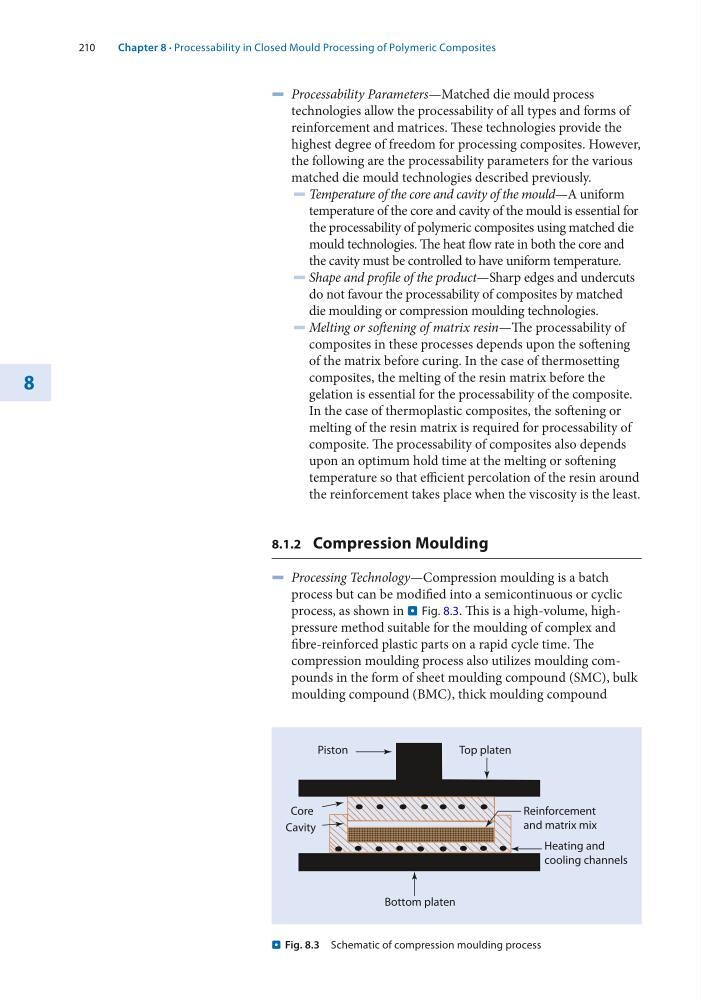
5 Processing Technology—Compression moulding is a batch
process but can be modified into a semicontinuous or cyclic
process, as shown in . Fig. 8.3. This is a high-volume, highpressure method suitable for the moulding of complex and
fibre-reinforced plastic parts on a rapid cycle time. The
compression moulding process also utilizes moulding compounds in the form of sheet moulding compound (SMC), bulk
moulding compound (BMC), thick moulding compound
Piston
Core
Cavity
Bottom platen
Top platen
Reinforcement
and matrix mix
Heating and
cooling channels
. Fig. 8.3 Schematic of compression moulding process
Chapter 8 · Processability in Closed Mould Processing of Polymeric Composites
8
5 Processability Parameters—Matched die mould process
technologies allow the processability of all types and forms of
reinforcement and matrices. These technologies provide the
highest degree of freedom for processing composites. However,
the following are the processability parameters for the various
matched die mould technologies described previously.
5 Temperature of the core and cavity of the mould—A uniform
temperature of the core and cavity of the mould is essential for
the processability of polymeric composites using matched die
mould technologies. The heat flow rate in both the core and
the cavity must be controlled to have uniform temperature.
5 Shape and profile of the product—Sharp edges and undercuts
do not favour the processability of composites by matched
die moulding or compression moulding technologies.
5 Melting or softening of matrix resin—The processability of
composites in these processes depends upon the softening
of the matrix before curing. In the case of thermosetting
composites, the melting of the resin matrix before the
gelation is essential for the processability of the composite.
In the case of thermoplastic composites, the softening or
melting of the resin matrix is required for processability of
composite. The processability of composites also depends
upon an optimum hold time at the melting or softening
temperature so that efficient percolation of the resin around
the reinforcement takes place when the viscosity is the least.
8.1.2 Compression Moulding
5 Processing Technology—Compression moulding is a batch
process but can be modified into a semicontinuous or cyclic
process, as shown in . Fig. 8.3. This is a high-volume, highpressure method suitable for the moulding of complex and
fibre-reinforced plastic parts on a rapid cycle time. The
compression moulding process also utilizes moulding compounds in the form of sheet moulding compound (SMC), bulk
moulding compound (BMC), thick moulding compound
Piston
Core
Cavity
Bottom platen
Top platen
Reinforcement
and matrix mix
Heating and
cooling channels
. Fig. 8.3 Schematic of compression moulding process
Chapter 8 · Processability in Closed Mould Processing of Polymeric Composites