

208
8
ment and matrix. However, this calculation does not account for
processing errors, such as improper mould closure, dimensional
inaccuracies during layup, and void content. These deficiencies are
the practical problems, and during fabrication, these are difficult to
overcome. Therefore, in order to facilitate the processing of composite of good quality, 01 layer of glass fabric (01 lamina) is reduced
in the layup plan, and the composite is fabricated with 08 number
of glass fabric (08 number of lamina) layers. This amounts to the
removal of approximately 10% of the reinforcement. This argument
drives an important point that the processability of a composite
depends upon the right theoretical calculations as well as on the
decision of striking balance among many factors that have been
discussed in 7 Chap. 3. This example cites the importance of striking a correct balance between the reinforcement and the matrix.
The matched die moulding process is economically the secondbest processing method—after contact layup—for composites. This
process provides good control over dimensional accuracy; therefore, it is widely used for products where dimensional tolerances are
tight. The closing of the matched die mould can be controlled using
hydraulics, screw pressure, or by tightening nuts and bolts, depending upon the size of the mould. The products made from this process are radomes, nose cones, protective covers, packaging,
automotive parts, home appliances, electrical goods, etc.
8.1.1.1 Film-Stacking Process
Thermoplastic composites using continuous fibres are fabricated
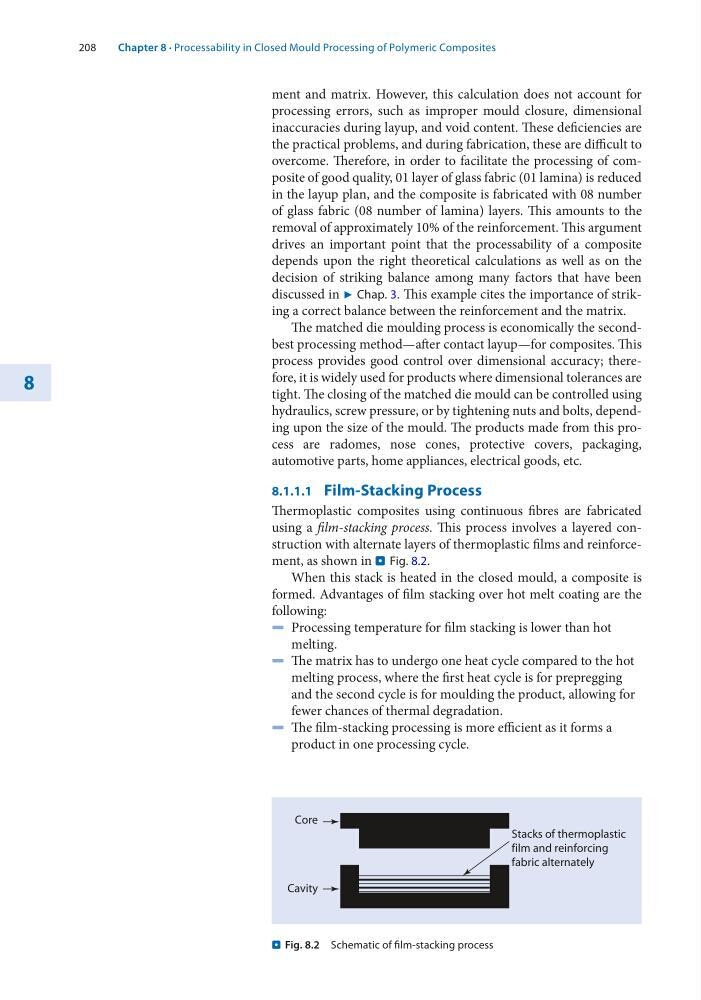
using a film-stacking process. This process involves a layered construction with alternate layers of thermoplastic films and reinforcement, as shown in . Fig. 8.2.
When this stack is heated in the closed mould, a composite is
formed. Advantages of film stacking over hot melt coating are the
following:
5 Processing temperature for film stacking is lower than hot
melting.
5 The matrix has to undergo one heat cycle compared to the hot
melting process, where the first heat cycle is for prepregging
and the second cycle is for moulding the product, allowing for
fewer chances of thermal degradation.
5 The film-stacking processing is more efficient as it forms a
product in one processing cycle.
Core
Stacks of thermoplastic
film and reinforcing
fabric alternately
Cavity
. Fig. 8.2 Schematic of film-stacking process
Chapter 8 · Processability in Closed Mould Processing of Polymeric Composites
8
ment and matrix. However, this calculation does not account for
processing errors, such as improper mould closure, dimensional
inaccuracies during layup, and void content. These deficiencies are
the practical problems, and during fabrication, these are difficult to
overcome. Therefore, in order to facilitate the processing of composite of good quality, 01 layer of glass fabric (01 lamina) is reduced
in the layup plan, and the composite is fabricated with 08 number
of glass fabric (08 number of lamina) layers. This amounts to the
removal of approximately 10% of the reinforcement. This argument
drives an important point that the processability of a composite
depends upon the right theoretical calculations as well as on the
decision of striking balance among many factors that have been
discussed in 7 Chap. 3. This example cites the importance of striking a correct balance between the reinforcement and the matrix.
The matched die moulding process is economically the secondbest processing method—after contact layup—for composites. This
process provides good control over dimensional accuracy; therefore, it is widely used for products where dimensional tolerances are
tight. The closing of the matched die mould can be controlled using
hydraulics, screw pressure, or by tightening nuts and bolts, depending upon the size of the mould. The products made from this process are radomes, nose cones, protective covers, packaging,
automotive parts, home appliances, electrical goods, etc.
8.1.1.1 Film-Stacking Process
Thermoplastic composites using continuous fibres are fabricated
using a film-stacking process. This process involves a layered construction with alternate layers of thermoplastic films and reinforcement, as shown in . Fig. 8.2.
When this stack is heated in the closed mould, a composite is
formed. Advantages of film stacking over hot melt coating are the
following:
5 Processing temperature for film stacking is lower than hot
melting.
5 The matrix has to undergo one heat cycle compared to the hot
melting process, where the first heat cycle is for prepregging
and the second cycle is for moulding the product, allowing for
fewer chances of thermal degradation.
5 The film-stacking processing is more efficient as it forms a
product in one processing cycle.
Core
Stacks of thermoplastic
film and reinforcing
fabric alternately
Cavity
. Fig. 8.2 Schematic of film-stacking process
Chapter 8 · Processability in Closed Mould Processing of Polymeric Composites