

207
8
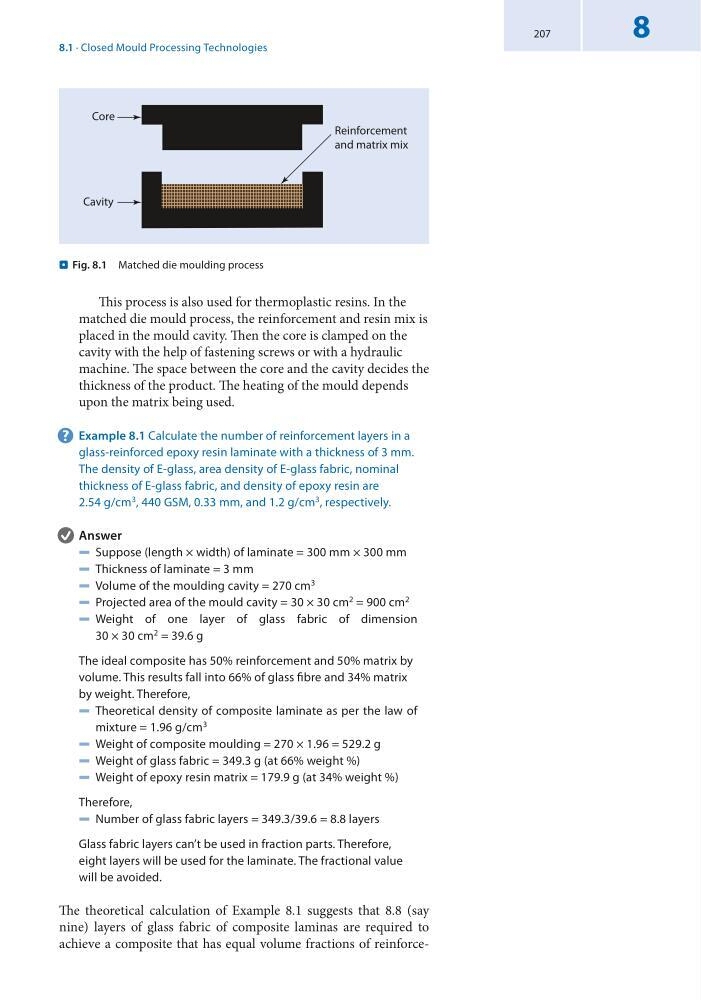
This process is also used for thermoplastic resins. In the
matched die mould process, the reinforcement and resin mix is
placed in the mould cavity. Then the core is clamped on the
cavity with the help of fastening screws or with a hydraulic
machine. The space between the core and the cavity decides the
thickness of the product. The heating of the mould depends
upon the matrix being used.
? Example 8.1 Calculate the number of reinforcement layers in a
glass-reinforced epoxy resin laminate with a thickness of 3 mm.
The density of E-glass, area density of E-glass fabric, nominal
thickness of E-glass fabric, and density of epoxy resin are
2.54 g/cm 3 , 440 GSM, 0.33 mm, and 1.2 g/cm 3 , respectively.
v Answer
5 Suppose (length × width) of laminate = 300 mm × 300 mm
5 Thickness of laminate = 3 mm
5 Volume of the moulding cavity = 270 cm 3
5 Projected area of the mould cavity = 30 × 30 cm 2 = 900 cm 2
5 Weight of one layer of glass fabric of dimension
30 × 30 cm 2 = 39.6 g
The ideal composite has 50% reinforcement and 50% matrix by
volume. This results fall into 66% of glass fibre and 34% matrix
by weight. Therefore,
5 Theoretical density of composite laminate as per the law of
mixture = 1.96 g/cm 3
5 Weight of composite moulding = 270 × 1.96 = 529.2 g
5 Weight of glass fabric = 349.3 g (at 66% weight %)
5 Weight of epoxy resin matrix = 179.9 g (at 34% weight %)
Therefore,
5 Number of glass fabric layers = 349.3/39.6 = 8.8 layers
Glass fabric layers can’t be used in fraction parts. Therefore,
eight layers will be used for the laminate. The fractional value
will be avoided.
The theoretical calculation of Example 8.1 suggests that 8.8 (say
nine) layers of glass fabric of composite laminas are required to
achieve a composite that has equal volume fractions of reinforceReinforcement
and matrix mix
Core
Cavity
. Fig. 8.1 Matched die moulding process
8.1 · Closed Mould Processing Technologies
8
This process is also used for thermoplastic resins. In the
matched die mould process, the reinforcement and resin mix is
placed in the mould cavity. Then the core is clamped on the
cavity with the help of fastening screws or with a hydraulic
machine. The space between the core and the cavity decides the
thickness of the product. The heating of the mould depends
upon the matrix being used.
? Example 8.1 Calculate the number of reinforcement layers in a
glass-reinforced epoxy resin laminate with a thickness of 3 mm.
The density of E-glass, area density of E-glass fabric, nominal
thickness of E-glass fabric, and density of epoxy resin are
2.54 g/cm 3 , 440 GSM, 0.33 mm, and 1.2 g/cm 3 , respectively.
v Answer
5 Suppose (length × width) of laminate = 300 mm × 300 mm
5 Thickness of laminate = 3 mm
5 Volume of the moulding cavity = 270 cm 3
5 Projected area of the mould cavity = 30 × 30 cm 2 = 900 cm 2
5 Weight of one layer of glass fabric of dimension
30 × 30 cm 2 = 39.6 g
The ideal composite has 50% reinforcement and 50% matrix by
volume. This results fall into 66% of glass fibre and 34% matrix
by weight. Therefore,
5 Theoretical density of composite laminate as per the law of
mixture = 1.96 g/cm 3
5 Weight of composite moulding = 270 × 1.96 = 529.2 g
5 Weight of glass fabric = 349.3 g (at 66% weight %)
5 Weight of epoxy resin matrix = 179.9 g (at 34% weight %)
Therefore,
5 Number of glass fabric layers = 349.3/39.6 = 8.8 layers
Glass fabric layers can’t be used in fraction parts. Therefore,
eight layers will be used for the laminate. The fractional value
will be avoided.
The theoretical calculation of Example 8.1 suggests that 8.8 (say
nine) layers of glass fabric of composite laminas are required to
achieve a composite that has equal volume fractions of reinforceReinforcement
and matrix mix
Core
Cavity
. Fig. 8.1 Matched die moulding process
8.1 · Closed Mould Processing Technologies