

188
7
5 Processability Parameters—The following are the processability
parameters for filament winding technology:
5 Winding path—In this technology, the filament can be
wound on a geodesic path only. A non-geodesic path will
not allow the wounded filaments to remain at that position;
rather, they will slip away. Non-geodesic path winding is an
area of current research and interest. In this process, it is
necessary to have raw materials that provide high friction so
that the filament wound fibres do not slip from their
position. Also, the winding path is designed in such a way
that the wound fibres get physically anchored by the
previously wound fibres.
5 Tenacity of fibres—In filament winding technology, only
high-tenacity fibres are processable. The endurance of
rovings or tows must be high enough to sustain the tensile
force of winding.
5 Form of reinforcement—In filament winding technology,
only reinforcement in the form of rovings or tows is
processable. This technology also does not allow the
processability of fabrics and particulate reinforcements.
5 Fuzzing of fibres—Poor surface treatment, poor storage
conditions, and breakage in the fibres cancause fuzzing
(collection of fibres) at the payout eye. This phenomenon
causes a reduction in the bandwidth of the wound fibre on
the mandrel, causing a reduction in the strength of the
composite. Fuzzing is mostly observed in carbon tows. The
layered structure of carbon fibre and its skin core heterogeneity causes fuzzing from the removal of the surface layer of
carbon fibre.
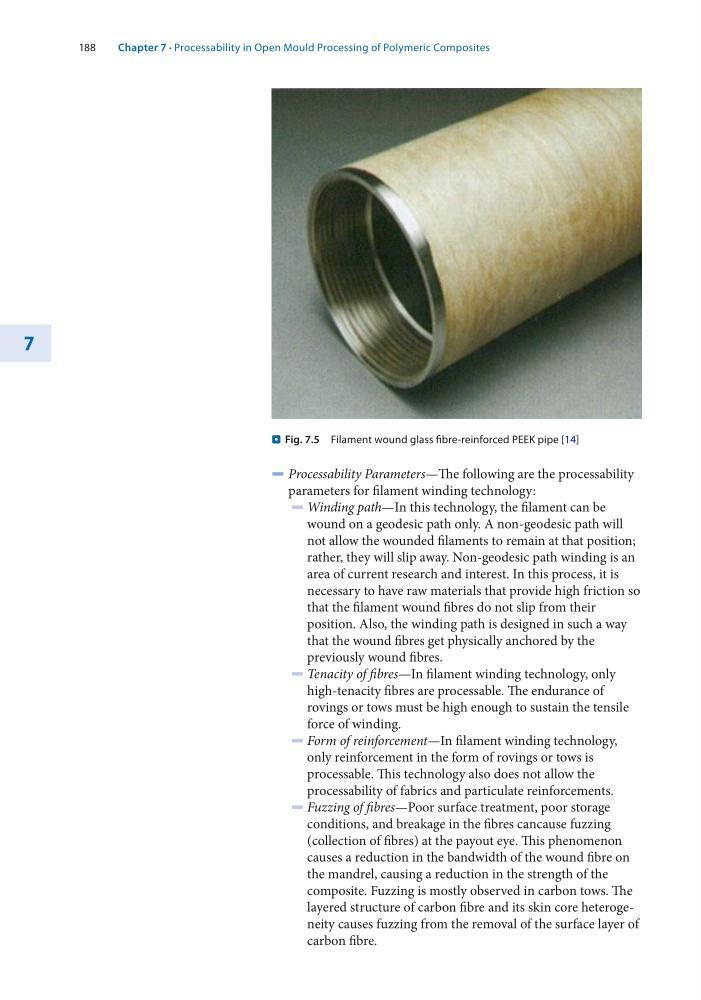
. Fig. 7.5 Filament wound glass fibre-reinforced PEEK pipe [14]
Chapter 7 · Processability in Open Mould Processing of Polymeric Composites
7
5 Processability Parameters—The following are the processability
parameters for filament winding technology:
5 Winding path—In this technology, the filament can be
wound on a geodesic path only. A non-geodesic path will
not allow the wounded filaments to remain at that position;
rather, they will slip away. Non-geodesic path winding is an
area of current research and interest. In this process, it is
necessary to have raw materials that provide high friction so
that the filament wound fibres do not slip from their
position. Also, the winding path is designed in such a way
that the wound fibres get physically anchored by the
previously wound fibres.
5 Tenacity of fibres—In filament winding technology, only
high-tenacity fibres are processable. The endurance of
rovings or tows must be high enough to sustain the tensile
force of winding.
5 Form of reinforcement—In filament winding technology,
only reinforcement in the form of rovings or tows is
processable. This technology also does not allow the
processability of fabrics and particulate reinforcements.
5 Fuzzing of fibres—Poor surface treatment, poor storage
conditions, and breakage in the fibres cancause fuzzing
(collection of fibres) at the payout eye. This phenomenon
causes a reduction in the bandwidth of the wound fibre on
the mandrel, causing a reduction in the strength of the
composite. Fuzzing is mostly observed in carbon tows. The
layered structure of carbon fibre and its skin core heterogeneity causes fuzzing from the removal of the surface layer of
carbon fibre.
. Fig. 7.5 Filament wound glass fibre-reinforced PEEK pipe [14]
Chapter 7 · Processability in Open Mould Processing of Polymeric Composites