

187
7
high degree of fibre loading, which in turn provides high
mechanical properties, such as the tensile strengths and
Young’s modulus. The filament winding process is generally
used for fabrication of tubular structures, such as cylindrical
products like chemical and fuel storage tanks, pipes, stacks,
pressure vessels, and rocket motor cases. Mandrels of suitable
size and shape made of steel or aluminium form the inner
surface of the hollow part. Some mandrels are collapsible to
facilitate part removal.
In this process, a release agent is applied over the mandrel.
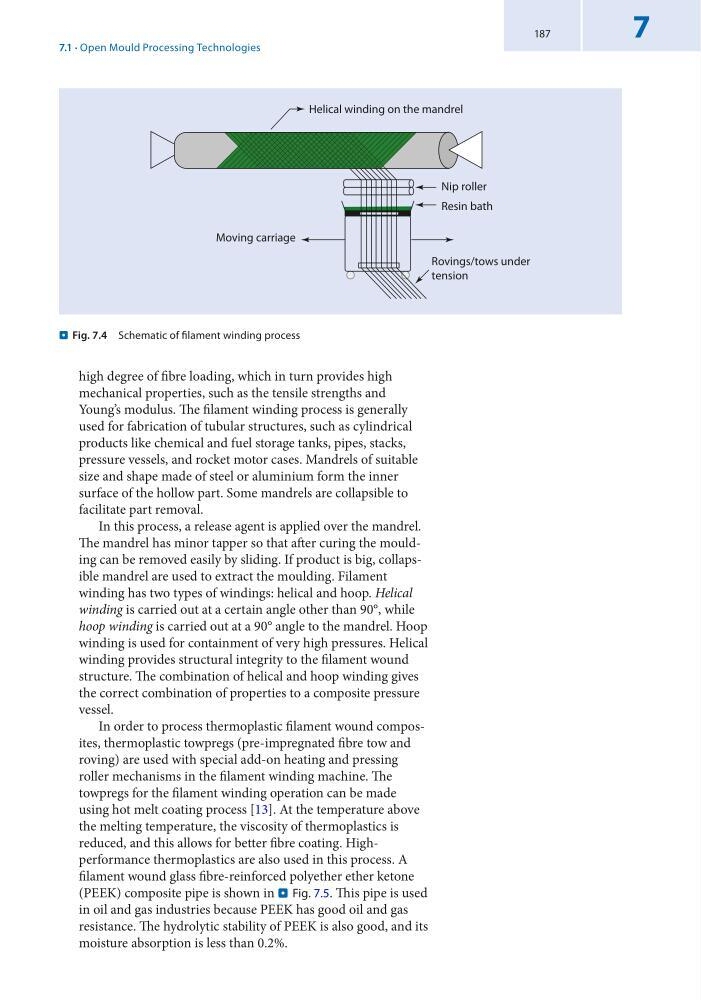
The mandrel has minor tapper so that after curing the moulding can be removed easily by sliding. If product is big, collapsible mandrel are used to extract the moulding. Filament
winding has two types of windings: helical and hoop. Helical
winding is carried out at a certain angle other than 90°, while
hoop winding is carried out at a 90° angle to the mandrel. Hoop
winding is used for containment of very high pressures. Helical
winding provides structural integrity to the filament wound
structure. The combination of helical and hoop winding gives
the correct combination of properties to a composite pressure
vessel.
In order to process thermoplastic filament wound composites, thermoplastic towpregs (pre-impregnated fibre tow and
roving) are used with special add-on heating and pressing
roller mechanisms in the filament winding machine. The
towpregs for the filament winding operation can be made
using hot melt coating process [13]. At the temperature above
the melting temperature, the viscosity of thermoplastics is
reduced, and this allows for better fibre coating. Highperformance thermoplastics are also used in this process. A
filament wound glass fibre-reinforced polyether ether ketone
(PEEK) composite pipe is shown in . Fig. 7.5. This pipe is used
in oil and gas industries because PEEK has good oil and gas
resistance. The hydrolytic stability of PEEK is also good, and its
moisture absorption is less than 0.2%.
Nip roller
Helical winding on the mandrel
Resin bath
Rovings/tows under
tension
Moving carriage
. Fig. 7.4 Schematic of filament winding process
7.1 · Open Mould Processing Technologies
7
high degree of fibre loading, which in turn provides high
mechanical properties, such as the tensile strengths and
Young’s modulus. The filament winding process is generally
used for fabrication of tubular structures, such as cylindrical
products like chemical and fuel storage tanks, pipes, stacks,
pressure vessels, and rocket motor cases. Mandrels of suitable
size and shape made of steel or aluminium form the inner
surface of the hollow part. Some mandrels are collapsible to
facilitate part removal.
In this process, a release agent is applied over the mandrel.
The mandrel has minor tapper so that after curing the moulding can be removed easily by sliding. If product is big, collapsible mandrel are used to extract the moulding. Filament
winding has two types of windings: helical and hoop. Helical
winding is carried out at a certain angle other than 90°, while
hoop winding is carried out at a 90° angle to the mandrel. Hoop
winding is used for containment of very high pressures. Helical
winding provides structural integrity to the filament wound
structure. The combination of helical and hoop winding gives
the correct combination of properties to a composite pressure
vessel.
In order to process thermoplastic filament wound composites, thermoplastic towpregs (pre-impregnated fibre tow and
roving) are used with special add-on heating and pressing
roller mechanisms in the filament winding machine. The
towpregs for the filament winding operation can be made
using hot melt coating process [13]. At the temperature above
the melting temperature, the viscosity of thermoplastics is
reduced, and this allows for better fibre coating. Highperformance thermoplastics are also used in this process. A
filament wound glass fibre-reinforced polyether ether ketone
(PEEK) composite pipe is shown in . Fig. 7.5. This pipe is used
in oil and gas industries because PEEK has good oil and gas
resistance. The hydrolytic stability of PEEK is also good, and its
moisture absorption is less than 0.2%.
Nip roller
Helical winding on the mandrel
Resin bath
Rovings/tows under
tension
Moving carriage
. Fig. 7.4 Schematic of filament winding process
7.1 · Open Mould Processing Technologies