

6
1
? Example 1.2 A chair is made out of an E-glass CSM-reinforced
polyester composite. The chair does not have any internal or
residual stress. Calculate the processability constant for this
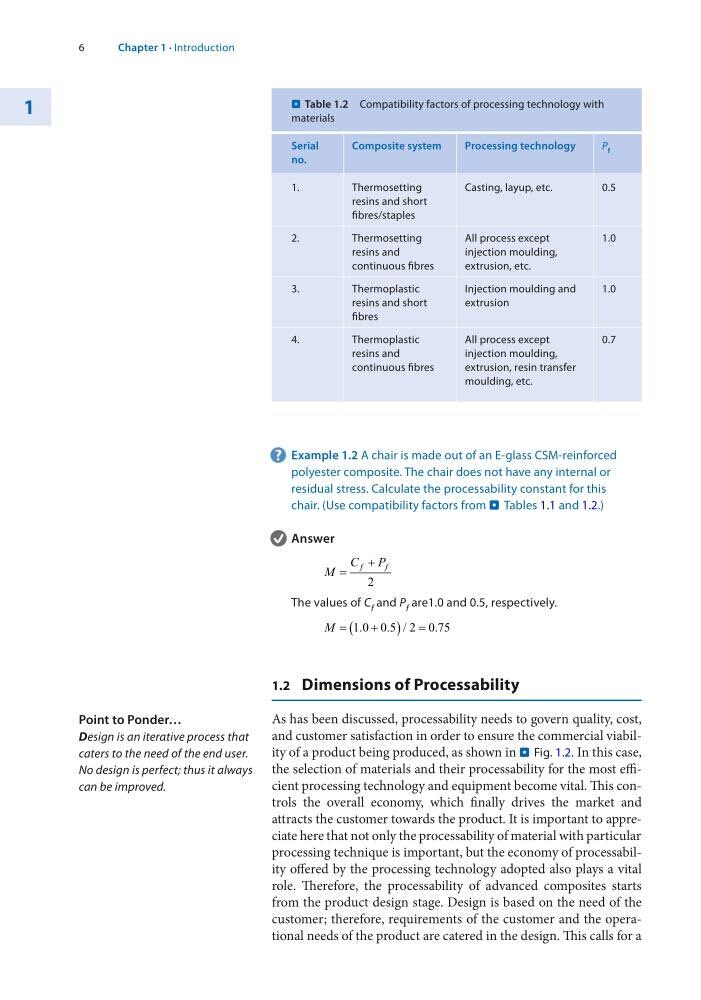
chair. (Use compatibility factors from . Tables 1.1 and 1.2.)
v Answer
M
C
P
=
+
f
f
2
The values of C f and P f are1.0 and 0.5, respectively.
M =
+
(
) =
1 0 0 5 2 0 75
.
. /
.
1.2 Dimensions of Processability
As has been discussed, processability needs to govern quality, cost,
and customer satisfaction in order to ensure the commercial viability of a product being produced, as shown in . Fig. 1.2. In this case,
the selection of materials and their processability for the most efficient processing technology and equipment become vital. This controls the overall economy, which finally drives the market and
attracts the customer towards the product. It is important to appreciate here that not only the processability of material with particular
processing technique is important, but the economy of processability offered by the processing technology adopted also plays a vital
role. Therefore, the processability of advanced composites starts
from the product design stage. Design is based on the need of the
customer; therefore, requirements of the customer and the operational needs of the product are catered in the design. This calls for a
Point to Ponder…
Design is an iterative process that
caters to the need of the end user.
No design is perfect; thus it always
can be improved.
. Table 1.2 Compatibility factors of processing technology with
materials
Serial
no.
Composite system
Processing technology
P f
1.
Thermosetting
resins and short
fibres/staples
Casting, layup, etc.
0.5
2.
Thermosetting
resins and
continuous fibres
All process except
injection moulding,
extrusion, etc.
1.0
3.
Thermoplastic
resins and short
fibres
Injection moulding and
extrusion
1.0
4.
Thermoplastic
resins and
continuous fibres
All process except
injection moulding,
extrusion, resin transfer
moulding, etc.
0.7
Chapter 1 · Introduction
1
? Example 1.2 A chair is made out of an E-glass CSM-reinforced
polyester composite. The chair does not have any internal or
residual stress. Calculate the processability constant for this
chair. (Use compatibility factors from . Tables 1.1 and 1.2.)
v Answer
M
C
P
=
+
f
f
2
The values of C f and P f are1.0 and 0.5, respectively.
M =
+
(
) =
1 0 0 5 2 0 75
.
. /
.
1.2 Dimensions of Processability
As has been discussed, processability needs to govern quality, cost,
and customer satisfaction in order to ensure the commercial viability of a product being produced, as shown in . Fig. 1.2. In this case,
the selection of materials and their processability for the most efficient processing technology and equipment become vital. This controls the overall economy, which finally drives the market and
attracts the customer towards the product. It is important to appreciate here that not only the processability of material with particular
processing technique is important, but the economy of processability offered by the processing technology adopted also plays a vital
role. Therefore, the processability of advanced composites starts
from the product design stage. Design is based on the need of the
customer; therefore, requirements of the customer and the operational needs of the product are catered in the design. This calls for a
Point to Ponder…
Design is an iterative process that
caters to the need of the end user.
No design is perfect; thus it always
can be improved.
. Table 1.2 Compatibility factors of processing technology with
materials
Serial
no.
Composite system
Processing technology
P f
1.
Thermosetting
resins and short
fibres/staples
Casting, layup, etc.
0.5
2.
Thermosetting
resins and
continuous fibres
All process except
injection moulding,
extrusion, etc.
1.0
3.
Thermoplastic
resins and short
fibres
Injection moulding and
extrusion
1.0
4.
Thermoplastic
resins and
continuous fibres
All process except
injection moulding,
extrusion, resin transfer
moulding, etc.
0.7
Chapter 1 · Introduction