

5
1
The polymeric composites, having no residual or internal
stresses, have very low or negligible configurational entropy.
The processability constant (M) is the mean value of the compatibility factor between reinforcement and matrix and the compatibility factor of processing technology with materials. It may
be written as
M
C
P
=
+
f
f
2
(1.1)
where
5 M = Processability constant
5 C f = Compatibility factor between reinforcement and matrix
5 P f = Compatibility factor of processing technology with
materials
The compatibility factors between reinforcement and matrix are
shown in . Table 1.1.
The compatibility factors of processing technology with materials are tabulated in . Table 1.2.
Processability
Customers’
satisfaction
• Customers’ need
• Design
• Materials
• Process
• Properties
• Performance
• Cost
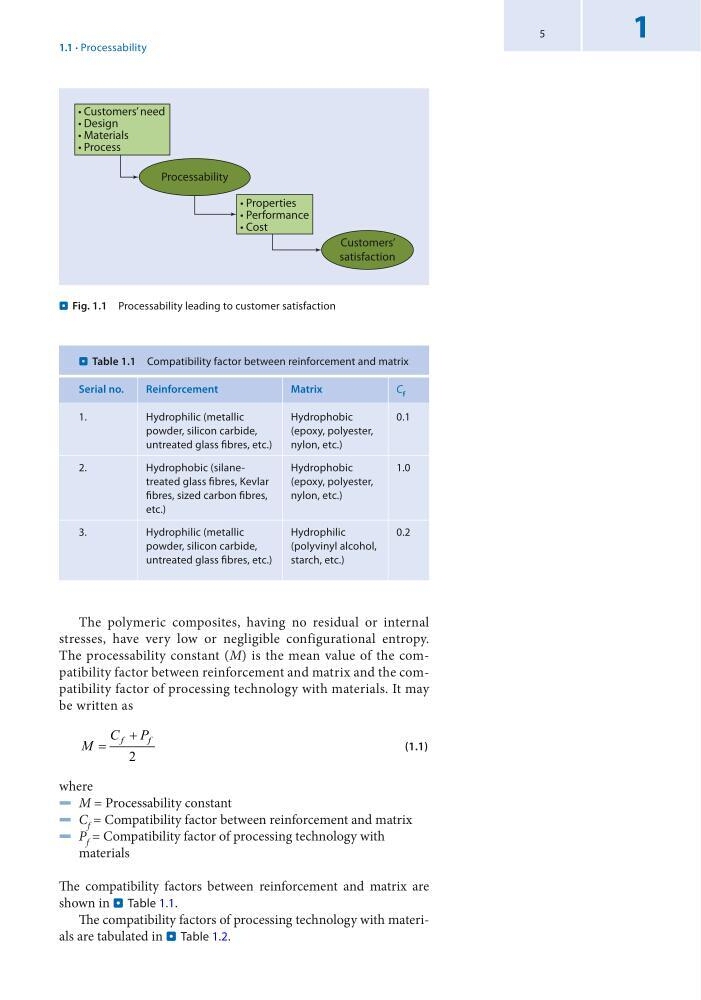
. Fig. 1.1 Processability leading to customer satisfaction
. Table 1.1 Compatibility factor between reinforcement and matrix
Serial no.
Reinforcement
Matrix
C f
1.
Hydrophilic (metallic
powder, silicon carbide,
untreated glass fibres, etc.)
Hydrophobic
(epoxy, polyester,
nylon, etc.)
0.1
2.
Hydrophobic (silanetreated glass fibres, Kevlar
fibres, sized carbon fibres,
etc.)
Hydrophobic
(epoxy, polyester,
nylon, etc.)
1.0
3.
Hydrophilic (metallic
powder, silicon carbide,
untreated glass fibres, etc.)
Hydrophilic
(polyvinyl alcohol,
starch, etc.)
0.2
1.1 · Processability
1
The polymeric composites, having no residual or internal
stresses, have very low or negligible configurational entropy.
The processability constant (M) is the mean value of the compatibility factor between reinforcement and matrix and the compatibility factor of processing technology with materials. It may
be written as
M
C
P
=
+
f
f
2
(1.1)
where
5 M = Processability constant
5 C f = Compatibility factor between reinforcement and matrix
5 P f = Compatibility factor of processing technology with
materials
The compatibility factors between reinforcement and matrix are
shown in . Table 1.1.
The compatibility factors of processing technology with materials are tabulated in . Table 1.2.
Processability
Customers’
satisfaction
• Customers’ need
• Design
• Materials
• Process
• Properties
• Performance
• Cost
. Fig. 1.1 Processability leading to customer satisfaction
. Table 1.1 Compatibility factor between reinforcement and matrix
Serial no.
Reinforcement
Matrix
C f
1.
Hydrophilic (metallic
powder, silicon carbide,
untreated glass fibres, etc.)
Hydrophobic
(epoxy, polyester,
nylon, etc.)
0.1
2.
Hydrophobic (silanetreated glass fibres, Kevlar
fibres, sized carbon fibres,
etc.)
Hydrophobic
(epoxy, polyester,
nylon, etc.)
1.0
3.
Hydrophilic (metallic
powder, silicon carbide,
untreated glass fibres, etc.)
Hydrophilic
(polyvinyl alcohol,
starch, etc.)
0.2
1.1 · Processability