

155
6
load-bearing cross section decreases with increasing filler content. The same correlation can be used to describe the composition dependence of the tensile strength if the elongation of the
composite is small, usually less than 100%. A detailed study of
numerous composites has proven that, in composites containing
stiff fillers or reinforcements, a hard interphase is formed. This
increases the load-bearing capacity of the filler and contributes
to the reinforcement. Only the formation of such a hard interphase explains that yield stresses of a composite exceeding the
yield stress of the matrix are achieved occasionally. The load carried by the second component depends also on the properties of
the matrix; the extent of reinforcement is larger in a softer than
in a stiffer polymer. This factor also must be taken into account
when composites prepared with different matrices are compared
with each other.
This model was developed specifically for composites containing spherical particles. The BI values reported for various systems
are 9.7 for PBT/ABAS/Mica (ϕ f < 0.07) and 10.4 for TiO 2 -filled
PBT/ABAS blends (ϕ f < 0.25). PP filled with CaCO 3 showed a BI
value of 1.5, and montmorillonite (MMT) clay-filled PP showed a
BI value of 1.8. On the other hand, a MMT-filled PP with a fully
exfoliated state showed a BI value of 190–200.
? Example 6.1 Calculate effective load-bearing cross section
index of a particulate composites having ϕ m 0.7.
v Answer
φ m = 0 7
.
φ f = 0 3
.
So, the effective load-bearing cross section is
1
1 2 5
0 35
−
+
=
φ
φ
f
f
.
.
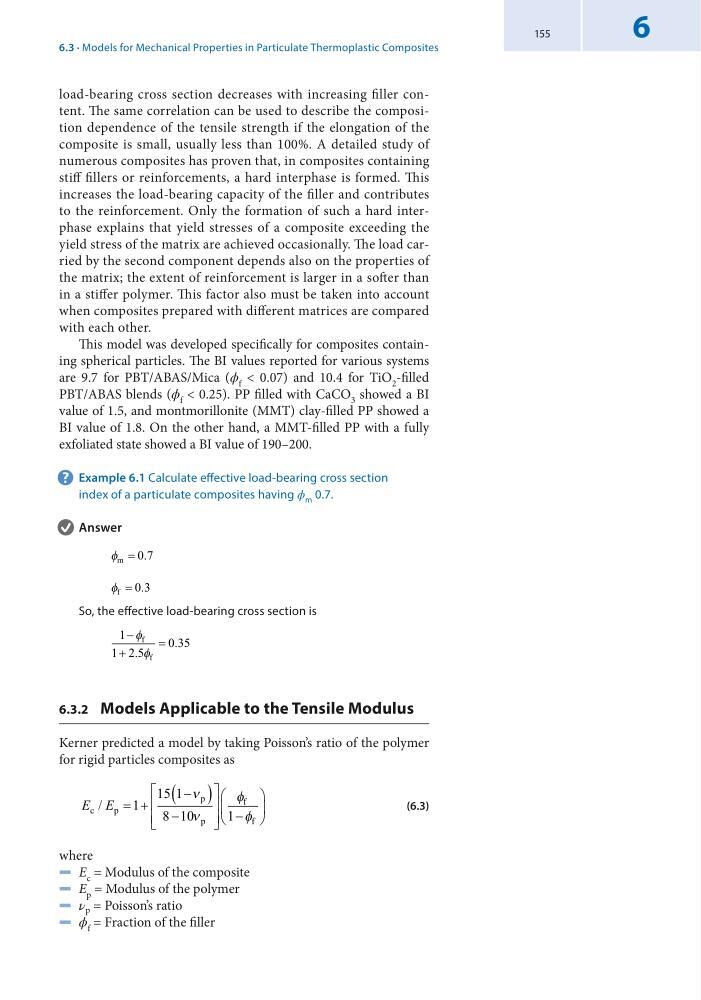
6.3.2 Models Applicable to the Tensile Modulus
Kerner predicted a model by taking Poisson’s ratio of the polymer
for rigid particles composites as
E E
c
p
p
p
f
f
/
= +
−
( )
−
−
1
15 1
8 10
1
ν
ν
φ
φ
(6.3)
where
5 E c = Modulus of the composite
5 E p = Modulus of the polymer
5 ν p = Poisson’s ratio
5 ϕ f = Fraction of the filler
6.3 · Models for Mechanical Properties in Particulate Thermoplastic Composites
6
load-bearing cross section decreases with increasing filler content. The same correlation can be used to describe the composition dependence of the tensile strength if the elongation of the
composite is small, usually less than 100%. A detailed study of
numerous composites has proven that, in composites containing
stiff fillers or reinforcements, a hard interphase is formed. This
increases the load-bearing capacity of the filler and contributes
to the reinforcement. Only the formation of such a hard interphase explains that yield stresses of a composite exceeding the
yield stress of the matrix are achieved occasionally. The load carried by the second component depends also on the properties of
the matrix; the extent of reinforcement is larger in a softer than
in a stiffer polymer. This factor also must be taken into account
when composites prepared with different matrices are compared
with each other.
This model was developed specifically for composites containing spherical particles. The BI values reported for various systems
are 9.7 for PBT/ABAS/Mica (ϕ f < 0.07) and 10.4 for TiO 2 -filled
PBT/ABAS blends (ϕ f < 0.25). PP filled with CaCO 3 showed a BI
value of 1.5, and montmorillonite (MMT) clay-filled PP showed a
BI value of 1.8. On the other hand, a MMT-filled PP with a fully
exfoliated state showed a BI value of 190–200.
? Example 6.1 Calculate effective load-bearing cross section
index of a particulate composites having ϕ m 0.7.
v Answer
φ m = 0 7
.
φ f = 0 3
.
So, the effective load-bearing cross section is
1
1 2 5
0 35
−
+
=
φ
φ
f
f
.
.
6.3.2 Models Applicable to the Tensile Modulus
Kerner predicted a model by taking Poisson’s ratio of the polymer
for rigid particles composites as
E E
c
p
p
p
f
f
/
= +
−
( )
−
−
1
15 1
8 10
1
ν
ν
φ
φ
(6.3)
where
5 E c = Modulus of the composite
5 E p = Modulus of the polymer
5 ν p = Poisson’s ratio
5 ϕ f = Fraction of the filler
6.3 · Models for Mechanical Properties in Particulate Thermoplastic Composites