

154
6
6.2 Forms of Reinforcements for Thermoplastic
Composites
The most common processes used for the fabrication of thermoplastic composites are injection moulding and compression moulding methods. Short fibres, staples, particles, whiskers, etc. are used
commonly as reinforcement for thermoplastic matrices in the
injection moulding process. A chopped strand mat (CSM) is not
used in thermoplastic composites because the wettability of fibres is
difficult and can increase the cost of production. Natural fibres are
used with care so that their thermal stability is more than the processing temperature of the composite. Reinforcement in the form of
fabrics is used with compression moulding. Prepregs (fabric/rovings/tows) are also used for specialized applications, such as hollow
weight-bearing structures, pressure vessels, etc. [5–7]. The forms of
reinforcement used in thermoplastic composites are the same as
those mentioned in 7 Chap. 4.
6.3 Models for Mechanical Properties
in Particulate Thermoplastic Composites
Various properties also can be calculated from idealized models
that closely approximate real composite behaviour. Models applicable to reinforcing systems for tensile strengths and tensile modulus are given in this section.
6.3.1 Models Applicable to Tensile Strength
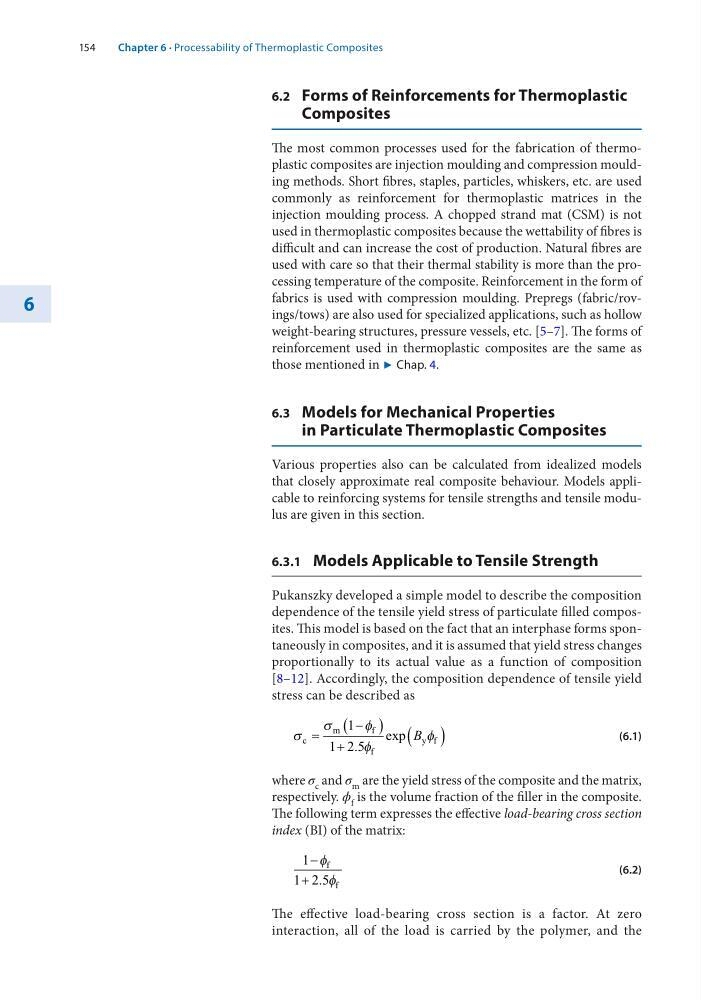
Pukanszky developed a simple model to describe the composition
dependence of the tensile yield stress of particulate filled composites. This model is based on the fact that an interphase forms spontaneously in composites, and it is assumed that yield stress changes
proportionally to its actual value as a function of composition
[8–12]. Accordingly, the composition dependence of tensile yield
stress can be described as
σ
σ
φ
φ
φ
c
m
f
f
y f
=
−
(
)
+
( )
1
1 2 5
.
exp B
(6.1)
where σ c and σ m are the yield stress of the composite and the matrix,
respectively. ϕ f is the volume fraction of the filler in the composite.
The following term expresses the effective load-bearing cross section
index (BI) of the matrix:
1
1 2 5
−
+
φ
φ
f
f
.
(6.2)
The effective load-bearing cross section is a factor. At zero
interaction, all of the load is carried by the polymer, and the
Chapter 6 · Processability of Thermoplastic Composites
6
6.2 Forms of Reinforcements for Thermoplastic
Composites
The most common processes used for the fabrication of thermoplastic composites are injection moulding and compression moulding methods. Short fibres, staples, particles, whiskers, etc. are used
commonly as reinforcement for thermoplastic matrices in the
injection moulding process. A chopped strand mat (CSM) is not
used in thermoplastic composites because the wettability of fibres is
difficult and can increase the cost of production. Natural fibres are
used with care so that their thermal stability is more than the processing temperature of the composite. Reinforcement in the form of
fabrics is used with compression moulding. Prepregs (fabric/rovings/tows) are also used for specialized applications, such as hollow
weight-bearing structures, pressure vessels, etc. [5–7]. The forms of
reinforcement used in thermoplastic composites are the same as
those mentioned in 7 Chap. 4.
6.3 Models for Mechanical Properties
in Particulate Thermoplastic Composites
Various properties also can be calculated from idealized models
that closely approximate real composite behaviour. Models applicable to reinforcing systems for tensile strengths and tensile modulus are given in this section.
6.3.1 Models Applicable to Tensile Strength
Pukanszky developed a simple model to describe the composition
dependence of the tensile yield stress of particulate filled composites. This model is based on the fact that an interphase forms spontaneously in composites, and it is assumed that yield stress changes
proportionally to its actual value as a function of composition
[8–12]. Accordingly, the composition dependence of tensile yield
stress can be described as
σ
σ
φ
φ
φ
c
m
f
f
y f
=
−
(
)
+
( )
1
1 2 5
.
exp B
(6.1)
where σ c and σ m are the yield stress of the composite and the matrix,
respectively. ϕ f is the volume fraction of the filler in the composite.
The following term expresses the effective load-bearing cross section
index (BI) of the matrix:
1
1 2 5
−
+
φ
φ
f
f
.
(6.2)
The effective load-bearing cross section is a factor. At zero
interaction, all of the load is carried by the polymer, and the
Chapter 6 · Processability of Thermoplastic Composites